


Listen to the article
Lebanese Christians Observe Holy Week Far from Home Amid Israel-Hezbollah Conflict
The Rev. Maroun Ghafari never imagined he would be conducting Easter services in a Beirut suburb, standing next to a cardboard cutout of his church in Alma al-Shaab. For years, he had delivered Easter sermons in his predominantly Christian village near Lebanon’s southern border with Israel. Now, like thousands of other Lebanese Christians, he finds himself displaced by the escalating conflict between Israel and Hezbollah.
“Everyone is tired, and we see that war brings nothing but destruction, death and displacement,” Ghafari told The Associated Press from St. Anthony Church in Jdeideh, a northern Beirut suburb where many displaced Christians have sought refuge.
Since fighting intensified last month between Israel and Lebanon’s Iran-backed Hezbollah militant group, more than 1,400 people have been killed in Lebanon, and over 1 million residents have been forced to flee their homes. Among the displaced are thousands of Christians from southern Lebanon, where Christian communities have maintained a significant presence through centuries of Byzantine, Arab, and Ottoman rule.
Christians represent approximately one-third of Lebanon’s 5.5 million population, making the country home to the largest proportion of Christians in the Arab world, with twelve distinct Christian denominations. This Easter season, many find themselves observing sacred traditions far from their ancestral churches and communities.
The conflict has been particularly devastating for villages like Alma al-Shaab. Residents initially resisted Israel’s evacuation warnings, choosing to shelter in their local church. However, the situation became untenable after Sami Ghafari, the priest’s 70-year-old brother, was killed by an Israeli drone strike on March 8 when he briefly left the church to tend his garden.
Following this tragedy, United Nations peacekeepers from UNIFIL, which has monitored the region for nearly five decades, evacuated the remaining villagers to Beirut’s northern suburbs. “We wanted to stay, but it was always possible that one of us could be targeted or killed at any moment,” Rev. Ghafari explained.
For displaced Christians, traditional Holy Week observances have taken on new poignancy. Holy Saturday typically involves visiting the graves of loved ones, but this year, the displaced could only reflect from afar. Nabila Farah, who was among the last to leave Alma al-Shaab, expressed her heartbreak during the Saturday service at St. Anthony Church.
“You miss the smell of home, the lovely traditions and customs, the sounds of the bells of three churches ringing,” she said. “As much as we experience the Easter atmosphere here, it will never be as it is over there.”
The situation for Christians who have remained in southern Lebanon grows increasingly precarious. In the city of Tyre, Father Marius Khairallah and a portion of his congregation have chosen to stay despite the dangers. “We remain not out of stubbornness, but out of a sense of mission, to remain alongside their fellow faithful, as witnesses,” Khairallah said.
These communities face mounting challenges as the Lebanese army, which has maintained neutrality in the Israel-Hezbollah conflict, withdraws from parts of southern Lebanon, leaving civilians exposed as Israeli forces advance deeper into Lebanese territory. Dwindling supplies and limited humanitarian access compound the crisis. A Vatican-led convoy carrying over 40 tons of aid intended for the Christian village of Debel was canceled due to what Lebanon’s Maronite Church cited as “security reasons.”
In his Easter homily, Patriarch Beshara al-Rai of Lebanon’s Maronite Church placed blame on both sides of the conflict. “The country is going through a critical situation due to Iranian interference through Hezbollah and Israeli aggression,” he stated. “Our hearts bleed for the victims of the conflict imposed on Lebanon.”
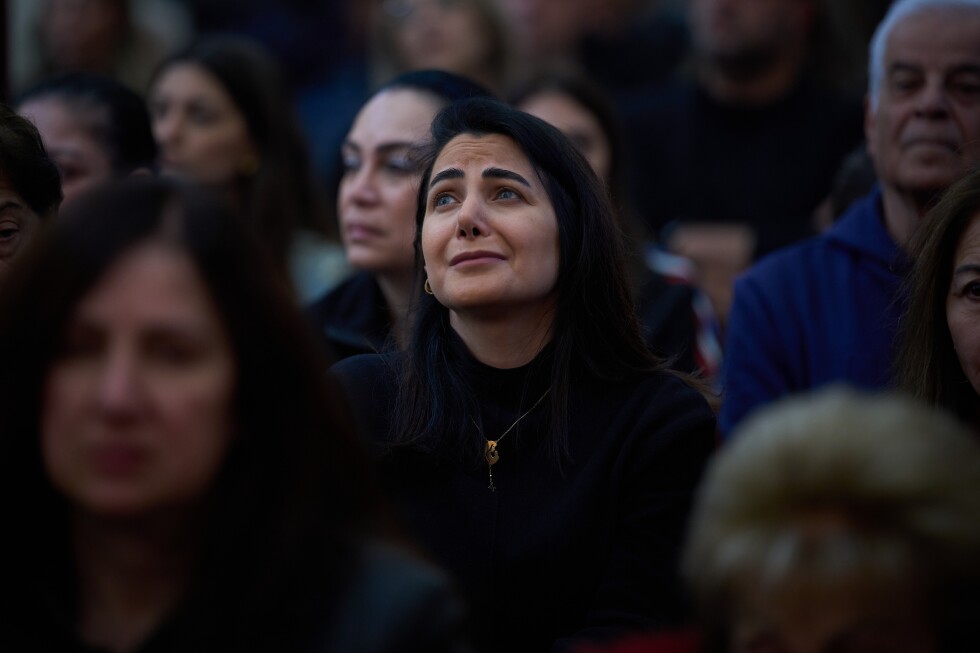
At St. Anthony Church in Jdeideh, Rev. Dori Fayyad delivered a moving Good Friday sermon to a congregation so large that many stood or crouched on the back stairs. As he named the southern churches one by one, illustrated by cardboard cutouts next to the pulpit, some worshippers wiped away tears.
“These churches in these villages are not only places of worship,” Fayyad said. “They are silent witnesses to suffering and to faith.”
As Easter Sunday arrives, Lebanon’s Christian communities find themselves scattered but resilient, their ancient faith traditions continuing even as the conflict that displaced them shows no signs of abating.
Fact Checker
Verify the accuracy of this article using The Disinformation Commission analysis and real-time sources.

8 Comments
This is a devastating situation for the Christian community in Lebanon. To have their most cherished religious observances disrupted by war and displacement is truly heartbreaking. I hope the international community can work to restore peace and allow these people to return to their homes and churches.
This is a truly tragic situation for the Christian community in Lebanon. War and displacement always take a heavy toll, especially on vulnerable populations. I hope the displaced are able to find safe refuge and return home soon.
The plight of these displaced Lebanese Christians is a sobering reminder of the human toll of conflict. Forced to celebrate their most sacred holidays away from their homes and churches – this must be an incredibly difficult experience. I hope a lasting peace can be achieved so they can safely return.
It’s heartbreaking to see people forced to observe their most sacred holidays away from their homes and communities. No one should have to experience such upheaval and loss, especially during cherished religious celebrations.
You’re right, the human cost of this conflict is immense. I hope the international community can work to broker a lasting peace and allow these displaced Christians to return safely to their homes.
The situation facing Lebanese Christians is truly heartbreaking. Forced from their homes and unable to celebrate the most important holidays in their own churches – this is a tragic consequence of the ongoing violence. I hope the displaced find safety and comfort during this difficult time.
This conflict has already caused so much devastation and suffering. While the geopolitical factors are complex, the impact on ordinary people like these displaced Lebanese Christians is heartbreaking. I hope a peaceful resolution can be found soon.
It’s so sad to see religious and cultural traditions disrupted by war and displacement. These Lebanese Christians deserve to be able to celebrate Easter in their own communities, not forced to seek refuge elsewhere. I hope this conflict can be resolved peacefully so they can return home.