


Listen to the article
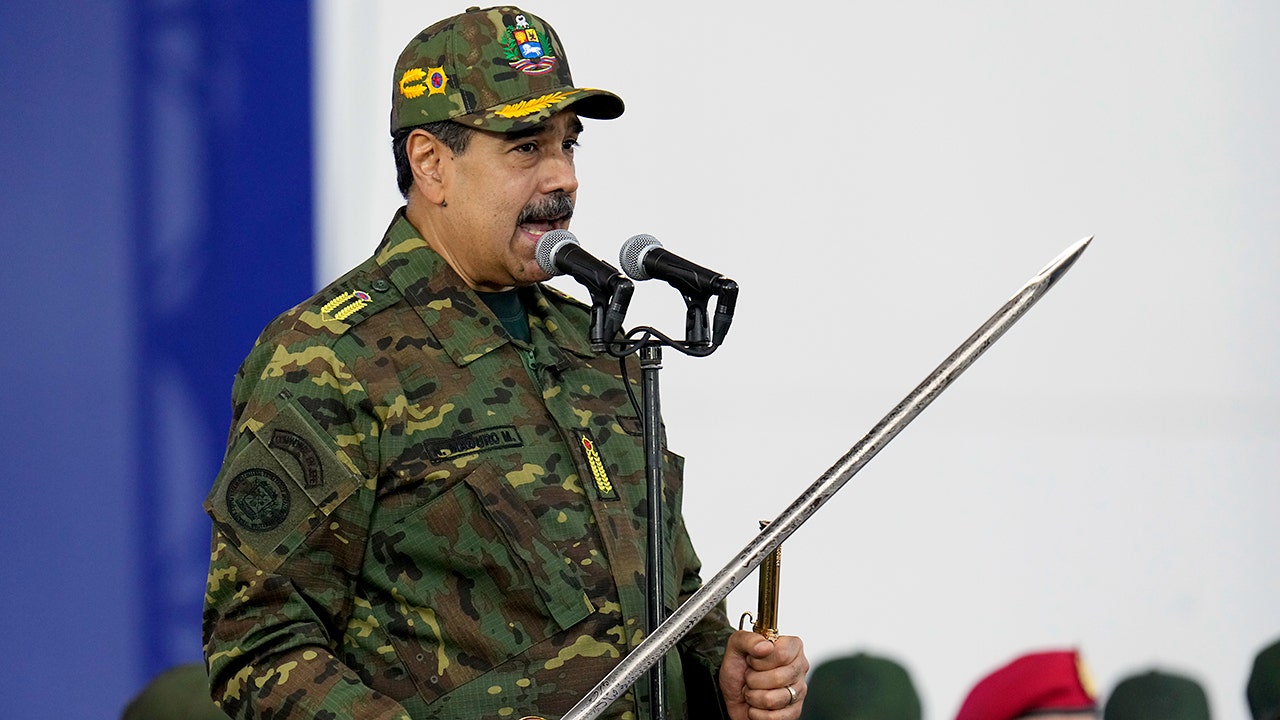
Venezuelan President Nicolás Maduro issued a stark warning to his supporters this week, brandishing the sword of independence hero Simón Bolívar during a defiant rally in Caracas as tensions escalate between Venezuela and the United States.
The fiery address came as President Donald Trump announced plans to expand anti-drug trafficking operations against Venezuela from maritime interdictions to land operations, heightening the already strained diplomatic relations between the two nations.
“For anyone, whether civilian, politician, military, or police. Let no one make excuses. Failure is not an option. The homeland demands it!” Maduro declared while raising Bolívar’s symbolic sword – a powerful gesture invoking the 19th-century revolutionary revered across South America. “If the homeland demands it, the homeland will have our lives, if necessary.”
Maduro framed the confrontation as resistance against “imperialist aggression,” urging Venezuelans to mobilize against what he characterized as external threats to national sovereignty. The rally was clearly designed to bolster domestic support amid growing international pressure.
The rhetorical escalation follows months of U.S. maritime operations that Washington says have targeted vessels used by drug traffickers with links to the Venezuelan government. According to Reuters, these strikes have resulted in more than 80 deaths since September, while coastal communities in Venezuela have experienced increased surveillance and security crackdowns.
During his Thanksgiving address to U.S. service members, Trump claimed the maritime operations have already curtailed approximately 85% of drugs arriving by sea, prompting traffickers to shift their routes.
“In recent weeks, you’ve been working to deter Venezuelan drug traffickers, of which there are many. Of course, there aren’t too many coming in by sea anymore,” Trump said. “Now people aren’t wanting to be delivering by sea, and we’ll be starting to stop them by land also. The land is easier, but that’s going to start very soon.”
Trump emphasized that these traffickers are responsible for “hundreds of thousands of people a year” dying from narcotics brought into the United States. “We warn them, stop sending poison to our country,” he asserted.
The maritime operations, which began in early September, have destroyed dozens of vessels across the Caribbean and eastern Pacific. U.S. officials maintain that many of these vessels were connected to Venezuelan and Colombian criminal organizations, which they claim operate with the tacit approval of high-ranking Venezuelan officials.
Earlier this month, Trump further escalated tensions by refusing to rule out sending U.S. troops to Venezuela as part of the administration’s broader strategy to dismantle criminal networks allegedly tied to senior figures in Caracas. “No, I don’t rule out that, I don’t rule out anything,” he stated when questioned about potential military action.
However, Trump has simultaneously left the door open for diplomatic engagement. “We may be having some conversations with Maduro, and we’ll see how that turns out. They would like to talk,” he told reporters over the weekend, suggesting a potential willingness to pursue diplomatic channels alongside the enforcement actions.
The confrontation occurs against the backdrop of Venezuela’s ongoing political and economic crisis. Maduro, who has maintained a tight grip on power since 2013 despite international criticism of his government’s democratic legitimacy, faces significant challenges including widespread poverty, hyperinflation, and mass emigration of citizens seeking better opportunities abroad.
International relations experts note that the timing of this escalation is significant, coming as Trump prepares to begin his second term as U.S. president in January. His administration has signaled a more aggressive approach to what it considers hostile regimes in Latin America, with Venezuela being a primary focus.
For residents in Venezuela’s coastal communities, the consequences of this geopolitical tension have been immediate and severe. Local reports indicate increased military presence, surveillance, and restrictions on movement in areas where U.S. maritime operations have occurred, further complicating daily life in a country already struggling with severe economic hardships.
Fact Checker
Verify the accuracy of this article using The Disinformation Commission analysis and real-time sources.

14 Comments
The rising tensions between Venezuela and the US are concerning, given Venezuela’s role as a supplier of key minerals and energy resources. I wonder how this could impact global commodity markets in the coming months.
Maduro’s use of Bolívar’s sword is a powerful symbol, but it remains to be seen whether it will be enough to shore up domestic support amid the country’s ongoing economic and political turmoil.
This seems like a high-stakes game of geopolitical brinkmanship, with potential ramifications for the energy and mining sectors. I’ll be closely following developments to understand how it might impact commodity prices and related equities.
Maduro’s defiant posturing is understandable, but the expanded US operations could further destabilize the situation. It’s a complex issue with no easy solutions.
The tensions between Venezuela and the US are concerning, especially given Venezuela’s importance as a supplier of key minerals and energy resources. I wonder how this will impact commodity markets and related equities.
Maduro seems intent on portraying this as a fight against ‘imperialist aggression,’ but the US likely views it as a crackdown on drug trafficking. Navigating this geopolitical minefield will be tricky.
Maduro’s use of Bolívar’s sword is a potent symbol, but it remains to be seen whether this rally will meaningfully bolster his position amid the ongoing economic and political crisis in Venezuela.
The potential for further escalation between the US and Venezuela is worrying. This situation bears close watching, as it could have significant ramifications for energy and mining interests in the region.
The tensions between Venezuela and the US are concerning, given the country’s importance as a supplier of key minerals and energy resources. I’ll be watching closely to see how this situation unfolds and what it might mean for global commodity markets.
Maduro’s use of Bolívar’s sword is a bold symbolic gesture, but it remains to be seen whether it will translate into meaningful support or stability within Venezuela.
This certainly seems like an inflamed situation between Venezuela and the US. It will be interesting to see how this diplomatic standoff plays out and what the implications are for the region’s energy and mining sectors.
Maduro’s defiant rhetoric and symbolic gestures appear aimed at rallying domestic support. However, the expanded US operations could further destabilize the situation.
This is a complex geopolitical situation with high stakes for the energy and mining sectors. I’m curious to see how it unfolds and what the implications might be for commodity prices and related equities.
Maduro’s defiant rhetoric and symbolic gestures suggest he is digging in, even as the US ratchets up pressure. It’s an unpredictable situation that could have far-reaching consequences.