


Listen to the article
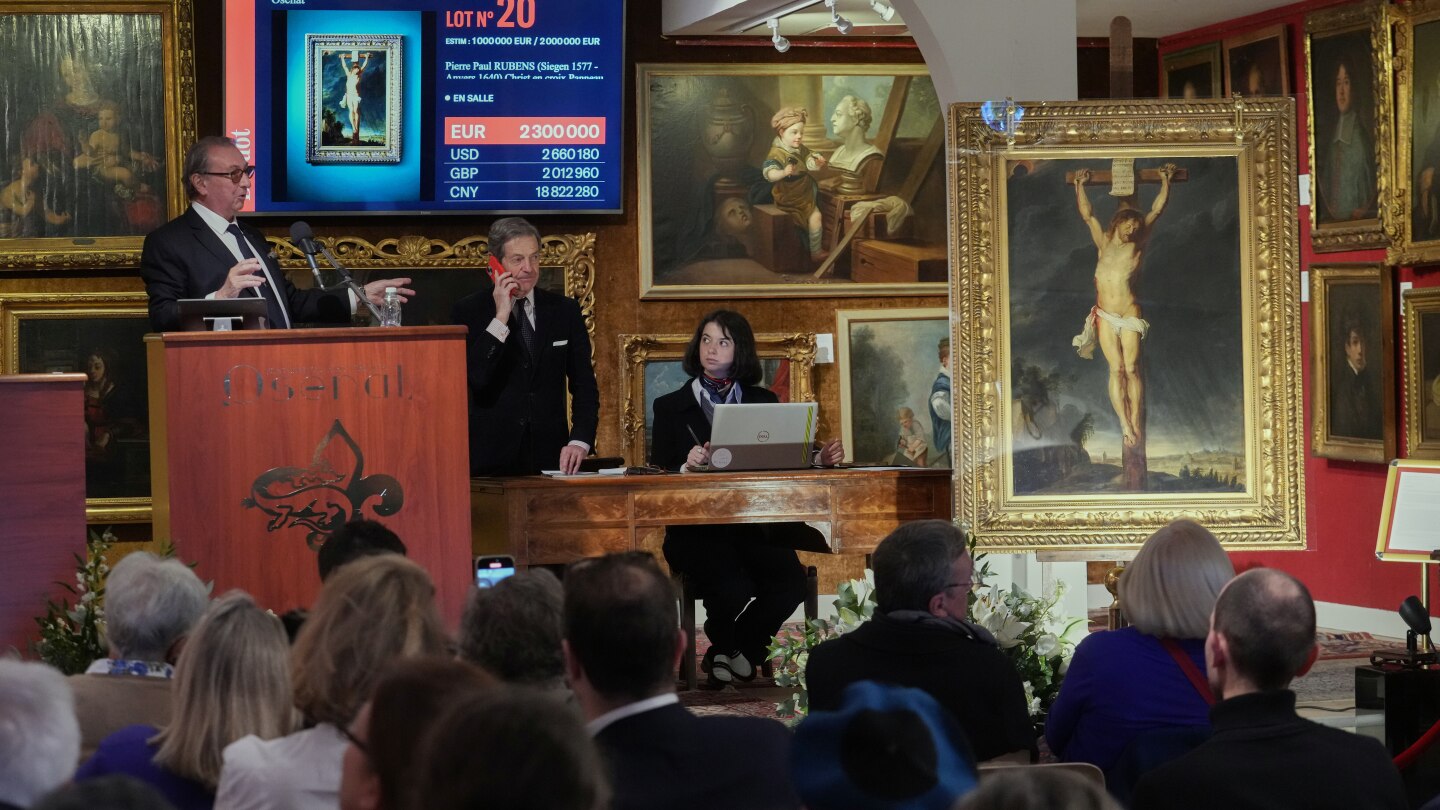
A long-lost painting by Baroque master Peter Paul Rubens sold for 2.3 million euros ($2.7 million) at an auction in Versailles on Sunday, marking the remarkable end to a centuries-old mystery surrounding the artwork.
The painting, which depicts the crucifixion of Jesus Christ, was recently discovered in a private townhouse in Paris where it had remained hidden for more than four centuries. Until its authentication, the artwork was believed to be from one of the many Rubens workshops operating during the 17th century and was valued at less than 10,000 euros ($11,500).
“I immediately had a hunch about this painting, and I did everything I could to try to have it authenticated,” auctioneer Jean-Pierre Osenat told The Associated Press. “And finally, we managed to have it authenticated by the Rubenianum, which is the Rubens committee in Antwerp.”
The authentication represents a significant art world discovery, adding another masterpiece to Rubens’ known body of work. The Flemish painter (1577-1640) is widely regarded as one of the most influential artists of the Baroque period, known for his dramatic, dynamic compositions and technical virtuosity.
What makes this particular crucifixion painting especially valuable is its unique portrayal among Rubens’ religious works. Art historian Nils Büttner, a renowned Rubens expert, noted before the auction that while the master frequently painted crucifixion scenes, he rarely depicted “the crucified Christ as a dead body on the cross.”
“This is the one and only painting showing blood and water coming out of the side wound of Christ, and this is something that Rubens only painted once,” Büttner explained. This distinctive iconographic detail helped confirm the work’s authenticity and adds to its art historical significance.
The Osenat auction house conducted extensive scientific analysis to verify the painting’s provenance. Microscopic examination of the paint layers revealed a technique characteristic of Rubens’ approach to rendering human flesh. Beyond the expected white, black, and red pigments, researchers found blue and green pigments—a hallmark of Rubens’ sophisticated approach to depicting skin tones, which helped create the luminous quality for which his work is known.
Art expert Eric Turquin told the packed auction house that the painting had essentially vanished from public knowledge shortly after its creation in the early 1600s. Its provenance was partially traced to the 19th-century French classical painter William Bouguereau before being passed down through his family.
The rediscovery and sale of this Rubens masterpiece highlights the ongoing potential for significant art historical finds in private collections. In recent years, several important works by Old Masters have emerged from obscurity, often in unexpected locations like private homes where they remained unrecognized for generations.
The art market for authenticated Old Master paintings remains robust despite fluctuations in other collecting categories. Works by artists of Rubens’ stature rarely appear on the market, and when they do, they often command premium prices, especially those with clear provenance and condition.
The €2.3 million sale price reflects both the painting’s artistic importance and its rarity. For collectors and institutions, authentic works by Baroque masters represent not just financial investments but opportunities to acquire pieces of significant cultural and historical value that have survived the centuries.
The successful authentication and sale of this Rubens crucifixion painting also demonstrates the crucial role of specialized art research institutions like the Rubenianum in Antwerp, which maintains the definitive scholarship on the artist’s complete works and provides the authoritative word on attributions.
Fact Checker
Verify the accuracy of this article using The Disinformation Commission analysis and real-time sources.

30 Comments
Production mix shifting toward World might help margins if metals stay firm.
Nice to see insider buying—usually a good signal in this space.
I like the balance sheet here—less leverage than peers.
Good point. Watching costs and grades closely.
Good point. Watching costs and grades closely.
I like the balance sheet here—less leverage than peers.
Good point. Watching costs and grades closely.
Good point. Watching costs and grades closely.
The cost guidance is better than expected. If they deliver, the stock could rerate.
Good point. Watching costs and grades closely.
Good point. Watching costs and grades closely.
If AISC keeps dropping, this becomes investable for me.
Good point. Watching costs and grades closely.
Interesting update on Long-lost Rubens painting depicting crucifixion sells for $2.7M. Curious how the grades will trend next quarter.
Good point. Watching costs and grades closely.
Good point. Watching costs and grades closely.
Uranium names keep pushing higher—supply still tight into 2026.
Good point. Watching costs and grades closely.
Nice to see insider buying—usually a good signal in this space.
Good point. Watching costs and grades closely.
Good point. Watching costs and grades closely.
If AISC keeps dropping, this becomes investable for me.
Good point. Watching costs and grades closely.
Interesting update on Long-lost Rubens painting depicting crucifixion sells for $2.7M. Curious how the grades will trend next quarter.
Good point. Watching costs and grades closely.
Good point. Watching costs and grades closely.
I like the balance sheet here—less leverage than peers.
Good point. Watching costs and grades closely.
Production mix shifting toward World might help margins if metals stay firm.
Good point. Watching costs and grades closely.