


Listen to the article
G20 Leaders Break Tradition, Adopt Early Declaration Amid US Boycott
World leaders from the Group of 20 rich and developing economies made an unprecedented move Saturday by adopting their declaration at the start of their summit in South Africa, despite the United States boycotting the two-day talks in Johannesburg.
Vincent Magwenya, spokesperson for South African President Cyril Ramaphosa, announced that the 122-point declaration was adopted unanimously by attending members at the summit’s outset—a break from the customary practice of finalizing declarations at the conclusion of G20 gatherings.
The declaration focuses heavily on issues affecting developing nations, calling for increased global action on climate-related disasters and sovereign debt relief. Host country South Africa hailed the agreement as a victory for the first G20 summit held on African soil, though Argentina later clarified it did not endorse the document.
The summit has been overshadowed by President Donald Trump’s decision to boycott the event. The U.S. administration reportedly pressured South Africa against adopting a leaders’ declaration in America’s absence, adding tension to an already strained diplomatic relationship between the two countries.
In what appeared to be an unplanned live broadcast of what should have been private discussions, President Ramaphosa was heard proposing to “adopt our declaration now” before being informed the cameras were still rolling. “I’m told that the cameras are still on. They should be off,” Ramaphosa quickly responded after his foreign minister whispered in his ear.
South Africa had set an ambitious agenda focused on climate change solutions and addressing global inequality. As Ramaphosa opened the summit, he expressed satisfaction that “consensus has emerged” despite resistance from the United States on several key priorities.
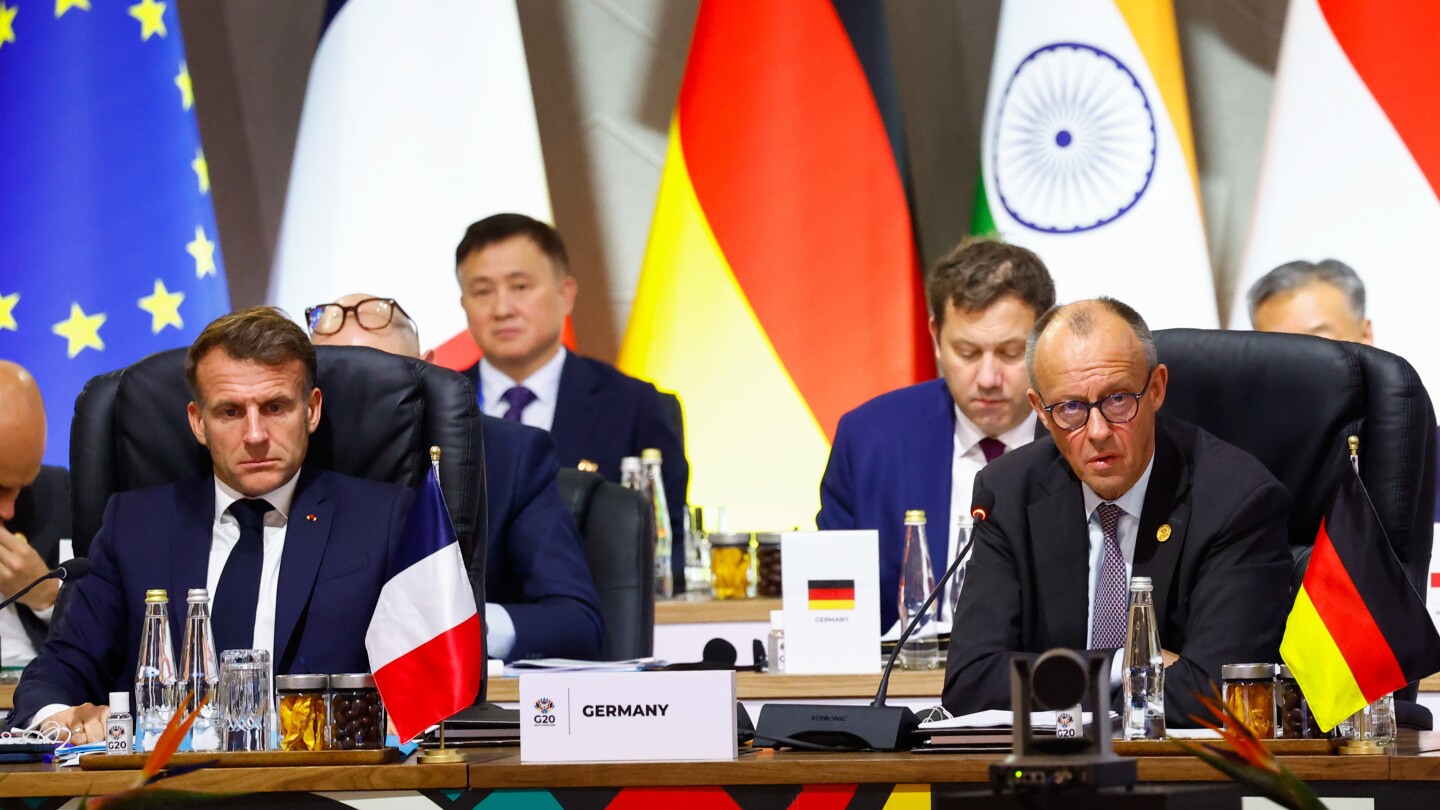
On the summit’s sidelines, leaders and officials from France, Germany, the UK, Canada, and Japan held meetings regarding a proposed U.S. peace deal for the Russia-Ukraine war. German Chancellor Friedrich Merz announced that representatives from European countries, the EU, the United States, and Ukraine would continue discussions in Switzerland on Sunday.
The peace plan, developed by the Trump administration and Russia, reportedly includes concessions to Russian demands that Ukrainian President Volodymyr Zelenskyy has previously rejected, particularly regarding territorial concessions. In a joint statement, twelve nations including EU members, Canada, and Japan acknowledged the proposal as “a basis which will require additional work,” emphasizing that “borders must not be changed by force.”
South Africa’s presidency of the G20 prioritized assistance for developing nations recovering from climate disasters, reducing foreign debt burdens, transitioning to renewable energy sources, and enabling countries to benefit from their critical mineral resources. However, these efforts were complicated by the absence of the world’s largest economy.
Trump’s boycott stems from his claims that South Africa is persecuting its white Afrikaner minority. The Trump administration has also expressed opposition to South Africa’s focus on climate change and inequality issues.
French President Emmanuel Macron expressed regret over the American absence but urged progress: “I do regret it, but it should not block us. Our duty is to be present, engage and work all together because we have so many challenges.”
The G20, which actually comprises 21 members (19 nations plus the European Union and the African Union), represents approximately 85% of the global economy, 75% of international trade, and more than half the world’s population. Formed in 1999 to bridge the gap between wealthy and developing nations during financial crises, the group operates on consensus rather than binding resolutions.
The diplomatic tension between South Africa and the U.S. intensified when South African officials revealed American pressure to water down the final declaration to merely a unilateral statement from the host country. President Ramaphosa defiantly responded earlier this week, stating “we will not be bullied.”
The G20’s direction is expected to shift dramatically as the United States takes over the rotating presidency at the summit’s conclusion. The White House indicated that America’s only role at this meeting would be sending an embassy representative to the formal handover ceremony—a move South African officials have described as insulting to President Ramaphosa.
South Africa has suggested that under these circumstances, a formal handover ceremony is unlikely to take place on Sunday as originally planned.
Fact Checker
Verify the accuracy of this article using The Disinformation Commission analysis and real-time sources.

22 Comments
Adopting the G20 declaration at the start of the summit is an unconventional move, but it seems to reflect the host country’s determination to make progress on important global issues.
The focus on climate change and debt relief is particularly noteworthy. These are challenges that require international cooperation, so it’s good to see them being prioritized.
The early adoption of the G20 declaration is an intriguing development. It shows the host country is willing to take a proactive stance, even in the face of US opposition. This could be an important moment for global cooperation.
The declaration’s emphasis on the concerns of developing nations is a welcome shift. It will be interesting to see how the summit discussions unfold and what long-term impact this could have.
Adopting the G20 declaration early is an unconventional but potentially effective strategy. It allows the summit to set the agenda and build momentum, even with the US opposition.
The declaration’s emphasis on the concerns of developing nations is a welcome shift. It will be interesting to see how the summit proceedings unfold from here.
The G20 summit in South Africa is a significant event, and the early adoption of the declaration is an intriguing development. It suggests the host country is taking a proactive approach to setting the agenda.
The US decision to boycott is disappointing, but it’s encouraging to see the other leaders moving forward. Hopefully this sets the stage for productive discussions on the key issues.
The G20 summit in South Africa is an important global event, and it’s encouraging to see leaders adopting a declaration focused on key issues like climate change and debt relief.
The US decision to boycott is disappointing, but the summit seems to be moving forward productively despite the absence. Hopefully this sets a positive tone for the discussions.
It’s notable that the G20 leaders were able to reach a consensus declaration, even with the US boycotting. This underscores the importance of these global discussions, despite political differences.
The US opposition to the early declaration suggests they may have wanted to shape the agenda more. But the G20 seems determined to move forward on key priorities for the developing world.
The early adoption of the G20 declaration is an interesting strategic move by the host country. It suggests they want to set the agenda and keep the summit on track, despite the US opposition.
The declaration’s emphasis on the concerns of developing nations is a welcome shift. It will be important to see how the summit discussions unfold and what concrete actions emerge.
The early adoption of the G20 declaration is a bold move, and it will be fascinating to see how it shapes the summit discussions. The US absence is regrettable, but the summit appears determined to make progress.
I’m particularly interested in the declaration’s focus on climate action and debt relief. These are critical issues that require global cooperation, so it’s good to see them at the forefront.
This early adoption of the G20 declaration is an unusual and bold move. It shows the host country South Africa is determined to make progress, even in the face of US resistance.
I’m curious to see how the summit discussions unfold from here, and whether the US will eventually engage or remain on the sidelines.
This G20 summit in South Africa is shaping up to be a pivotal event, with the early adoption of the declaration despite US resistance. It’s a bold move that signals the host country’s determination to make progress.
The declaration’s focus on issues like climate change and debt relief is encouraging. Hopefully this sets the tone for productive discussions and tangible outcomes at the summit.
Interesting development at the G20 summit in South Africa. Adopting the declaration early despite US opposition shows that global leaders are willing to move forward on key issues despite disagreements.
The declaration’s focus on climate action and debt relief for developing nations is a positive sign. Hopefully this sets the stage for productive discussions at the summit.