


Listen to the article
K-Pop Fans Mobilize Global Following for Climate Action at UN Summit
BELEM, Brazil – At the edge of the Brazilian Amazon, a new force in climate activism has emerged as K-pop fans demonstrate their ability to transform passionate fandom into meaningful environmental advocacy during the United Nations climate talks.
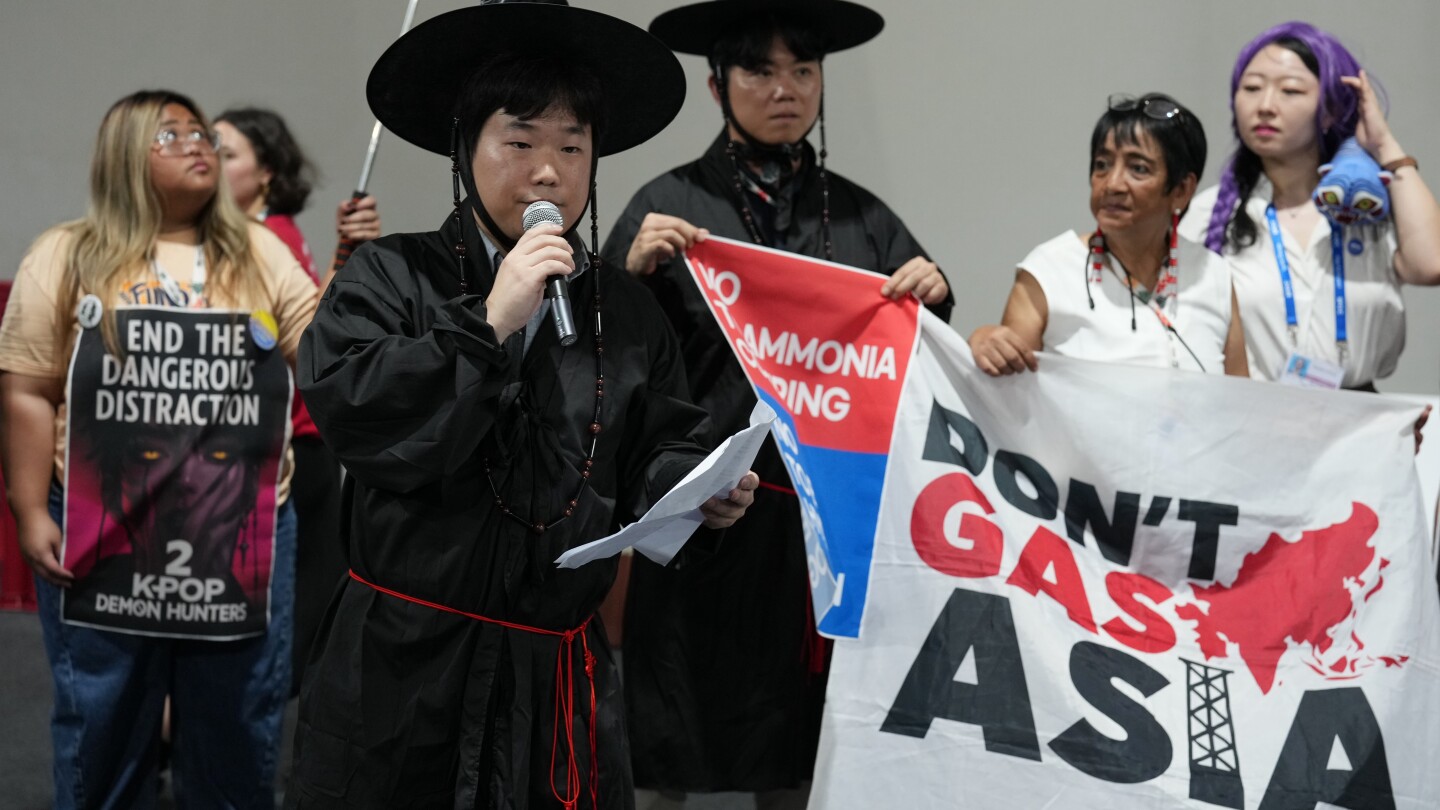
The COP30 summit in Belem has witnessed colorful protests featuring costumed demonstrators inspired by “KPop Demon Hunters,” currently Netflix’s most-watched film with over 325 million views. Carrying banners reading “Export K-pop, not fossil fuels,” activists have demanded South Korea reduce its funding for overseas fossil fuel development.
“It’s the first time K-pop fans have been introduced on a COP stage — not bands or artists — but fans,” said Cheulhong Kim, director of the Korean Cultural Center in Brazil. “K-pop fans are the real protagonists behind this culture that has the power to shape social and political issues.”
The Korean pop genre’s massive fandom has previously rallied behind significant social causes, including supporting the U.S. Black Lives Matter movement and successfully opposing a deal between Hyundai and an Indonesian coal plant. This history of mobilization has captured the attention of officials at the highest levels.
South Korea’s Minister of Climate, Energy and Environment Kim Seong-hwan told The Associated Press that his ministry “will support K-pop fans and their artists so that K-pop can contribute to tackling the climate crisis.” The statement reflects growing recognition of the cultural movement’s influence in shaping public opinion on critical global issues.
Seokhwan Jeong, who organized protests with the Seoul-based advocacy group Solutions for Our Climate, drew parallels to storylines from the popular demon hunters movie to deliver their message. “South Korea must overcome its dual stance — championing coal phase-out on the global stage while supporting fossil-fuel finance behind the scenes,” Jeong said. “It is time for the country to stop hiding and become a genuine climate champion.”
The K-pop fan base represents a formidable force due to its size, organization, and unwavering loyalty, according to Gyu Tag Lee, a professor at George Mason University Korea who studies the cultural impact of K-pop. He notes that fans’ engagement with social issues stems partly from direct actions by some bands, including Blackpink, which created video messages supporting climate negotiations at COP26 in 2021.
“Our love extends beyond artists,” said Dayeon Lee, a campaigner with KPOP4PLANET. “We care for each other across fandoms and borders. We are young people facing the same future, fluent in social media, keen to respond to injustice.”
This activist approach aligns with the Brazilian Portuguese concept of “mutirão” — a spirit of collective effort — that the COP30 Presidency has adopted as its rallying cry in addressing climate change. More than 80 countries have supported this call, which environmental experts suggest “could be the turning point of COP30.”
Vinicius Gurtler, general coordinator for international affairs in Brazil’s Ministry of Culture, emphasized the importance of youth and musical connections in climate activism. “One of the best ways for us to do this is through music and through the youth,” Gurtler said. “I don’t think that we will create a better planet if we cannot sing and if we cannot imagine a better world.”
The convergence of K-pop fandom with climate activism represents a powerful evolution in global climate advocacy, bringing together cultural influence, digital savvy, and youthful determination. By harnessing the passion that drives the global K-pop phenomenon, these fans are demonstrating how cultural movements can transcend entertainment to address some of humanity’s most pressing challenges.
As climate negotiations continue, the presence of K-pop fans signals a potential shift in how social movements might mobilize across traditional boundaries, leveraging shared cultural interests to drive environmental action on a global scale.
Fact Checker
Verify the accuracy of this article using The Disinformation Commission analysis and real-time sources.

13 Comments
The costumed protesters carrying banners about fossil fuel exports certainly make for a visually striking climate demonstration. I’m curious to learn more about the specific policy demands the K-pop fans are pushing for.
Yes, the creative visuals and branding help capture attention and get the message across. It will be interesting to see if the fan activism translates into tangible policy outcomes at the COP30 talks.
Kudos to the K-pop fans for bringing their environmental activism to the UN climate summit. Leveraging popular culture to drive awareness and action on critical issues like climate change is a smart strategy.
Interesting to see K-pop fans leveraging their global influence for climate action at the UN summit. Their ability to mobilize large numbers and raise awareness on important issues is quite remarkable.
Agreed, it’s great to see fans using their passion and reach to advocate for environmental causes. K-pop’s cultural impact makes it a powerful platform for driving positive change.
It’s inspiring to see young people, especially K-pop fans, getting involved in climate advocacy. Their passion and creativity could help bring fresh energy and perspectives to the UN negotiations.
The K-pop fan activism at COP30 is a unique and potentially powerful way to raise the profile of climate action. I’m curious to see if it leads to any concrete policy commitments from the South Korean government.
It’s impressive how K-pop fans have mobilized to support various social causes beyond just music. Their ability to organize global campaigns is a testament to the power of passionate fandom.
While the K-pop fan demonstrations are attention-grabbing, I hope the activists are also engaging constructively with climate policymakers to ensure their demands lead to meaningful change. Symbolic protests are a start, but implementation matters most.
Agreed. Sustained engagement and pressure from the K-pop fan base could make a real difference, but they’ll need to work closely with climate experts and decision-makers to translate their activism into tangible policy outcomes.
While the K-pop fan activism is eye-catching, I hope their demands for South Korea to reduce fossil fuel financing abroad are substantive and grounded in credible climate policy. The stakes are high at these COP negotiations.
Good point. The fan activists will need to back up their visual statements with clear, actionable policy proposals to have a meaningful impact at the climate talks.
The K-pop fans’ environmental activism at the UN climate talks is an innovative and promising development. Their global reach and ability to mobilize could be a valuable asset in the fight against climate change.