


Listen to the article
The jury in the federal trial of Mohammad Sharifullah began deliberations Tuesday after hearing closing arguments in a case centered on his alleged role in the 2021 Kabul airport bombing that killed 160 Afghans and 13 U.S. service members. After approximately five hours of deliberation, jurors failed to reach a verdict and will resume their discussions Wednesday.
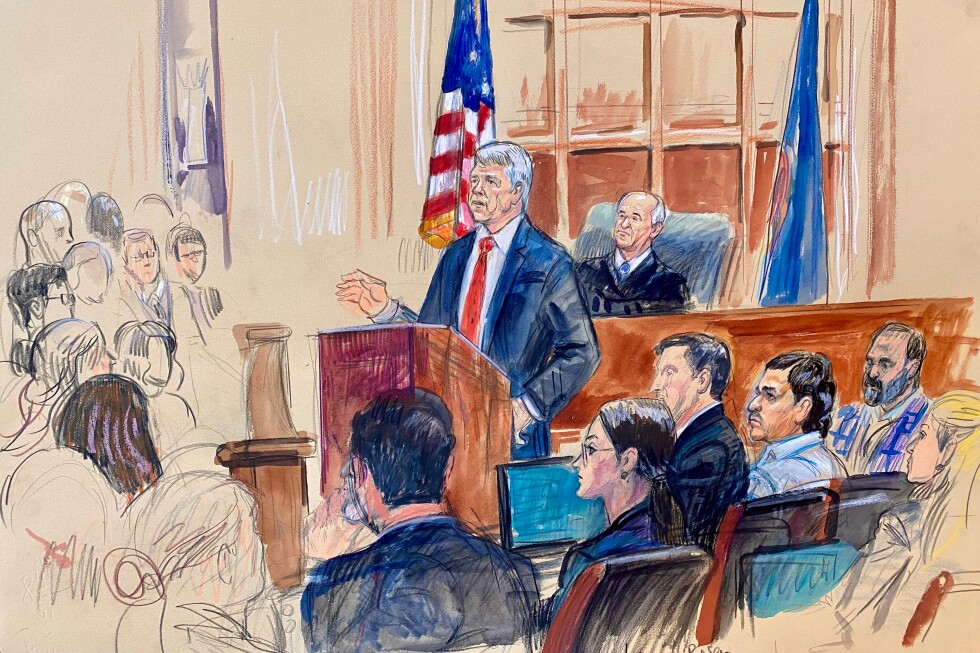
Defense attorney Lauren Rosen challenged the prosecution’s case, arguing that authorities have relied solely on Sharifullah’s own statements to FBI agents without corroborating evidence. According to Rosen, Sharifullah falsely confessed to helping plan the deadly suicide bombing at Abbey Gate during the chaotic U.S. withdrawal from Afghanistan.
“The problem was, he didn’t know much about what actually happened that day,” Rosen told jurors. “The government has told you nothing about how this attack actually happened.”
Rosen suggested her client may have fabricated his confession out of fear of torture while in Pakistani custody before being transferred to U.S. authorities. She also questioned the government’s attribution of the attack to Islamic State militants, suggesting that Taliban offshoots controlling access to Abbey Gate could have been involved instead.
“You can’t base your verdict on mere conjecture and speculation,” Rosen argued. “That’s what the prosecution is asking you to do.”
Justice Department prosecutor Ryan White countered that Sharifullah played a crucial role in planning the Abbey Gate bombing and was involved in several other attacks by ISIS-K, the Islamic State’s regional branch in Afghanistan. White claimed Sharifullah was also connected to the March 2024 attack at a Moscow concert hall that killed approximately 140 people.
“The defendant thought nothing of killing,” White said during closing arguments. “For him, it was just another day at the office.”
White further cited statements Sharifullah allegedly made to a journalist expressing his desire to “catch and kill the crusaders” from the United States for invading Afghanistan after the September 11, 2001 terror attacks. “This case is not complicated,” White told jurors. “The defendant told you everything you need to know.”
Sharifullah, who did not testify during the weeklong trial, faces one count of providing material support to a designated foreign terrorist organization resulting in death. If convicted, he could receive a maximum sentence of life imprisonment.
A review conducted by U.S. Central Command identified the Abbey Gate bomber as Abdul Rahman al-Logari, an Islamic State militant released from an Afghan prison by the Taliban. According to an FBI affidavit, Sharifullah recognized the alleged bomber as an operative he had known while incarcerated.
The August 26, 2021 attack occurred during the final days of America’s military withdrawal from Afghanistan, ending what had become the longest war in U.S. history. As American forces rushed to evacuate both U.S. citizens and vulnerable Afghan allies, security conditions deteriorated rapidly around Hamid Karzai International Airport in Kabul.
Congressional testimony from a former Marine revealed that potential suspects had been spotted behaving suspiciously on the morning of the bombing, but permission to act was not granted. However, the Central Command review concluded that these individuals were not the actual bomber and determined the attack was not preventable.
The case has been politically charged, with former President Donald Trump highlighting Sharifullah’s capture during a joint session of Congress last year. The investigation has not been without controversy—a prosecutor originally assigned to the Abbey Gate case was fired in 2023 amid criticism from right-wing commentators regarding his work during the Biden administration.
Throughout his recent presidential campaign, Trump repeatedly criticized President Biden’s handling of the Afghanistan withdrawal and blamed him directly for the Abbey Gate attack, making the incident a significant point of contention between the two administrations.
Fact Checker
Verify the accuracy of this article using The Disinformation Commission analysis and real-time sources.

12 Comments
Interesting case involving the Kabul airport bombing. I’m curious to see if the jury can reach a verdict based on the evidence presented. Seems like the defense is challenging the lack of corroborating evidence and the alleged confession.
This case highlights the complexities of terrorism investigations and the importance of due process. I’m interested to see how the jury navigates the conflicting accounts and evidence presented.
Tragic incident at the Kabul airport. I hope the jury can weigh all the evidence objectively and reach a verdict that serves the ends of justice, whatever that may be.
Curious to see how this case unfolds. The defense’s arguments about the reliability of the alleged confession and lack of corroborating evidence seem worth considering. A thorough, unbiased review of the facts is crucial.
The Kabul airport attack was a tragic event that cost many lives. I’m glad the justice system is carefully deliberating this case to ensure a fair trial. It’s important to hear all perspectives and examine the evidence thoroughly.
The defense’s arguments about lack of corroborating evidence and potential false confession are worth considering. It’s important the jury examines the case objectively and doesn’t jump to conclusions based on initial allegations alone.
Agreed, a thorough and impartial review of the evidence is crucial. The jury must remain objective and avoid making assumptions, regardless of the initial claims.
This case highlights the complexities of terrorism investigations and prosecutions. I hope the jury can carefully weigh the evidence and reach a just conclusion, regardless of the outcome. Ensuring due process is critical in such high-stakes cases.
The Kabul airport bombing was a devastating attack. I hope the jury can carefully sift through the details and reach a fair verdict based on the evidence, not just the initial allegations.
The defense’s points about lack of corroborating evidence and potential false confession are valid concerns that the jury should thoroughly examine. A fair and impartial trial is essential in a case of this magnitude.
The Kabul airport bombing was a devastating attack. I hope the jury can carefully examine all the evidence and arguments presented to reach a fair and impartial verdict, regardless of the initial allegations.
Agreed, the jury must remain objective and not jump to conclusions based on the initial claims. A thorough and unbiased review of the evidence is essential in a case of this magnitude.