


Listen to the article
In a world increasingly fraught with misinformation and conflict, Pakistan has called upon the United Nations to foster a more truthful and respectful global information environment. The appeal came during a recent session of the UN Committee on Information, where Pakistani representatives highlighted growing concerns about digital manipulation and propaganda, particularly in regions experiencing occupation and conflict.
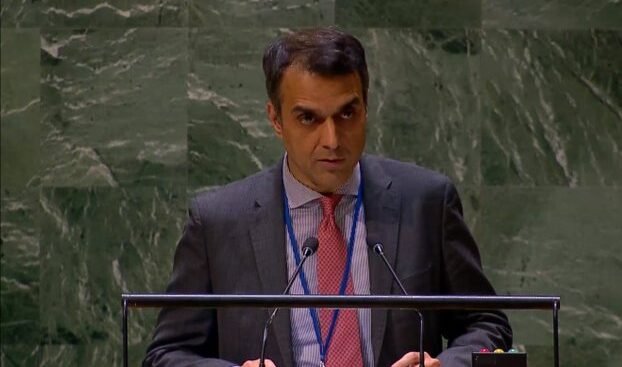
Ambassador Usman Jadoon, Pakistan’s deputy permanent representative to the UN, emphasized the critical importance of accurate communication in today’s polarized geopolitical landscape. “Timely, accurate, and impartial communication is most essential particularly at a time marked by geopolitical tensions, polarization, widening and inequalities,” he told the committee, which oversees the work of the Department of Global Communications (DGC).
Though not explicitly naming the territories, Jadoon’s remarks clearly referenced situations in Palestine and Kashmir when he expressed concern over disinformation tactics employed in occupied regions. “False narratives are deployed to obscure human rights violations, demonize lawful struggles for self-determination, and silence affected populations,” he stated.
The Pakistani envoy painted a sobering picture of today’s information landscape, acknowledging that while technological advancement has democratized information access, it has simultaneously facilitated unprecedented spread of harmful content. “These challenges strike at the core of public trust, social cohesion, and the credibility of multilateral institutions, including the UN,” Jadoon observed.
His comments come at a time when social media platforms and digital communications have transformed how conflicts are portrayed globally. In regions like Kashmir, where India and Pakistan have disputed control since 1947, information warfare has become as significant as physical confrontation. Similarly, in the ongoing Israel-Palestine conflict, competing narratives shape international opinion and policy responses.
The Pakistani diplomat emphasized that information should function as “a bridge for dialogue and cooperation, not as a tool for manipulation, division, or repression.” He expressed particular alarm at how digital platforms amplify falsehoods and deepen societal divisions, noting the persistence of hate speech, racism, xenophobia, and Islamophobia in online spaces—problems that frequently translate into real-world violence and discrimination.
The emergence of artificial intelligence represents yet another dimension to these challenges. While acknowledging AI’s potential benefits for communication and development, Jadoon warned about its capacity to further undermine information integrity if misused.
Pakistan’s concerns reflect broader global anxieties about disinformation campaigns that have disrupted elections, inflamed ethnic tensions, and complicated international responses to humanitarian crises in recent years. The UN itself has struggled to maintain its authority as an information source amid competing narratives from state actors and non-state groups.
In his remarks, Jadoon praised the Department of Global Communications for adapting to these evolving challenges, particularly through the Secretary-General’s Global Principles for Information Integrity. “These efforts are timely and necessary to ensure that the UN remains an authoritative, trusted, and accessible source of information,” he concluded.
The appeal highlights a growing recognition within international forums that information governance has become a crucial component of global security and human rights protection. As technology continues to advance and geopolitical tensions persist, the UN faces increasing pressure to develop more robust mechanisms for promoting truthful communication while respecting diverse perspectives and freedom of expression.
Fact Checker
Verify the accuracy of this article using The Disinformation Commission analysis and real-time sources.

9 Comments
Pakistan raises an important point. In regions experiencing conflict and occupation, the spread of misinformation can have devastating humanitarian consequences. The UN needs to make this a top priority and develop effective strategies to counter digital manipulation.
Pakistan’s appeal to the UN is a timely and necessary call to action. Disinformation and hate speech pose a grave threat to global stability and the ability of people under occupation to have their voices heard. The UN must respond decisively.
This is a concerning development that requires urgent action. The UN must work to ensure that digital platforms are not exploited to spread hateful propaganda and obscure human rights violations in occupied territories.
The erosion of public trust due to disinformation is a worrying global trend. Pakistan is right to call on the UN to address this issue, as it undermines efforts to resolve long-standing geopolitical disputes and protect human rights.
Absolutely. The UN must take a firm stance in defending freedom of information and promoting transparency, to prevent authoritarian regimes from abusing communication channels for their own nefarious purposes.
Accurate and impartial information is essential, particularly in polarized geopolitical environments. The UN must do more to counter the spread of false narratives that obscure human rights abuses and undermine the legitimate struggles of people under occupation.
I agree, the UN has a responsibility to uphold transparency and protect freedom of expression, while also combating the malicious use of information as a tool of oppression.
This is a critical issue that deserves serious attention. Disinformation and hate speech can have devastating impacts, especially in regions experiencing conflict and occupation. Pakistan is right to call for the UN to take strong action to promote truthful, responsible communication.
This is a complex and concerning situation. Disinformation has become a potent weapon, used to demonize and silence vulnerable populations. The UN must take robust action to safeguard truthful communication and the right to self-determination.