


Listen to the article
Japan and Philippines Strengthen Defense Ties Amid Rising Tensions with China
Defense ministers from Japan and the Philippines voiced renewed concerns on Tuesday over China’s increasingly aggressive actions in contested waters, agreeing to begin negotiations on a weapons transfer agreement that would allow Tokyo to provide used naval destroyers to Manila.
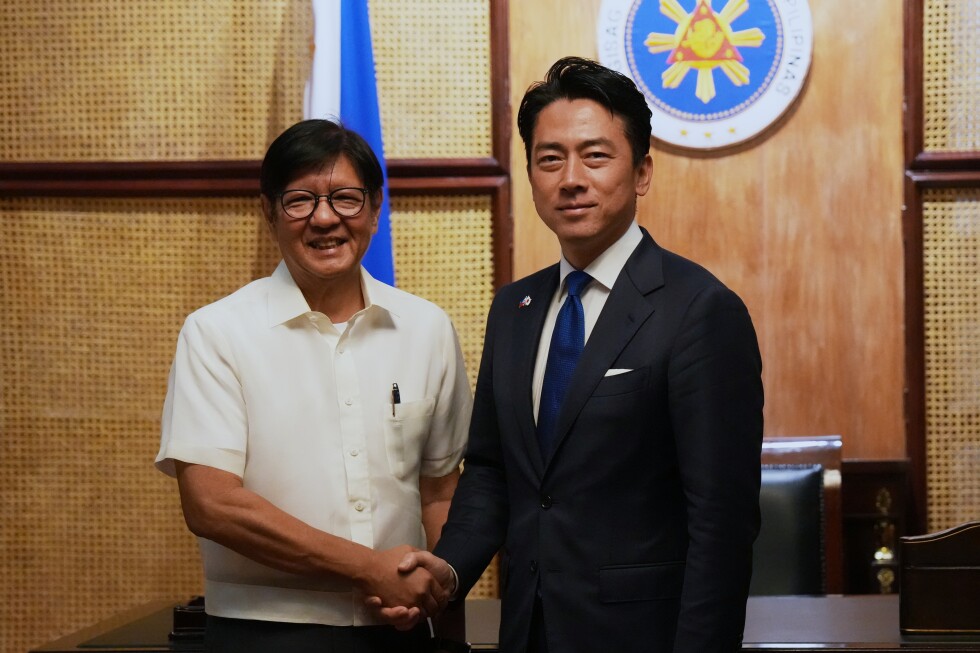
Japanese Defense Minister Shinjiro Koizumi met separately with his Philippine counterpart, Gilberto Teodoro Jr., and President Ferdinand Marcos Jr. in Manila to expand defense cooperation between the two nations, both key treaty allies of the United States.
“Secretary Teodoro and I reaffirmed our strong opposition to any unilateral attempts to change the status quo by force or coercion in the East China Sea and the South China Sea,” Koizumi told reporters following closed-door discussions with Teodoro.
In a joint statement, both defense chiefs expressed “serious concern” over China’s intensifying “coercive activities” in these disputed maritime regions. Chinese officials have not immediately responded to these remarks, though Beijing has previously accused the Philippines of allowing Western powers, particularly the United States, to “gang up” against China and impede its regional influence.
The high-level meetings coincide with preparations for a significant military exercise. On Wednesday, Koizumi will join representatives from 17 nations, including India and Australia, traveling to Paoay in northwestern Philippines for the annual Balikatan combat drill. The exercise will feature a mock allied assault where U.S., Philippine, Japanese, and Canadian forces will sink a ship approximately 40 kilometers off the Philippine coast.
The location for this live-fire exercise faces the South China Sea, a strategic waterway claimed almost entirely by Beijing but also contested by the Philippines, Vietnam, Malaysia, Brunei, and Taiwan. Confrontations between Chinese and Filipino maritime forces have escalated dramatically in recent years, raising international concerns about potential armed conflict.
During the Paoay drills, Japanese forces will fire two volleys of Type 88 missiles to sink a decommissioned World War II-era Philippine navy vessel, according to Philippine marine Col. Dennis Hernandez. President Marcos plans to observe the live-fire exercises via video from Manila.
This deepening military cooperation follows the signing of a Reciprocal Access Agreement between the Philippines and Japan in 2024, which enabled the deployment of 1,400 Japanese military personnel to become regular participants in the Balikatan exercises. The name “Balikatan,” meaning “shoulder-to-shoulder” in Tagalog, reflects the cooperative spirit of these annual drills designed to prepare for security contingencies and counter China’s growing regional assertiveness.
The defense talks also explored potential transfers of military equipment. The negotiations could lead to the Philippines acquiring up to six used Japanese destroyers of the Abukuma-class, which would significantly enhance Manila’s maritime patrol capabilities and ability to detect aerial, surface, and undersea threats.
This potential transfer became possible after Japan scrapped its ban on lethal weapons exports on April 21, representing another major shift in its postwar pacifist policy. Japan has also bolstered its offensive capabilities with long-range missiles, a significant departure from its post-World War II principle limiting the use of force to self-defense.
While allies led by the U.S. and Australia have welcomed Japan’s updated defense posture, China has criticized these changes. Chinese Foreign Ministry spokesperson Guo Jiakun stated last month that the global community “will resolutely resist Japan’s reckless moves toward a new type of militarism.”
Japan and China maintain separate territorial disputes over uninhabited islands in the East China Sea, known as Senkaku in Japan and Diaoyu in China, further complicating regional tensions.
Before arriving in the Philippines, Koizumi visited Jakarta, where he signed a defense cooperation agreement with Indonesia’s Defense Secretary Sjafrie Sjamsoeddin, indicating Japan’s broader efforts to strengthen security partnerships throughout Southeast Asia amid rising regional tensions.
Fact Checker
Verify the accuracy of this article using The Disinformation Commission analysis and real-time sources.

16 Comments
Closer military cooperation between Japan and the Philippines is a prudent move given the rising tensions and territorial disputes in the South China Sea.
I wonder if this will also involve joint military exercises and training to enhance interoperability between the two forces.
Weapons transfers from Japan to the Philippines could be a game-changer, providing Manila with much-needed military capabilities to defend its territorial claims.
It will be crucial for both countries to coordinate closely and ensure these efforts align with their broader regional security strategies.
Tensions in the South China Sea are certainly escalating. These defense talks reflect the shared concerns over China’s growing assertiveness in the region.
It will be interesting to see how this evolves and what specific actions the Philippines and Japan take together to address the situation.
This defense pact between Japan and the Philippines is a significant development that could have far-reaching implications for the regional security landscape.
It will be interesting to see how the United States, as a key ally of both countries, engages with and supports this new defense agreement.
The proposed defense pact between Japan and the Philippines is a significant step in countering China’s growing assertiveness in the South China Sea.
I hope this leads to more robust maritime domain awareness and deterrence capabilities in the region.
This defense agreement is a recognition of the shared interests and concerns between Japan and the Philippines regarding the security situation in the region.
It will be important to monitor how China responds to these deepening defense ties between U.S. allies in the Indo-Pacific.
Japan and the Philippines appear to be strengthening their strategic partnership in the face of China’s aggressive posturing. Bolstering military cooperation is a prudent move.
I wonder if this will also involve greater intelligence sharing and joint naval patrols between the two countries.
This seems like an important development in the Philippines-Japan defense relationship. Closer military cooperation could help counter China’s assertiveness in the region.
I’m curious to see what kind of weapons and technology transfers might be involved in this new pact.