


Listen to the article
Alabama Republicans are pushing forward with a new congressional map that could diminish Democratic representation in the state, following recent Supreme Court rulings on redistricting. The move comes as the GOP maintains a narrow majority in the U.S. House of Representatives.
State Republican leaders argue that the Supreme Court’s recent decision limiting the use of race in redistricting has fundamentally changed the legal landscape, giving them grounds to revisit and potentially overturn a court-imposed map that had reshaped Alabama’s congressional districts to increase minority voter representation.
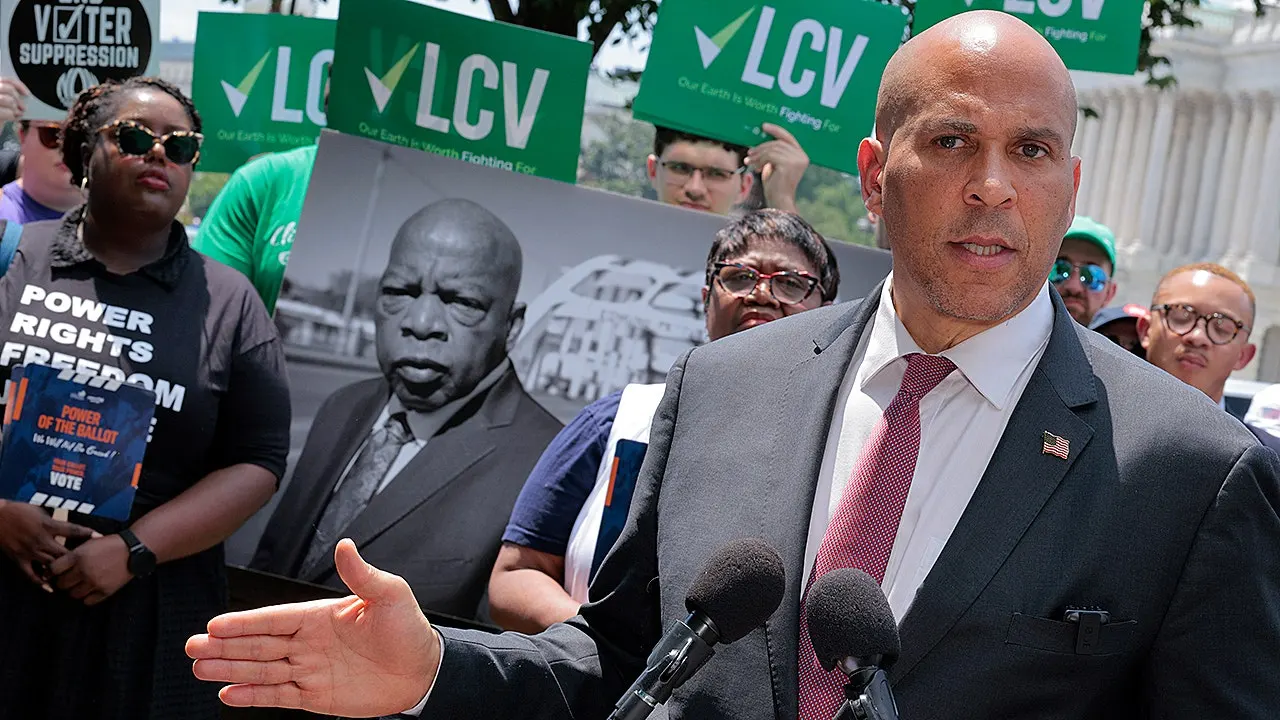
The redistricting battle has drawn national attention, with Sen. Cory Booker (D-N.J.) traveling to Birmingham to join Alabama’s lone Democratic representative, Terri Sewell, in opposing the Republican-led effort. At a redistricting town hall, Booker declared that voting rights are on the ballot and characterized the Supreme Court’s recent decisions as undoing decades of progress made by Alabamians.
Alabama House Speaker Nathaniel Ledbetter, R-Rainville, dismissed Booker’s involvement, telling Fox News Digital: “Well, I’m probably guessing that’s first time Cory Booker’s ever been in Alabama. The thing about it is the people that we represent have lived here most of all of their lives and they’re the ones that ask us to do something for them — not the Cory Bookers.”
The controversy stems from a series of legal battles over Alabama’s congressional districts. Last year, the Supreme Court’s decision in Allen v. Milligan forced the state to redraw its map, resulting in a court-imposed plan that shifted the state’s delegation from a 6-1 Republican advantage to a 5-2 split after Democrats flipped a district.
Republicans had previously created what became known as the “Livingston map,” named after State Senator Steve Livingston, R-Scottsboro, which gave minority districts with 55% and 40% representation respectively. That map was rejected by the courts at the time.
However, the Supreme Court’s recent ruling striking down Louisiana’s congressional map has emboldened Alabama Republicans. That decision rejected a map where race was considered a significant factor in drawing districts represented by Democratic Representatives Cleo Fields and Troy Carter.
Ledbetter argues the Livingston map should now be revisited and upheld by the Supreme Court in line with its more recent Louisiana ruling. “If we did nothing, we had no shot, and doing this gives us the opportunity to have a ball in the air in case they do overturn [Milligan],” he said.
Governor Kay Ivey has called the legislature into special session to create plans for potentially adjusting upcoming primary elections if the state succeeds in forcing the redistricting issue before the Supreme Court. In a statement, Ivey said Alabama has been battling “federal courts and activist groups who think they know Alabama better than Alabama” since the 2020 census.
“By calling the Legislature into a special session, I am ensuring Alabama is prepared should the courts act quickly enough to allow Alabama’s previously drawn congressional and state Senate maps to be used during this election cycle,” she added.
The timeline is extremely tight, as Alabama’s primaries are scheduled for May 19. Secretary of State Wes Allen has stated that regardless of what happens in the special session, that date cannot be changed, adding urgency to the Republicans’ efforts.
Ledbetter defended the Livingston map as fair, claiming it actually gives all voting blocs a better opportunity under today’s population distribution. “When that was redistricted that was a 50-50 seat,” he said of one of the Democrat-friendly districts on the map. “It gives everybody a shot and it’s got all seven seats open.”
The House Speaker also criticized national Democrats for attempting to influence redistricting in various states, arguing that Alabamians elected a Republican supermajority in Montgomery and want that reflected in Congress. “I don’t think it’s right for the courts to overstep their boundary and try to do legislation,” he concluded.
With both sides digging in, the Supreme Court would have approximately one week to intervene ahead of the May 19 primary, ensuring that national attention remains focused on Alabama as this latest chapter in the ongoing redistricting battles plays out.
Fact Checker
Verify the accuracy of this article using The Disinformation Commission analysis and real-time sources.

18 Comments
The redistricting debate in Alabama highlights the ongoing challenges in balancing representation and compliance with legal standards. I hope the state’s leaders can find a solution that upholds democratic principles.
While I respect Speaker Ledbetter’s perspective, I think it’s valuable for elected officials from outside the state to lend their voice to important civil rights discussions. Open dialogue is crucial.
Redistricting is a complex and often contentious issue, and I appreciate the engagement of both state and national leaders in the debate in Alabama. It’s crucial that the process remains transparent and that the interests of all constituents are fairly considered.
The Supreme Court’s recent rulings on redistricting have certainly changed the legal landscape, and I’m curious to see how that will impact the outcome in Alabama. I hope the state’s leaders can find a balanced solution that upholds democratic principles.
As an unbiased observer, I’m curious to learn more about the Supreme Court’s recent rulings on redistricting and how they’ve changed the legal landscape. It’s a nuanced topic worth exploring from multiple perspectives.
Voting rights are indeed a critical issue, and I appreciate Sen. Booker’s engagement on the matter. However, I think it’s important to consider all stakeholders and avoid partisan rhetoric.
Redistricting is a complex issue with significant implications for voter representation. I encourage all parties involved to approach this matter with nuance, civility, and a commitment to upholding democratic ideals.
It will be interesting to see how the Supreme Court’s recent rulings on redistricting play out in Alabama’s case. I hope the process remains transparent and that the interests of all constituents are fairly considered.
Redistricting is a complex and often contentious process, and I’m glad to see both state and national leaders actively engaged in the debate in Alabama. It’s crucial that all voices are heard and that the final outcome upholds democratic principles.
The Supreme Court’s recent rulings on redistricting have certainly changed the legal landscape, and it will be interesting to see how that plays out in Alabama’s case. I hope the process remains transparent and that the interests of all constituents are fairly considered.
The redistricting debate in Alabama highlights the ongoing challenges in balancing representation and compliance with legal standards. I encourage all parties involved to approach this matter with nuance, civility, and a commitment to upholding democratic ideals.
While I respect Speaker Ledbetter’s perspective, I believe it’s valuable for national figures like Sen. Booker to lend their voice to these important discussions. Voting rights are fundamental to a healthy democracy, and open dialogue is crucial.
The redistricting battle in Alabama is a complex issue with valid arguments on both sides. It’s important to carefully consider the legal and historical context as well as the potential impacts on minority representation.
Regardless of political affiliation, ensuring fair and equal voting rights should be a top priority. I hope the parties can find a solution that upholds democratic principles.
The redistricting battle in Alabama is a prime example of the ongoing challenges in ensuring fair and equitable representation. I encourage all parties involved to approach this matter with nuance, civility, and a commitment to upholding democratic ideals.
While I respect Speaker Ledbetter’s perspective, I believe it’s valuable for national figures like Sen. Booker to lend their voice to these important discussions. Voting rights are fundamental to a healthy democracy, and open dialogue is crucial.
The redistricting debate in Alabama highlights the ongoing tension between partisan interests and the need for fair and equitable representation. I hope the state’s leaders can find a balanced solution that upholds democratic principles.
While I appreciate Speaker Ledbetter’s perspective, I think it’s valuable for national figures like Sen. Booker to engage on these issues. Voting rights are fundamental to a healthy democracy.