


Listen to the article
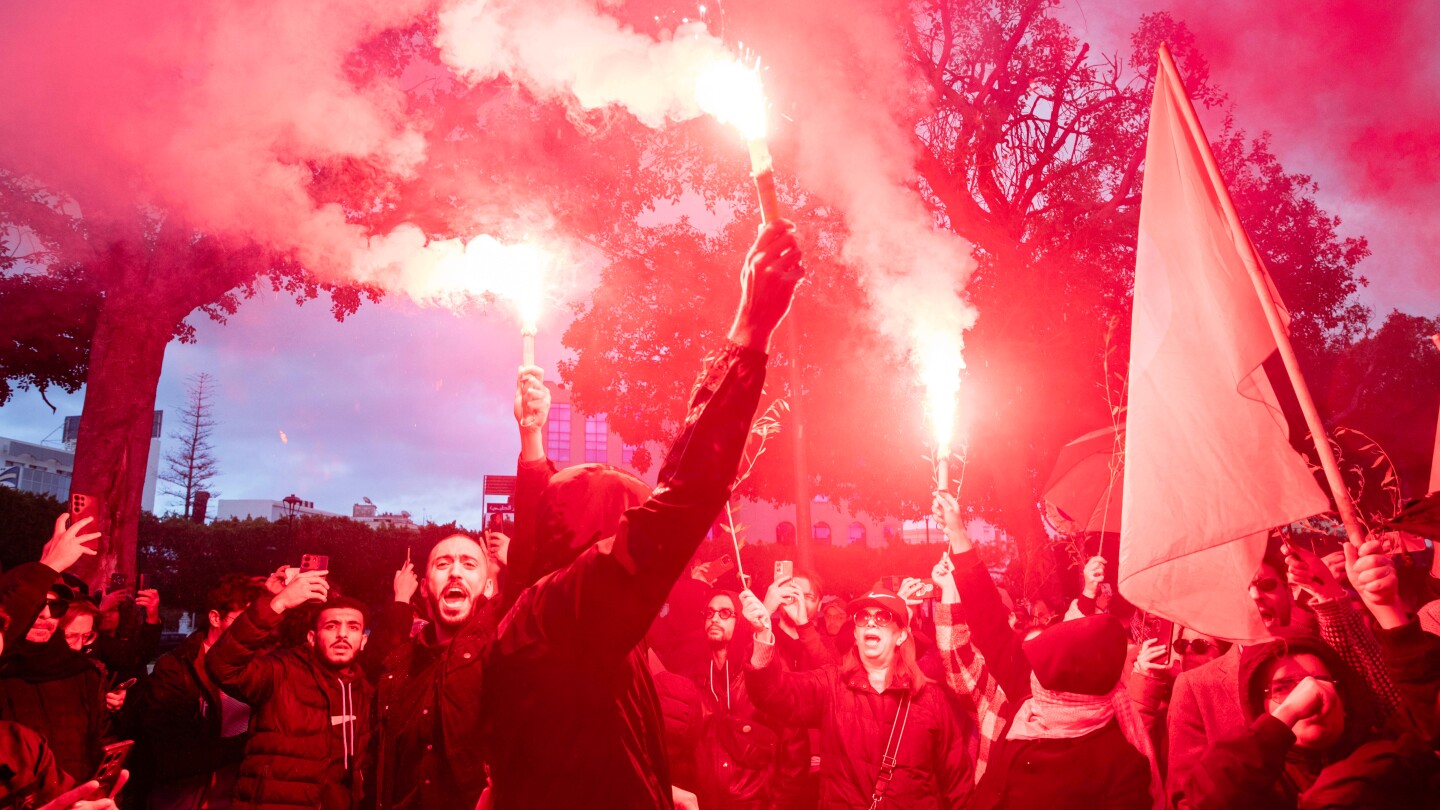
Thousands of Tunisians gathered in downtown Tunis on Saturday to protest against what they described as President Kais Saied’s increasingly authoritarian rule, demanding the release of political prisoners and an end to government repression.
The demonstration, organized under the banner “Against Injustice,” brought together more than 1,000 protesters from diverse ideological backgrounds, including families of detained political figures and civil society activists.
Demonstrators, many dressed in black, chanted anti-regime slogans that echoed those heard during the 2011 Arab Spring revolution that toppled longtime dictator Zine El Abidine Ben Ali. “The people want to overthrow the regime,” “What a great country! Oppression and tyranny!” and “No fear, no terror, the street belongs to the people,” reverberated through the capital’s streets.
Ayoub Amara, one of the protest organizers, told reporters that the demonstration aimed to spotlight the plight of those imprisoned for their political opinions. He emphasized that the protest addressed broader grievances, including environmental concerns in the phosphate-producing city of Gabes and arbitrary arrests under Tunisia’s anti-terrorism laws.
“All the progress of the past 14 years has been overturned,” Amara said, referring to democratic gains made since the 2011 revolution. “Tunisia is big enough for all Tunisians, and no single person can rule it according to his whims.”
The protest comes amid mounting tension in Tunisia, as President Saied has consolidated power since July 2021, when he suspended parliament and seized control of all branches of government in what critics describe as a constitutional coup. Saied has defended his actions as necessary to root out corruption, eliminate what he calls “traitors,” and restore state institutions.
Among those attending Saturday’s demonstration was Monia Brahim, wife of jailed opposition figure Abdelhamid Jlassi. “I came to defend my rights as a citizen,” she told The Associated Press. “Political prisoners know for a fact that they are in prison to pay the price for their principles, their constitutional right for civil and political activism, and are being held hostage by the regime established today in Tunisia.”
The demonstration highlighted growing concern for detained political figures, including constitutional law professor Jawher Ben Mbarek, who has been on hunger strike for over 20 days. His case has become emblematic of what rights advocates describe as a systematic campaign to silence opposition voices.
Saturday’s protest follows a demonstration by Tunisian journalists on Thursday against the widening crackdown on press freedom and the temporary suspension of several prominent civil society organizations. Protesters have consistently called out Saied’s interference in the judiciary and accused him of using police powers to target political opponents.
Human Rights Watch has sounded the alarm about Tunisia’s deteriorating human rights situation, reporting that over 50 individuals – including politicians, lawyers, journalists, and activists – have been subjected to arbitrary arrest or prosecution since late 2022 for exercising their rights to freedom of expression, peaceful assembly, or political activity.
The rights organization has warned that Saied’s government is increasingly using broad anti-terrorism and cybercrime laws to criminalize dissent and restrict free speech – tactics reminiscent of the pre-2011 era under Ben Ali’s authoritarian rule.
Tunisia, once hailed as the Arab Spring’s sole democratic success story, has seen its economy deteriorate significantly under Saied’s leadership. The country faces high unemployment, rising inflation, and shortages of essential goods, further fueling public discontent.
The convergence of political repression and economic hardship has led to what many observers describe as the most significant challenge to Saied’s rule since his 2021 power grab, as protests continue to gain momentum across the North African nation.
Fact Checker
Verify the accuracy of this article using The Disinformation Commission analysis and real-time sources.

18 Comments
This is a concerning development in Tunisia. Protesters’ demands for political freedoms and the release of prisoners seem justified, but the government’s crackdown is worrying. I hope the situation can be resolved peacefully and through dialogue.
Agreed, the erosion of civil liberties is troubling. The government should listen to the people’s grievances and find a constructive path forward.
The images of the protests are powerful. It’s clear the Tunisian people feel strongly about defending their freedoms and rights. I hope a peaceful resolution can be found.
This situation bears close watching. The struggle for democracy and human rights in Tunisia is far from over, and the international community should continue to pressure the government to respect civil liberties.
Absolutely. The gains made after the Arab Spring must be protected. I hope the Tunisian people are able to peacefully assert their rights and that the government responds with restraint and dialogue.
Anti-terrorism laws are often used as a pretext to suppress dissent. I hope the Tunisian government is not abusing such laws to target political opponents and activists unjustly.
The diversity of the protesters, from families of detainees to civil society groups, suggests this is a broad-based movement against the president’s actions. That makes it harder for the government to dismiss.
Good point. The unity of the opposition is a strength, and the government will have a hard time painting this as just a fringe group. Broad-based popular discontent is difficult to ignore.
The chants of the protesters, echoing the 2011 revolution, underscore the depth of public sentiment against the government’s actions. This is a critical moment for Tunisia’s democratic future.
The phosphate industry and environmental concerns in Gabes are interesting angles to this story. I wonder how those local issues factor into the broader political unrest.
Good point. Environmental justice is often closely tied to broader human rights and governance issues. The government should address all of the protesters’ legitimate grievances.
Phosphate production and environmental issues in Gabes are an interesting angle. Resource extraction often intersects with broader political and social tensions. I wonder how those local concerns factor into the nationwide protests.
That’s a good point. Environmental justice and resource governance are frequently at the heart of political unrest. The government would be wise to address those local grievances as part of a broader effort to resolve the crisis.
It’s crucial that Tunisia upholds the hard-won democratic gains of the Arab Spring. Peaceful protest is a fundamental right, and the government must respect that rather than resorting to repression.
Absolutely. The Tunisian people deserve to have their voices heard, not silenced. I hope the international community closely monitors this situation.
This crackdown seems to be part of a worrying global trend of authoritarianism on the rise. I hope the Tunisian people are able to preserve the democratic progress made after the Arab Spring.
Tunisia was once seen as a success story of the Arab Spring, but this backsliding on civil liberties is very concerning. The government must respect the will of the people.
Agreed. Tunisia’s democratic transition was hard-won, and it would be a shame to see that progress unravel. I hope the international community applies pressure to uphold human rights.