


Listen to the article
“Hamnet” Stars Find Profound Connection in Shakespeare’s Personal Loss
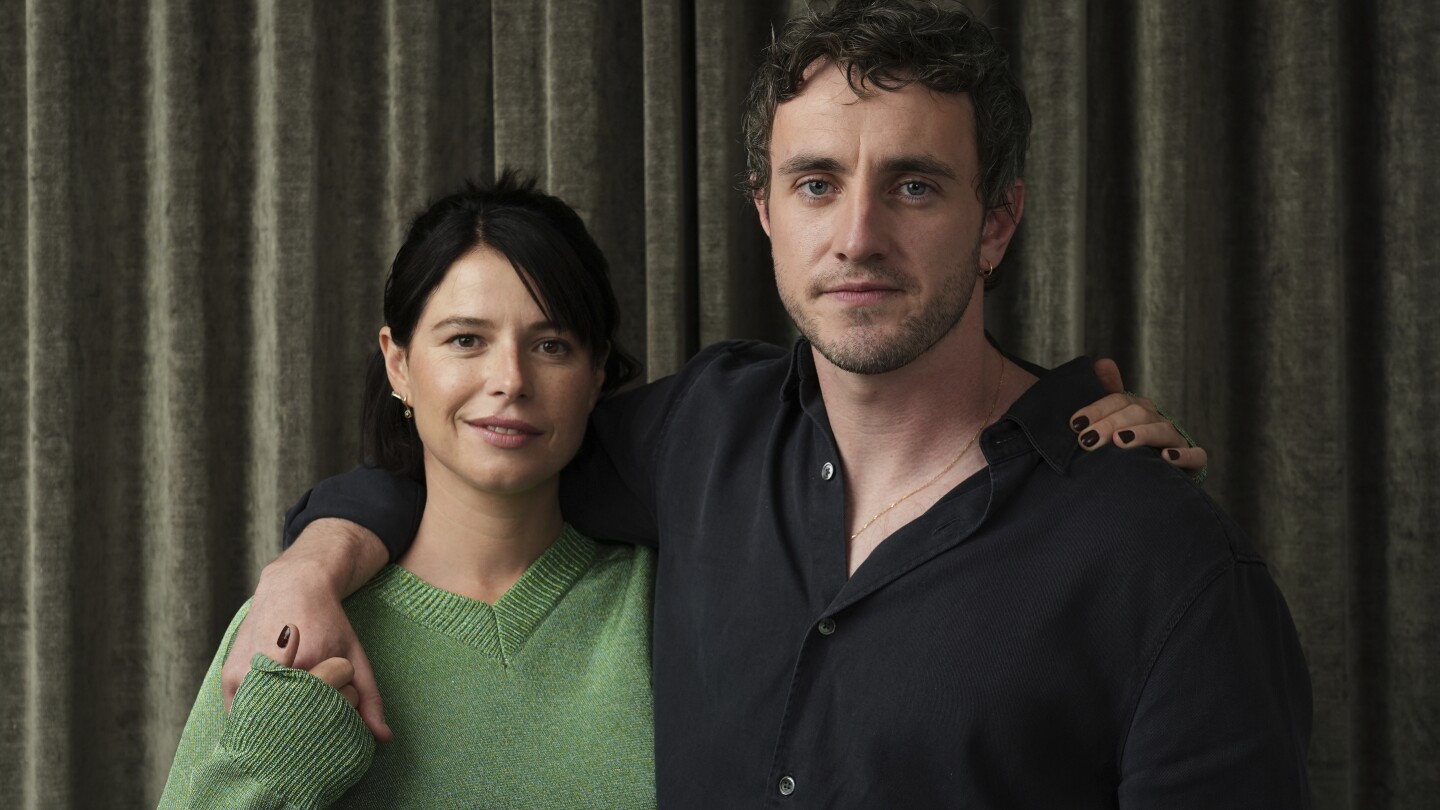
In the emotionally charged final scene of “Hamnet,” actors Jessie Buckley and Paul Mescal faced a physical obstacle: the camera blocked their view of each other. “We were like: ‘No, we have to see each other,'” Buckley recalls. When they finally made eye contact, Mescal laughs, it was both overwhelming and “glorious.”
That moment epitomizes the remarkable connection at the heart of Chloé Zhao’s new film opening Wednesday in theaters. “Hamnet” adapts Maggie O’Farrell’s acclaimed 2020 novel, creating a fictional yet historically grounded portrayal of William Shakespeare and his wife, Agnes. The film explores the 1596 death of their 11-year-old son Hamnet and its influence on Shakespeare’s subsequent masterpiece, “Hamlet” – names scholars note were essentially interchangeable in 16th-century England.
The film examines how profound personal loss might have inspired one of literature’s most enduring works, but at its core, it’s a portrait of a marriage weathering grief and artistic creation. It’s also, fundamentally, about seeing and being seen. Both William and Agnes are introduced as misunderstood outsiders – he dismissed as “a pasty-faced scholar,” she branded a “forest witch.” Their relationship bridges these gaps of isolation through love in the film’s first half and art in its devastating final act.
Critics have praised Buckley’s and Mescal’s performances as among the year’s best, with Oscar nominations widely anticipated for both. Though they briefly appeared in separate timelines in Maggie Gyllenhaal’s “The Lost Daughter” (2021), “Hamnet” marks their first true on-screen collaboration.
“We entered the film at the perfect juncture,” Mescal explains. “I had huge respect for Jessie and loved spending time with her, but we were also at the point where we didn’t know each other all that well. So there was a kind of mystery.”
The chemistry between them was evident from the start. Zhao arranged a chemistry read that proved immediately unnecessary. “We’d forget that we were saying lines,” Mescal recalls. Buckley adds, “There was such a kinetic energy already between us. It just felt so possible.”
Their artistic partnership deepened throughout production. “I’m sure there will be someone at Oxford who’ll be like, ‘He would have spoken with a weird hybrid accent because of the time period,'” Mescal jokes about his portrayal of Shakespeare. “OK, whatever. I don’t care.”
Instead, both actors sought deeper truths by bringing themselves to their roles. Zhao, the Oscar-winning director of “Nomadland,” challenged them to play “extreme masculine and extreme feminine” while remaining grounded in authentic humanity.
“What Chloé wants you to do is move somewhere deeper within yourself to meet the person you’re going to come to understand,” Buckley explains. “It’s not about masks. If anything, it’s about becoming more human and pulling off a layer of skin that you’ve maybe kept around yourself too tightly.”
Zhao’s approach included daily meditations with the cast – three deep breaths before filming began, a practice she’s maintained at screenings. This contemplative atmosphere helped foster the emotional intimacy required for the film’s most powerful moments.
“Hamnet” reaches its extraordinary climax during a performance of “Hamlet” at the Globe Theatre, a sequence that has already become one of the year’s most discussed cinematic moments. Yet achieving this emotional crescendo proved challenging.
“To be completely honest, we had gone on this ginormous, epic journey of the heart. We got to the Globe. I had not a clue what to do. I was totally lost. I think Chloé was lost,” Buckley admits. Production faced further obstacles when rainstorms flooded the Globe for two days.
A breakthrough came when Buckley heard composer Max Richter’s “On the Nature of Daylight” on her playlist and shared it with Zhao. “Sometimes as an actor, you feel like you have to do it yourself,” Buckley says. “I realized on the third day how everyone around me was crucial. It became about surrendering to the community of feeling.”
The film’s power comes partly from its suggestion that all art, even something as monumental as “Hamlet,” springs from deeply personal experiences. Rather than portraying Shakespeare as a walking repository of eloquent verses, Mescal’s interpretation shows “someone who wanted to escape his life and love his life at the same time.”
The experience has forged a lasting bond between the two Irish actors, who have already committed to working together again. “I feel like we’re going to meet each other at pinnacles of our lives and help each other unravel the next layer,” Buckley reflects.
Mescal agrees: “Hands down, it was one of the most important collaborations that I’ve ever had. It’d be insane for that to be the only time we did it.”
For Buckley, the film’s impact extends beyond their personal connection to illuminate the universal purpose of storytelling: “Why we go to the cinema, why we go to the theater, why we tell stories is for these places to contain the parts of ourselves that are too hard to hold by ourselves.”
Standing at the edge of the Globe’s stage during that pivotal scene, Buckley experienced something transcendent: “I could just feel a tsunami of 300 people behind me opening up their hearts.”
Fact Checker
Verify the accuracy of this article using The Disinformation Commission analysis and real-time sources.

10 Comments
I’m curious to learn more about the historical context and how the film portrays the lives of Shakespeare and his family during that time period. Exploring the interplay of art and personal tragedy is always compelling.
The snippet suggests the film delves into the nuances of their marriage and the influence of Hamnet’s death. It will be interesting to see how the filmmakers handle that sensitive subject matter.
It’s remarkable how the film seems to capture the raw emotion and intimacy of such a personal tragedy for the Shakespeare family. Exploring the creative process through the lens of grief must have been a delicate balance for the filmmakers.
The challenge of bringing Shakespeare’s private life to the screen while respecting the historical details must have been considerable. I’m interested to see how they handle that balance.
As a fan of Shakespeare’s work, I’m intrigued by this take on the inspiration behind ‘Hamlet’. The idea of exploring the personal loss that may have shaped one of literature’s greatest plays is quite compelling.
The connection between Hamnet and Hamlet is a fascinating historical detail. I wonder how the film will dramatize that link and Shakespeare’s creative process.
As someone with a background in literature, I’m intrigued by the prospect of this film delving into the emotional and psychological underpinnings of Shakespeare’s most famous work. The personal tragedy at the heart of it all adds an additional layer of complexity.
Agreed, the connection between Hamnet’s death and the creation of ‘Hamlet’ is a compelling narrative hook. I’m curious to see how the filmmakers explore that intersection of art and life.
Fascinating to see how the personal loss of Shakespeare inspired such an iconic work of literature. It’s a profound exploration of grief, marriage, and the creative process.
Agreed, the emotional connection between Buckley and Mescal must have been powerful to capture that depth of feeling on screen.