


Listen to the article
In a quiet corner of western Japan, a century-old culinary tradition with European roots has become an unexpected national treasure. Baumkuchen, a ring-shaped cake originating in Germany, has transformed into a beloved Japanese confection symbolizing longevity and prosperity, with a history deeply intertwined with Japan’s tumultuous past.
The journey of this distinctive dessert—known as “tree cake” for its concentric rings resembling tree trunks—began during World War I on Ninoshima, a small island just a 20-minute ferry ride from Hiroshima. Today, making Baumkuchen has become one of the island’s most popular tourist activities, drawing visitors to the Juccheim Ninoshima Welcome Center built over the site of a former prisoner of war camp.
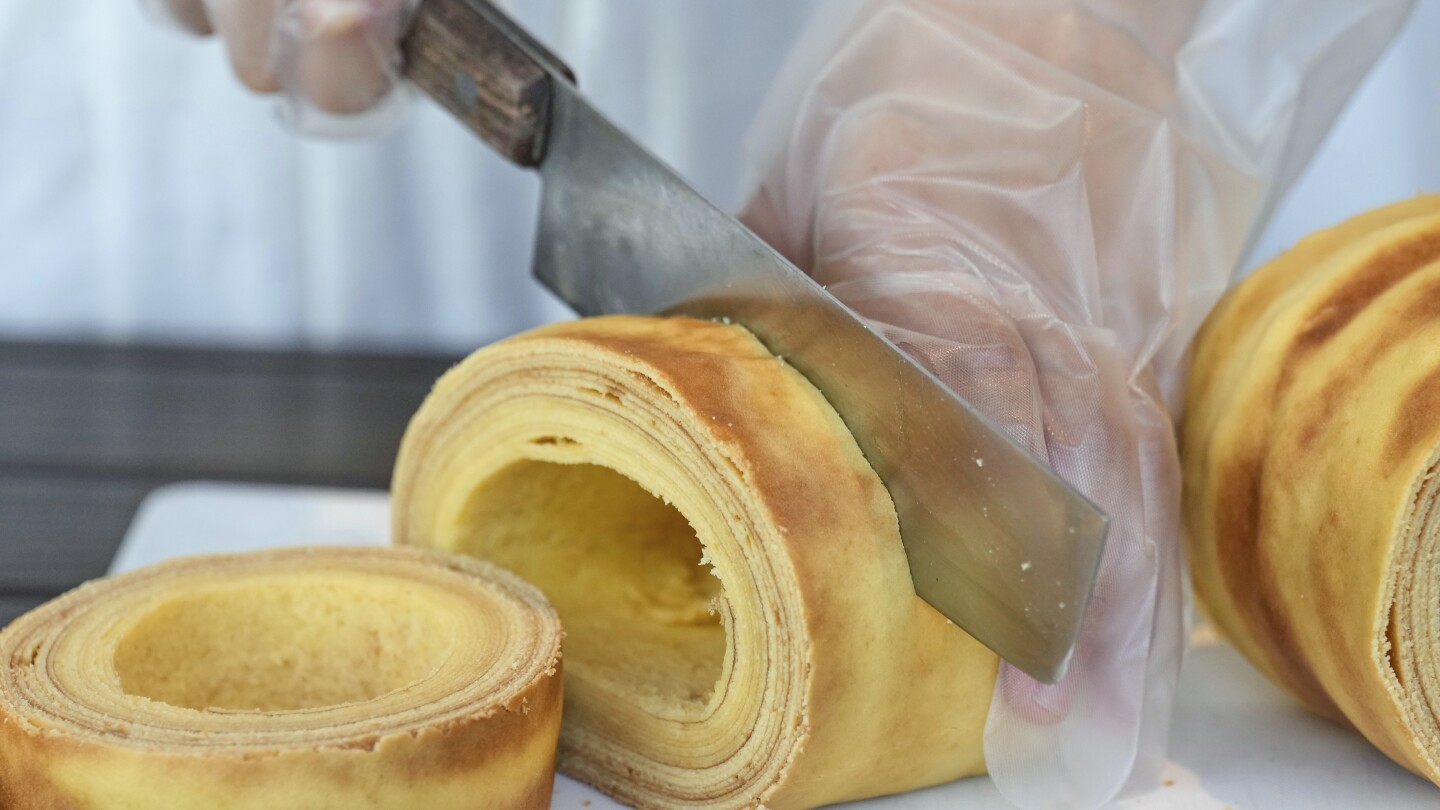
At the outdoor center, amateur bakers can experience the traditional method of creating the cake: pouring batter onto a bamboo pole and roasting it over charcoal. As each layer turns light brown, another is added, gradually forming the cake’s characteristic rings while filling the air with a sweet, inviting aroma.
This meticulous process mirrors the technique pioneered by Karl Juchheim, a German confectioner who first introduced Baumkuchen to Japan while imprisoned on Ninoshima over a century ago. Juchheim had been running a bakery in Qingdao, China—then a German territory—when Japanese forces captured him in 1915. He arrived on Ninoshima in 1917 alongside approximately 500 other German prisoners.
“The German prisoners at Ninoshima were given a certain degree of freedom and allowed to cook,” explains Kazuaki Otani, head of the welcome center. This relative liberty allowed Juchheim to experiment with his confectionery skills, developing the recipe that would later become his legacy.
When World War I concluded in 1918, Juchheim was among roughly 200 German POWs who chose to remain in Japan rather than repatriate. In March 1919, he formally introduced Baumkuchen to the Japanese public at the Hiroshima Prefectural Products Exhibition. Historical records indicate the handcrafted cake was an immediate sensation, drawing enthusiastic crowds.
Following this success, Juchheim established a pastry shop in Yokohama near Tokyo in 1922. However, his business faced a devastating setback when the Great Kanto Earthquake of 1923—one of Japan’s most destructive natural disasters—destroyed his establishment. Undeterred, Juchheim relocated to Kobe in western Japan, where he opened a coffee shop specializing in his signature cake.
Even as Japan’s military expansion intensified and hostilities grew during World War II, Juchheim continued his work. Tragedy struck again when U.S. firebombings leveled his Kobe shop just two months before the war’s conclusion. Despite these hardships, the business persevered with support from his wife Elise and dedicated Japanese staff.
In a poignant historical coincidence, Juchheim died from illness at a Kobe hotel on August 14, 1945—just one day before Japan announced its surrender, ending World War II. The atomic bombings of Hiroshima and Nagasaki days earlier had killed over 210,000 people by year’s end.
“His baking was an expression of his wish for peace,” Otani reflects. “By sharing with visitors what things were like back then, I hope it gives people an opportunity to reflect on peace.”
Today, Juchheim Co., Ltd. continues operating as one of Japan’s premier confectioners. The company’s legacy extends far beyond its founder, as Baumkuchen has been thoroughly embraced by Japanese culture. Modern Japanese versions incorporate local ingredients like matcha green tea and sweet potatoes, while maintaining the cake’s distinctive appearance.
The confection now occupies a special place in Japanese traditions, frequently presented as gifts at weddings and birthdays. Luxury department stores sell elegantly boxed versions, while individually wrapped, smaller portions can be found in convenience stores across the country. Baumkuchen festivals are regularly held nationwide, celebrating this unexpected cultural exchange that flourished despite—or perhaps because of—the tumultuous circumstances of its introduction.
Fact Checker
Verify the accuracy of this article using The Disinformation Commission analysis and real-time sources.

4 Comments
It’s wonderful to see how this German dessert has become an integral part of Japanese culture and identity. The fact that it’s now a popular tourist attraction on Ninoshima Island speaks to its enduring appeal and importance. Food really does have the power to bring people together across borders.
The traditional Baumkuchen-making process sounds quite labor-intensive but also fascinating. I’d love to try my hand at pouring the batter and watching the layers build up. It must be very rewarding to create such a visually stunning cake.
Baumkuchen’s journey from Germany to Japan is quite a remarkable story. I’m curious to learn more about how the recipe and techniques were adapted to suit Japanese tastes and preferences over the years. The blend of European and Asian influences must create a truly unique flavor profile.
What an interesting story! I had no idea Baumkuchen had such a rich history, surviving wars and transforming into a beloved Japanese treat. It’s amazing how food traditions can cross cultures and endure over time.