


Listen to the article
Scientists in Geneva successfully transported antiprotons by road for the first time on Tuesday, marking a significant milestone in antimatter research. The European Organization for Nuclear Research (CERN) moved 92 antiprotons in a specially designed vacuum container, suspended by supercooled magnets to prevent any contact with ordinary matter.
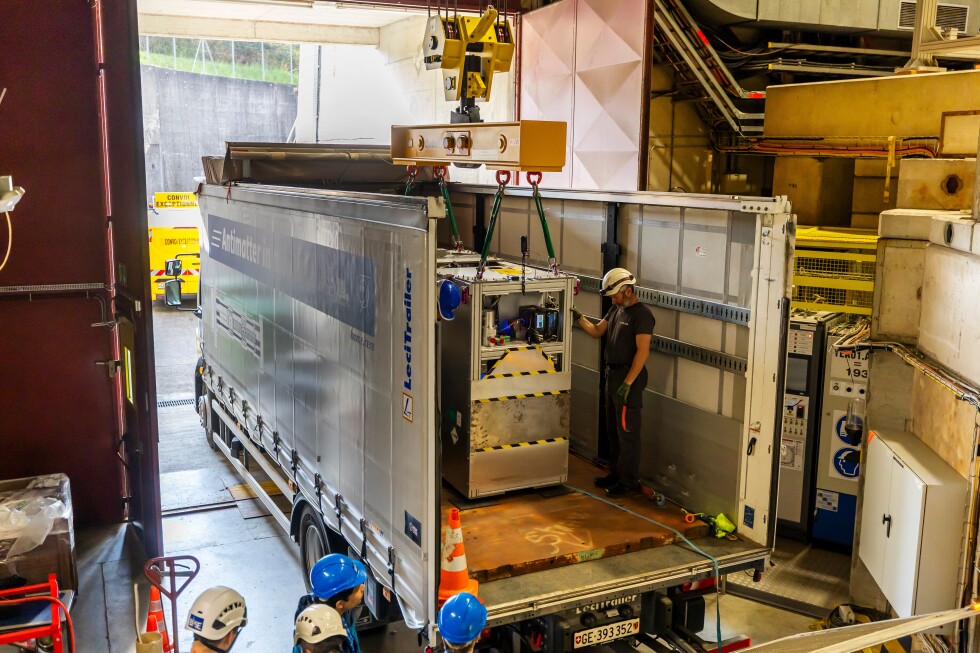
The delicate operation required extreme precision, as any contact between the antiprotons and regular matter would have resulted in immediate annihilation, releasing energy in a quick flash. The nearly 1,000-kilogram (2,200-pound) cryogenic box was carefully craned and loaded onto a truck for a 30-minute test drive around CERN’s campus.
“Transporting antimatter is a pioneering and ambitious project,” said Gautier Hamel de Monchenault, CERN’s director for research and computing. “We are at the beginning of an exciting scientific journey that will allow us to further deepen our understanding of antimatter.”
The successful test represents the first step toward the ultimate goal of transporting antiprotons to research facilities abroad, particularly Heinrich Heine University in Düsseldorf, Germany, approximately eight hours away by road. Such relocations would allow for more precise measurements and experiments.
“We are scientists. We want to understand something about the fundamental symmetries of nature, and we know that if we do these experiments outside of this accelerator facility, we can measure 100 to 1,000 times better,” explained Stefan Ulmer, the leader and spokesperson for Tuesday’s test run.
Antimatter remains one of physics’ greatest mysteries. For every particle that exists, there is a corresponding antiparticle with matching properties but opposite charge. When matter and antimatter meet, they annihilate each other, releasing energy. Despite comprising half the universe at creation, antimatter is now exceptionally rare, making its study challenging but crucial for understanding fundamental physics.
The antiprotons were contained in a “transportable antiproton trap” compact enough to fit through standard laboratory doors and onto a truck. The container used superconducting magnets cooled to an extreme -269 degrees Celsius (-452 Fahrenheit), creating a vacuum environment that kept the antiprotons suspended without touching the container’s inner walls.
The quantity of antimatter transported was minuscule—roughly equivalent to the mass of 100 hydrogen atoms. Even in a worst-case scenario where all antiprotons escaped and contacted matter, the energy release would be so small that only specialized equipment could detect it. To put this in perspective, Ulmer noted that a single grain of salt contains approximately 10^18 (a billion billion) particles, while they transported just about 100.
Challenges remain before long-distance transport becomes routine. Currently, the trap can sustain the antiprotons for only about four hours before they dissipate, while the journey to Düsseldorf requires approximately eight hours of driving time.
Professor Tara Shears, an experimental particle physicist from the University of Liverpool, emphasized the significance of this advancement: “Antimatter is one of the biggest mysteries that we have in science. We haven’t been able to study it very much, but it holds the keys to our understanding of why the universe is like it is.”
Oxford University physicist Alan Barr added that modern science requires increasingly precise experiments to detect subtle differences between matter and antimatter, making transportable antimatter particularly valuable for specialized laboratories.
CERN’s “Antimatter Factory” remains the world’s only facility capable of storing and studying antiprotons. The center produces antiprotons by firing proton beams into metal blocks, generating collisions that create secondary particles including antiprotons. The facility has already achieved breakthroughs in measuring, storing, and studying antimatter interactions.
Heinrich Heine University is developing a dedicated center to receive and study these antiprotons, with completion expected no earlier than 2029. The university offers advantages over CERN for detailed antimatter research, as CERN’s numerous activities generate magnetic interference that can compromise precise antimatter measurements.
This achievement adds to CERN’s impressive scientific legacy, which includes the Large Hadron Collider and Tim Berners-Lee’s invention of the World Wide Web in 1989, along with advances in touch screen technology and cancer treatment tools.
Fact Checker
Verify the accuracy of this article using The Disinformation Commission analysis and real-time sources.

11 Comments
Wow, transporting antimatter by road – that’s quite an accomplishment! CERN is really pushing the boundaries of what’s possible in this field.
Moving antimatter by road – who would have thought! CERN’s engineers have really pushed the boundaries of what’s possible. I can’t wait to see where this leads.
Sending antiprotons to research facilities abroad like Düsseldorf will open up so many new research avenues. This is an exciting step forward.
This is a fascinating milestone in antimatter research. Transporting such a delicate material like antiprotons with such precision is quite an impressive technical achievement.
I’m curious to see how this capability will enable further breakthroughs in our understanding of antimatter and its potential applications.
Antimatter research is truly on the cutting edge of science. Hats off to the CERN team for achieving this milestone – it must have required immense technical expertise.
I’m curious to learn more about the cryogenic container and magnetic suspension system they used. The engineering involved must be quite remarkable.
This successful test is an important step toward expanding antimatter research globally. I’m eager to see how this capability enables new discoveries.
Sending antiprotons to facilities like the one in Düsseldorf will open up so many new research possibilities. This is an exciting development.
Safely transporting antimatter is no easy task, so kudos to the CERN team for pulling this off. It’s a real testament to their technical expertise.
Transporting antimatter safely is no easy feat. CERN deserves credit for pulling this off with such precision. This could be a real game-changer for the field.