


Listen to the article
French Museum Unveils Gallery for Nazi-Looted Art, Confronting Historical Silence
A poignant painting of two children gazing across the Normandy coast now hangs in a groundbreaking new gallery at Paris’s Musée d’Orsay. The artwork, created by Belgian artist Alfred Stevens, once belonged to Adolf Hitler’s vast collection of plundered art before being recovered by Allied forces after World War II.
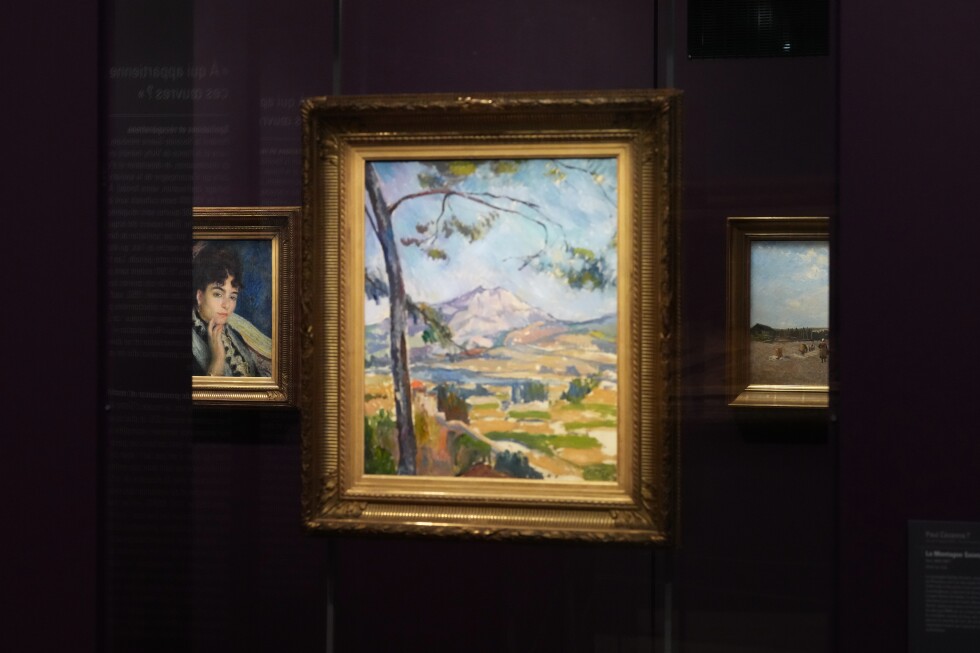
On Tuesday, this piece and other masterworks with similarly troubling histories found a permanent home in the museum’s first-ever gallery dedicated to what French officials call “MNR artworks” – Musées Nationaux Récupération, or National Museums Recovery. These are paintings recovered from Nazi Germany after 1945 whose rightful owners were never identified.
“I have seen those three letters – M, N, R – at the Louvre. I never knew what they meant. I thought it was a donor,” said Marie Duboisse, a retired schoolteacher from Lyon who paused to examine the Stevens painting during the gallery’s opening.
What distinguishes this exhibition is its transparency about the artwork’s troubled provenance. For the first time, paintings are displayed so visitors can see their backs – revealing stamps, labels and inventory marks that document how these pieces moved from private homes into Nazi hands during the Holocaust.
The Stevens painting exemplifies this dark journey. Initially earmarked for Hitler’s planned museum in Linz, Austria, it was later reassigned to his mountain retreat in Bavaria. Following Germany’s defeat, the “Monuments Men” – Allied art recovery specialists immortalized in George Clooney’s 2014 film – found the painting, but no heir ever came forward to claim it.
The Orsay gallery displays 13 such works from its collection of 225 MNR pieces. Throughout France, approximately 2,200 artworks share this status – recovered after the war and entrusted to French museums in the 1950s while awaiting identification of their rightful owners. The state doesn’t own them but holds them in trust for heirs who might still emerge.
Last month, the museum launched its first dedicated research unit to trace these orphaned artworks’ rightful owners. Six Franco-German researchers, led by Ines Rotermund-Reynard, the Orsay’s head of provenance research, now methodically investigate each piece’s history.
“All of this is part of the history of the Shoah,” said Rotermund-Reynard, using the Hebrew word for Holocaust. “When you try to understand this drive to take from Jewish families, it is part of the terrifying Nazi ideology to erase Jewish life.”
The gallery represents France’s belated reckoning with one of the longest silences in its postwar memory: the systematic looting of art during the Nazi occupation and the complicity of French officials and art dealers in the process.
This national conversation began in earnest during the late 1960s, when historians and documentarians started exposing the Vichy government’s collaboration with Nazi Germany – including its role in deporting 80,000 Jews from France to their deaths and facilitating a Paris art market that profited from stolen property.
A watershed moment came in July 1995, when President Jacques Chirac acknowledged, for the first time, that the French state bore responsibility for the 1942 Vél d’Hiv roundup, when thousands of Paris Jews were arrested before deportation. Two years later, France launched a national inquiry into wartime art plundering.
The scale of the theft was staggering. Approximately 100,000 cultural objects were looted from France during the war. While 60,000 were recovered and 45,000 returned to their owners, some 15,000 had no identified owner. The 2,200 MNR artworks were selected from this remainder.
For decades, these works represented a dormant file in France’s cultural conscience. Between 1954 and 1993, the country returned only four such pieces. Since Chirac’s public acknowledgment and the subsequent national reckoning, the pace has accelerated. The Orsay alone has returned 15 artworks since 1994, with the most recent – pieces by Alfred Sisley and Auguste Renoir – going to the heirs of Grégoire Schusterman in 2024.
The exhibition illustrates how Paris became the epicenter of Nazi art plundering. As Western Europe’s richest art hub in the early 20th century, the city’s Hôtel Drouot auction house reopened in autumn 1940 and operated throughout the occupation, with French dealers serving as conduits for looted art.
“The most important art market in Europe was concentrated in Paris,” Rotermund-Reynard explained. “The moment the Nazis arrived in occupied territory, they had enormous buying power. They threw themselves at the market.”
German museums eagerly dispatched buyers to expand their collections, while Hitler himself planned the world’s largest museum in Linz. His deputy, Hermann Göring, made 21 trips to Paris during the occupation specifically to acquire works taken from Jewish collectors.
The gallery’s opening comes at a time when antisemitic acts in France – home to Europe’s largest Jewish community – reached near-record levels in 2025, with 1,320 incidents reported by the French Interior Ministry.
While not built explicitly to combat antisemitism, the gallery acknowledges historical wrongs that still demand redress. As François Blanchetière, the Orsay’s chief sculpture curator and co-curator of the gallery, stated: “There is no statute of limitations on these crimes.”
Fact Checker
Verify the accuracy of this article using The Disinformation Commission analysis and real-time sources.

7 Comments
Seeing the backs of these paintings, with their stamps and labels, must add an emotional weight to the experience. This exhibit seems designed to foster reflection on a troubling history that still casts a long shadow.
Fascinating exhibit that sheds light on the tragic history of Nazi-looted art. It’s important to confront these dark chapters and ensure the rightful owners or their descendants are identified and compensated where possible.
This is a powerful way for the Musée d’Orsay to acknowledge the museum’s own complicated past and the broader reckoning France has undertaken with its wartime collaboration. Transparency around provenance is crucial for healing.
I agree, this exhibit represents an important step in that process. Displaying the artworks’ histories directly on the pieces themselves is a meaningful gesture.
The fact that so many of these recovered artworks remain unclaimed highlights the scale of the Nazi’s plundering and the ongoing challenges in tracing their rightful owners. This exhibit seems like a thoughtful approach to honoring that history.
This is a complex and sensitive issue, but I’m glad to see the museum taking it on directly. Providing that historical context for visitors is valuable, even if full restitution remains elusive in many cases.
While nothing can fully undo the harms of the past, this exhibit seems like an important step in France’s reckoning with its role in the Nazi looting of art. Transparency and education around these issues is crucial.