


Listen to the article
Louise Arbour Appointed as Canada’s Next Governor General
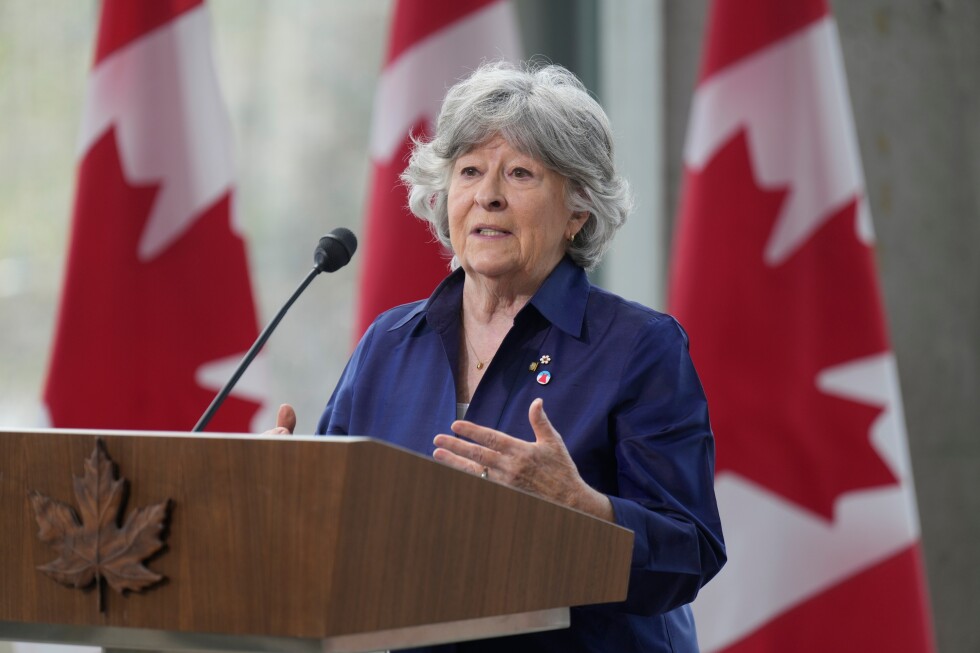
Retired Supreme Court Justice Louise Arbour will serve as Canada’s next governor general, Prime Minister Mark Carney announced Tuesday in Toronto.
The appointment, approved by King Charles III on Carney’s recommendation, places a distinguished legal scholar and human rights champion in the role that serves as the monarch’s representative in Canada. The British monarch remains Canada’s head of state, reflecting the country’s status as a member of the Commonwealth.
“I will have an opportunity to have very in-depth conversations with Arbour in private on issues that affect Canada and the rest of the world,” Carney said during the announcement.
While the governor general position involves crucial constitutional duties, it functions primarily in a ceremonial and symbolic capacity. Arbour, a native French speaker, will succeed Mary Simon, who made history as Canada’s first Indigenous governor general. Simon will conclude her five-year tenure in July.
When questioned about her views on the monarchy, Arbour responded in French that she “doesn’t really know what that term is supposed to mean” but expressed support for Canada’s current constitutional framework.
“I will be the representative of the Crown in a constitutional arrangement that has served Canada extremely well throughout our history, even more in recent decades,” she stated.
The appointment of a francophone governor general carries particular significance at this political moment. Daniel Béland, a political science professor at McGill University in Montreal, noted that Simon faced criticism from francophone communities over her limited French language proficiency.
“The previous Governor General Mary Simon’s lack of French language skills attracted criticisms from many francophone commenters,” Béland explained. He added that Arbour enjoys substantial respect in Quebec, which could prove strategically important given current political dynamics in the province.
The timing is especially notable as the provincial Parti Québécois has pledged to organize an independence referendum by 2030 if they secure a majority government in Quebec’s October 5 general election. “Having a francophone as Governor General might help,” Béland observed.
At 79, Arbour brings an impressive resume to the role. Her legal career includes appointments as a judge to the Supreme Court of Ontario, the Court of Appeal for Ontario, and the Supreme Court of Canada. Her international work has been equally consequential.
In 1996, the United Nations appointed her as Chief Prosecutor of the International Criminal Tribunals for the former Yugoslavia and Rwanda. Under her leadership, the tribunals secured the first conviction for genocide since the establishment of the 1948 Genocide Convention and issued the first indictment for war crimes against a sitting head of state. More recently, she served as the UN Special Representative for International Migration from 2017 to 2018.
The governor general appointment highlights Canada’s enduring constitutional structure. Unlike the United States, which gained independence from Britain and established a republic, Canada remained a British colony until 1867. After achieving independence, it maintained its status as a constitutional monarchy operating within a British-style parliamentary system.
The selection of Arbour reflects both practical political considerations and recognition of her distinguished career in law, human rights, and international justice. As Canada’s next governor general, she will represent the Crown while navigating the complex relationship between Canada’s modern democratic institutions and its historical ties to the British monarchy.
Fact Checker
Verify the accuracy of this article using The Disinformation Commission analysis and real-time sources.

30 Comments
Arbour’s selection is a positive move, but I’m curious to see how she will balance tradition and modernization in the governor general’s office. Her background suggests she may push for some reforms.
That’s a fair point. Arbour’s progressive views could lead to changes in how the role is defined and executed. It will be interesting to observe her approach.
Interesting choice for Canada’s next governor general. Arbour’s distinguished legal career and human rights advocacy should serve her well in this ceremonial role. I’m curious to hear her perspectives on the monarchy and Canada’s ties to the Commonwealth.
The choice of Louise Arbour as Canada’s next governor general is an intriguing one. Her background in law and human rights advocacy could provide a unique lens through which she approaches this traditionally ceremonial position.
Arbour has had an illustrious legal career, including serving as UN High Commissioner for Human Rights. This experience should serve her well in the governor general role.
Absolutely. Her international human rights work could bring a global outlook to the position and help raise Canada’s profile on the world stage.
I’m curious to hear Arbour’s views on the role of the monarchy in Canada. As a human rights advocate, will she seek to redefine the position in any way?
Arbour seems like a strong candidate to represent the monarchy in Canada. Her background as a Supreme Court Justice and human rights champion aligns well with the governor general’s duties. It will be insightful to hear her views on this position.
I agree, Arbour’s legal expertise and focus on human rights should bring an interesting perspective to the role. Looking forward to seeing how she approaches the ceremonial aspects as well as any policy discussions with the Prime Minister.
It’s encouraging to see Canada appoint a respected jurist and human rights champion to this position. Arbour’s tenure will be closely watched, both domestically and internationally.
Appointing a former Supreme Court Justice like Arbour as governor general suggests Canada values judicial independence and the rule of law. It will be intriguing to see how she approaches the ceremonial aspects of the role.
While the governor general role is largely ceremonial, Arbour’s appointment signals Canada’s commitment to upholding the rule of law and human rights. This sends an important message.
Canada choosing a former Supreme Court Justice as their next governor general speaks to the importance they place on the rule of law and judicial independence. Arbour’s background should lend credibility to the position.
Canada’s selection of Louise Arbour as the next governor general is an interesting move. Her legal expertise and human rights focus could bring a fresh perspective to this traditional position.
The appointment of Louise Arbour as Canada’s next governor general is an intriguing choice. Her distinguished career in law and human rights advocacy suggests she will bring a unique viewpoint to this traditionally ceremonial role.
This is an interesting appointment. Arbour has an impressive legal background and strong human rights credentials. It will be fascinating to see how she puts her stamp on the role of governor general.
I agree, Arbour’s experience and values should serve her well in this position. It will be worth watching how she navigates the ceremonial and symbolic aspects of the role.
Canada’s governor general serves as the formal head of state, so Arbour’s appointment is an important transition. Her legal expertise and human rights advocacy will likely shape her tenure.
Arbour’s appointment is a significant moment, as she will be the first francophone governor general since Michaëlle Jean. This could help strengthen the linguistic and cultural diversity represented in the role.
That’s a good point. Arbour’s French language skills and background will likely bring a different perspective to the governorship compared to recent predecessors.
Appointing a former Supreme Court Justice like Arbour as governor general signals Canada’s continued commitment to the country’s legal institutions and democratic values. I’m curious to see how she navigates the delicate balance of the position.
Agreed. Arbour’s background should lend gravitas to the role and help maintain public trust in Canada’s institutions, even as the governor general’s duties remain primarily ceremonial.
As Canada’s representative of the Crown, the governor general plays an important symbolic role. Arbour’s strong legal and human rights credentials bring a new dynamic to this position.
Arbour’s background in international law and conflict resolution could bring a unique perspective to the governor general’s role. I’m hopeful she will use the position to champion important causes.
Agreed. Her experience working on global human rights issues could lead to the governor general’s office playing a more active role in Canada’s foreign policy and diplomacy.
Canada’s governor general serves as the Queen’s representative, so this appointment reflects the country’s continued ties to the Commonwealth. Arbour’s background suggests she will bring a unique perspective to the role.
That’s a good point. The governor general position has evolved over time, so it will be interesting to see how Arbour approaches the balance between tradition and modernity.
Arbour’s appointment represents a departure from the more ceremonial governors general of recent decades. Her background suggests she may seek to redefine the position in meaningful ways.
That’s a fair assessment. Arbour’s activist tendencies could lead to a more engaged and influential governor general, which could be a positive development for Canada.
This is an intriguing choice for Canada’s next governor general. Arbour’s legal pedigree and focus on human rights are strong assets, but it will be interesting to see how she navigates the political aspects of the role.