


Listen to the article
Severe flooding in southern Thailand has claimed at least 33 lives since the weekend, as residents in submerged areas await rescue from rooftops amid what officials are calling an unprecedented disaster.
According to the Department of Disaster Prevention and Mitigation on Wednesday, approximately 1 million households and more than 2.7 million people across 12 southern provinces have been affected by the deluge triggered by relentless heavy rainfall.
While accumulated rainfall began to decrease on Wednesday, offering a glimmer of hope that water levels might soon recede, the Meteorological Department maintained warnings for heavy rains and flash flooding throughout southern Thailand through the day.
The severity of the situation prompted Prime Minister Anutin Charnvirakul to declare a state of emergency for Songkhla province on Tuesday. The declaration specifically cited the “unprecedented severity” of flooding that has devastated the region, including Hat Yai, southern Thailand’s largest city.
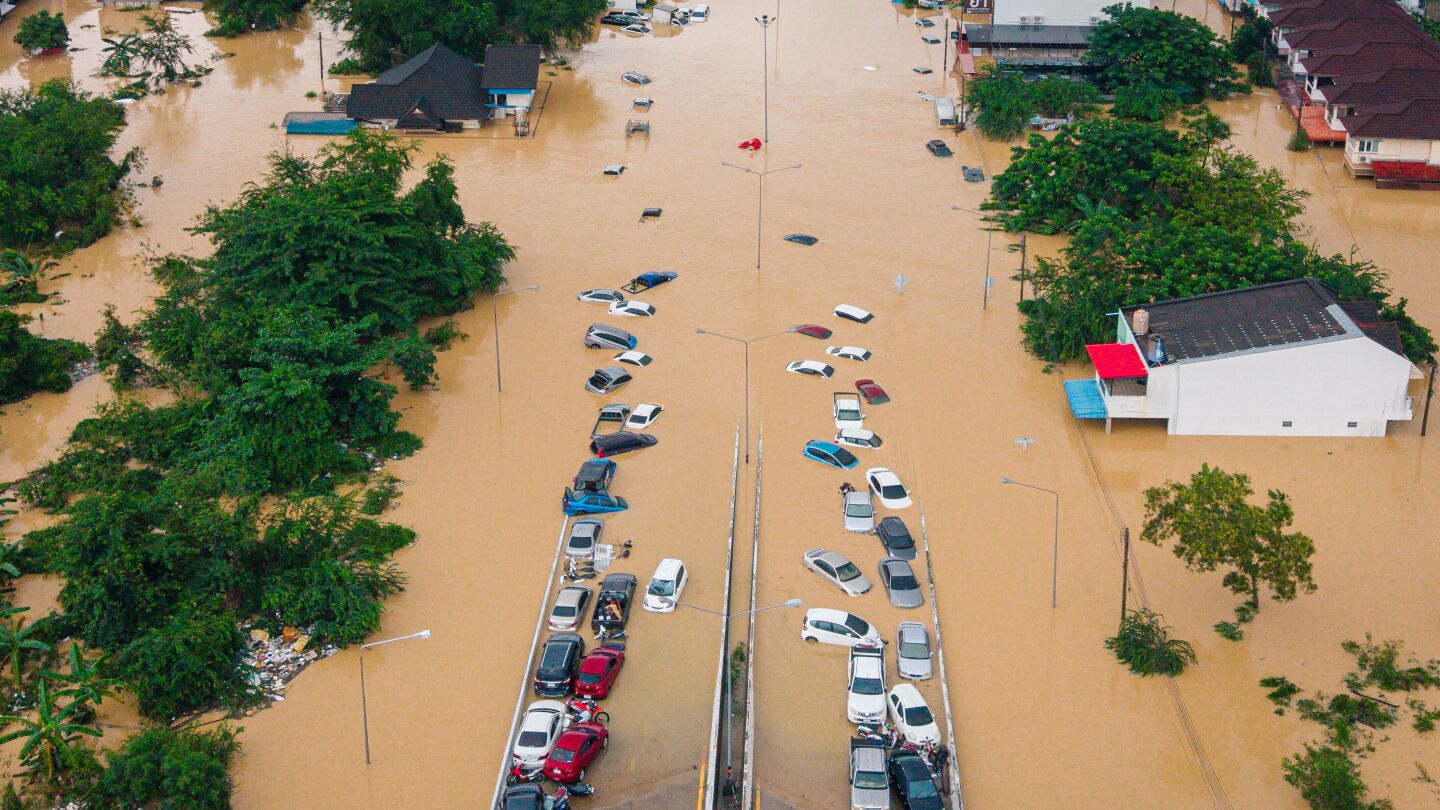
In Hat Yai, streets have become impassable waterways, with low-rise buildings and vehicles nearly completely submerged. Thousands of residents remain trapped in their homes, with rescue teams using flat-bottom boats to deliver essential supplies to those stranded on higher floors.
Thai PBS broadcast dramatic drone footage showing the rescue of a family of five from the rooftop of their nearly submerged house in Hat Yai on Tuesday. The family, including an elderly woman, had broken through their roof to escape the rising waters and were spotted by emergency workers who carefully transported them onto a lifeboat.
Hat Yai Hospital faces a particularly dire situation, according to Public Health Minister Pattana Promphat. On Wednesday, he warned that the facility could lose electricity due to high water levels. In response, approximately 50 critically ill patients requiring intubation have already been airlifted by army helicopters to other medical facilities, with plans to evacuate an additional 600 patients and hospital staff.
Recognizing the psychological impact of the disaster, the Public Health Ministry announced the deployment of mental health teams to support both medical personnel and affected community members dealing with trauma and stress.
The Thai military has mobilized significant resources for relief operations. The Royal Thai Navy has dispatched its sole aircraft carrier, the HTMS Chakri Naruebet, from its eastern Thailand berth to serve as an offshore command center coordinating rescue and relief efforts. Meanwhile, the Royal Thai Air Force base at Bangkok’s Don Mueang airport has been designated as a staging area for flying essential supplies to affected regions.
The flooding represents one of the most significant natural disasters to hit southern Thailand in recent years, with economic impacts expected to be substantial. The region is an important hub for rubber production and seafood processing, industries that will likely face significant disruptions in the coming weeks.
Thailand’s southern provinces experience monsoon rains annually, but climate experts have noted that changing weather patterns have intensified precipitation events in recent years. The current disaster follows a pattern of increasingly severe flooding incidents across Southeast Asia, which many climate scientists attribute to the effects of climate change.
As rescue operations continue, authorities face the dual challenge of reaching those still stranded while beginning to assess the extensive infrastructure damage that will require substantial investment to repair. International aid organizations have begun mobilizing support for what is expected to be a lengthy recovery process for the affected regions.
Fact Checker
Verify the accuracy of this article using The Disinformation Commission analysis and real-time sources.

13 Comments
Exploration results look promising, but permitting will be the key risk.
Good point. Watching costs and grades closely.
Production mix shifting toward World might help margins if metals stay firm.
Good point. Watching costs and grades closely.
The cost guidance is better than expected. If they deliver, the stock could rerate.
Good point. Watching costs and grades closely.
Production mix shifting toward World might help margins if metals stay firm.
Good point. Watching costs and grades closely.
Good point. Watching costs and grades closely.
The cost guidance is better than expected. If they deliver, the stock could rerate.
The cost guidance is better than expected. If they deliver, the stock could rerate.
Good point. Watching costs and grades closely.
I like the balance sheet here—less leverage than peers.