


Listen to the article
Ancient Choral Tradition in Church of England Faces Modern Challenges
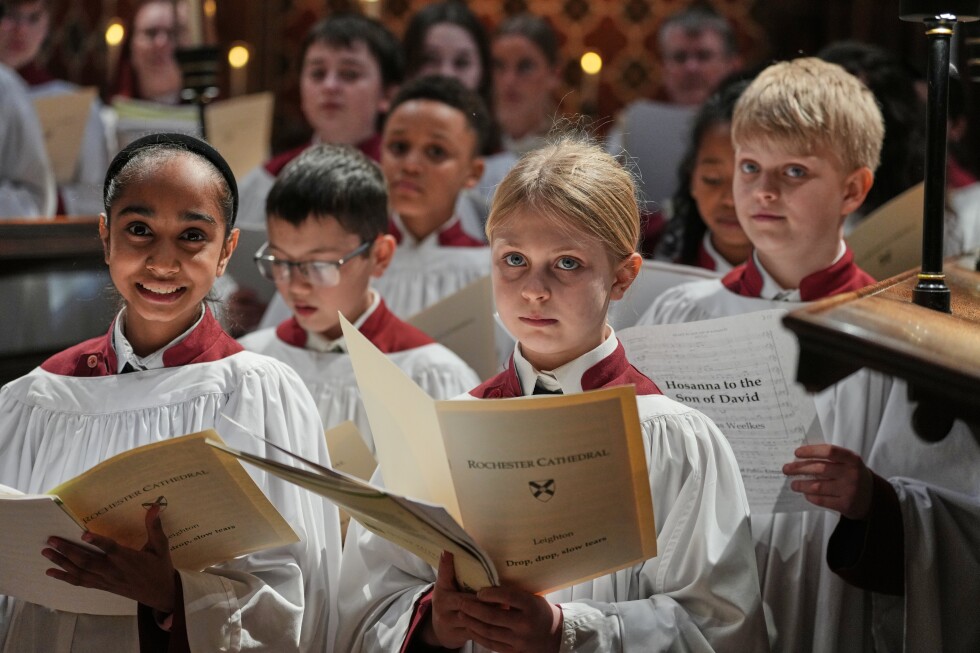
On a gray afternoon before Easter, a transformation unfolds within Rochester Cathedral. Schoolchildren shed their jackets and backpacks, don burgundy cassocks and white surplices, and process into the cathedral. Their youthful voices blend into a unified choir, continuing a choral tradition in the Church of England that has remained largely unchanged for nearly 500 years.
“I think for me, it’s one of the sounds of our country,” says Adrian Bawtree, the choir’s music director. “All of our cathedrals are beautiful, sacred spaces where you can come and just sit and be and you can be immersed, bathed, nourished, sent out back into the world transformed by an experience in 30 minutes.”
The epitome of this tradition is Choral Evensong, an evening service of hymns, psalms and prayers established by Archbishop Thomas Cranmer in 1549. The first Protestant archbishop of the Church of England created a service performed entirely by the choir, with congregations participating simply by listening.
This centuries-old tradition now faces significant challenges. The demands of modern life, declining church attendance, and financial constraints make it increasingly difficult to find and train the next generation of choristers. In response, enthusiasts have launched a campaign for the UK government to recognize English choral services as an important part of Britain’s cultural heritage under a United Nations program designed to protect “intangible cultural heritage.”
The UK government is currently seeking nominations for a nationwide inventory of cultural traditions that deserve preservation. From Morris dancing to the craft of building dry stone walls, protecting these traditions is considered crucial for strengthening community identity and supporting the UK economy through heritage tourism, which generates billions of pounds annually.
While many people know English choral services through the angelic voices at royal weddings and Christmas carol services, choirs perform daily in much more modest settings. Many are struggling financially, according to the Cathedral Music Trust, which was founded in 1956 to address the decline of church music after World War II. Last year, the trust provided £500,000 ($661,000) to 28 cathedrals and churches across the country.
The financial burden is substantial. Rochester Cathedral, for example, spends approximately £250,000 ($330,000) annually on music—a significant expenditure for a provincial cathedral, though less than some others.
The Cathedral Music Trust hopes that formal recognition of the English choral tradition will bring attention and crucial funding to choirs, which they consider important training grounds for future musicians, both religious and secular.
“Whilst it happens every day, it is actually quite fragile,” explains trust CEO Jonathan Mayes. “It takes an awful lot of work and it takes a lot of funding to actually make it happen and that doesn’t come without effort.”
Preserving Evensong carries historical importance as well. The service played a pivotal role in the development and spread of modern English language, according to Diarmaid MacCulloch, an expert on Christianity and emeritus professor at the University of Oxford.
Evensong is based on the Book of Common Prayer, compiled by Cranmer to establish English as the language of the Church of England after its separation from the Latin-dominated Catholic Church during the Protestant Reformation. The goal was to create accessible services for everyone.
“It is very much a drama, and it is a drama which has been performed by the people of England from 1549 through to the present day,” MacCulloch says. “It’s far more a vehicle of public consciousness performance than any play of Shakespeare.”
While some aspects have evolved—Rochester and other choirs now accept girls as well as boys—the fundamental structure remains remarkably consistent across the centuries.
“The service would be really quite recognizable to Queen Elizabeth I as much as Queen Elizabeth II,” MacCulloch notes. “And that’s quite remarkable.”
At Rochester Cathedral, Bawtree oversees the youngest singers, aged 9-13, known as choristers, as well as a youth choir for older children, all supported by professional adult singers. He was drawn to church music after hearing an organ and choir performance when he was about nine years old.
Bawtree emphasizes that services like Evensong make beautiful choral music accessible to anyone, regardless of their religious beliefs. “When I heard it, it was like big octopus arms came and grabbed me and said, ‘You’ve got to be part of this,'” he recalls. “So I think I am trying to speak to that 9-year-old child and saying actually this is something that could speak to most people, if not everyone.”
“We talk in the world of mindfulness and the power of music to transform lives,” Bawtree adds. “This is an extraordinary arena where that can happen.”
Fact Checker
Verify the accuracy of this article using The Disinformation Commission analysis and real-time sources.

10 Comments
Evensong sounds like a truly special musical experience, with its blend of hymns, psalms and prayers creating a sense of sacred contemplation. I can understand why the Church of England would want to protect this tradition.
The challenges of declining attendance and modern life are understandable, but I’m glad the choirs are proactively seeking UNESCO recognition to help safeguard this cultural treasure.
I’m curious to learn more about the specifics of how evensong is performed and its historical significance within the Anglican church. This seems like a uniquely rich cultural practice worth preserving.
The excerpt mentions the service is performed entirely by the choir, with the congregation just listening. That must create a very immersive, almost meditative experience for attendees.
It’s admirable that these English choirs are seeking UNESCO recognition for the evensong tradition. Maintaining centuries-old cultural practices in the face of modern pressures is no easy feat.
I hope they are successful in their efforts. UNESCO designation could provide valuable support and publicity to help sustain this beautiful choral heritage for years to come.
Fascinating to learn about the rich choral tradition of the Church of England. Evensong sounds like a beautiful and immersive musical experience. I can see why choirs would want to preserve this centuries-old heritage.
Maintaining traditions like this in the face of modern life is certainly a challenge. Hopefully the choirs can succeed in getting UNESCO recognition to help raise awareness and support for this unique cultural legacy.
The excerpt highlights how evensong provides a sacred, transformative space for people to find solace and renewal. It’s understandable why the Church of England would want to safeguard this cherished musical tradition.
With declining church attendance, securing funding and participation will be critical. UNESCO recognition could boost the profile of evensong and help ensure its survival for future generations.