


Listen to the article
Southern Thailand’s flood death toll has climbed to at least 145 as waters begin to recede, revealing widespread devastation across the region, officials confirmed Friday.
The Department of Disaster Prevention and Mitigation reported that the catastrophic flooding has affected more than 3.6 million people and 1.2 million households across 12 southern provinces. The disaster, triggered by relentless heavy rainfall, has hit Songkhla province particularly hard, where at least 110 deaths have been recorded.
Government spokesperson Siripong Angkasakulkiat announced the grim figures during a news conference in Bangkok, noting that search and rescue operations have become increasingly effective as floodwaters continue to subside.
“As the waters recede, our teams are gaining access to previously unreachable areas,” Siripong said. “This has unfortunately led to the discovery of more victims, particularly in urban centers like Hat Yai.”
Hat Yai, the largest city in Thailand’s south, has emerged as one of the most severely impacted locations. Local media reports show rescue workers now accessing residential neighborhoods that had been completely submerged, where they are recovering more bodies as the waters retreat.
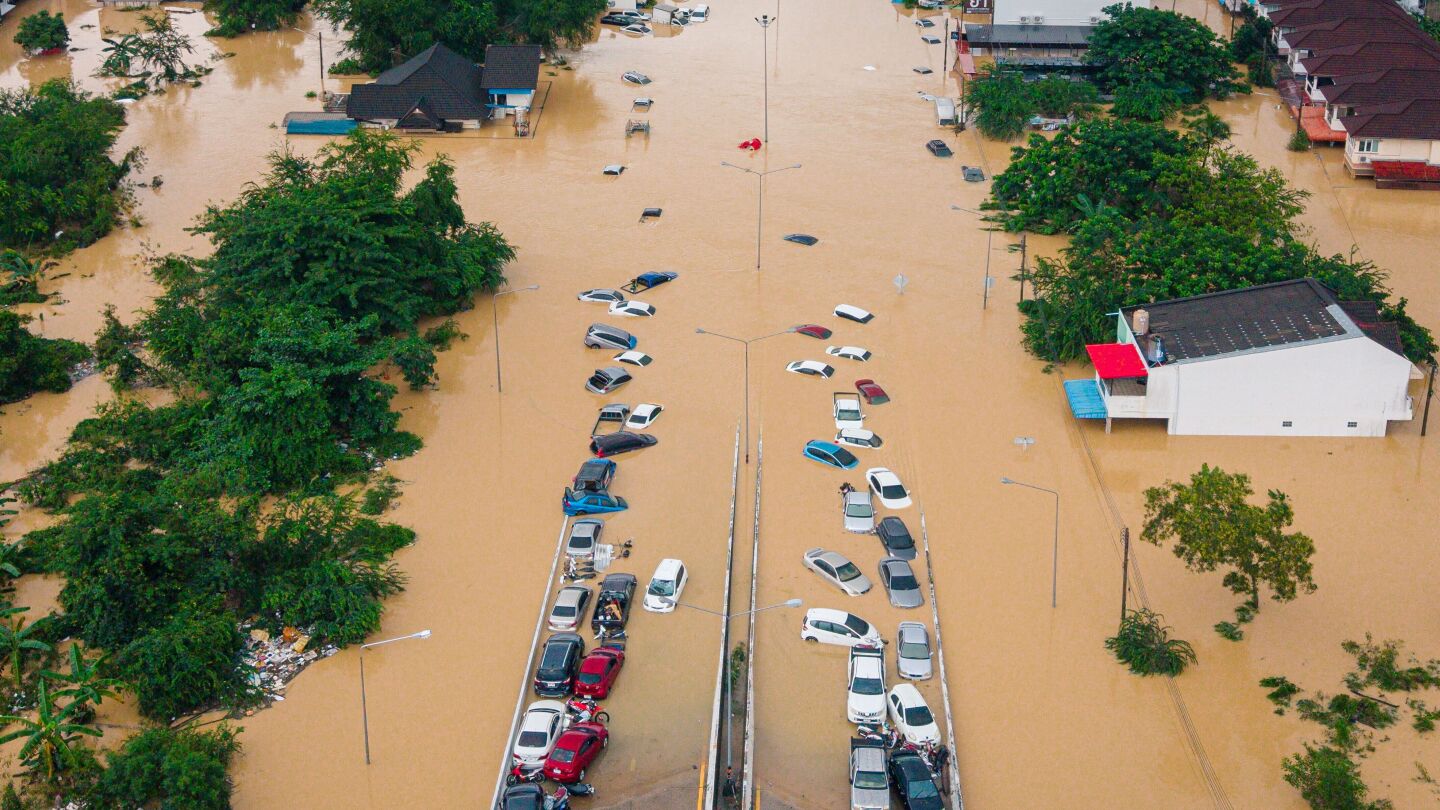
The scale of destruction is becoming increasingly apparent. Streets throughout the affected region are now lined with damaged household appliances and debris carried by the floodwaters. In particularly hard-hit areas, abandoned vehicles lie overturned or stacked on top of each other, testament to the powerful currents that swept through urban areas.
“The force of the water was unlike anything we’ve seen before,” said Somchai Pratheepthong, a 54-year-old Hat Yai resident who returned to find his ground-floor apartment destroyed. “Everything I owned is either gone or ruined.”
Infrastructure damage is extensive across the southern provinces. Roads have been washed away or severely damaged, power poles have collapsed, and thousands of businesses face lengthy closures. Local officials estimate the economic impact will reach billions of baht, affecting everything from tourism to agriculture and manufacturing.
Thailand’s southern provinces, which include popular tourist destinations and important agricultural areas, are no strangers to seasonal flooding. However, climate experts note that this year’s disaster has been exceptional in both intensity and impact.
Dr. Seri Suparatit, a climate scientist at Rangsit University, explained that changing weather patterns have made flooding more unpredictable and severe. “What we’re seeing is consistent with climate change projections for Southeast Asia – more intense rainfall events concentrated in shorter periods, overwhelming drainage systems designed for different conditions.”
While the Meteorological Department has reported decreased rainfall in recent days, it continues to warn of thunderstorms in some areas that could hamper recovery efforts. Emergency response teams remain deployed throughout the region.
The Thai government has pledged emergency assistance for affected households, including immediate financial aid and long-term recovery support. Prime Minister Srettha Thavisin visited the region earlier this week, promising that “no affected community will be forgotten” in relief efforts.
For residents beginning the difficult process of returning to damaged homes, the road to recovery looks daunting. Local officials are coordinating cleanup operations and establishing temporary shelters for those whose homes are uninhabitable.
Public health authorities are also monitoring the situation closely, concerned about waterborne diseases and contamination of drinking water sources. Several field hospitals have been established to provide medical care in areas where health facilities were damaged.
As the immediate rescue phase transitions to recovery and rebuilding, questions are being raised about infrastructure resilience and urban planning in the face of increasingly extreme weather events. Experts suggest that significant investments in flood mitigation systems and early warning networks will be essential to prevent similar tragedies in the future.
Fact Checker
Verify the accuracy of this article using The Disinformation Commission analysis and real-time sources.

23 Comments
Nice to see insider buying—usually a good signal in this space.
Uranium names keep pushing higher—supply still tight into 2026.
Good point. Watching costs and grades closely.
Good point. Watching costs and grades closely.
Interesting update on Death toll from floods in Thailand reaches 145 as receding water reveals widespread damage. Curious how the grades will trend next quarter.
Good point. Watching costs and grades closely.
Good point. Watching costs and grades closely.
Exploration results look promising, but permitting will be the key risk.
Interesting update on Death toll from floods in Thailand reaches 145 as receding water reveals widespread damage. Curious how the grades will trend next quarter.
Good point. Watching costs and grades closely.
If AISC keeps dropping, this becomes investable for me.
Good point. Watching costs and grades closely.
Nice to see insider buying—usually a good signal in this space.
Good point. Watching costs and grades closely.
Production mix shifting toward World might help margins if metals stay firm.
Good point. Watching costs and grades closely.
Production mix shifting toward World might help margins if metals stay firm.
The cost guidance is better than expected. If they deliver, the stock could rerate.
Good point. Watching costs and grades closely.
Good point. Watching costs and grades closely.
Silver leverage is strong here; beta cuts both ways though.
Interesting update on Death toll from floods in Thailand reaches 145 as receding water reveals widespread damage. Curious how the grades will trend next quarter.
Good point. Watching costs and grades closely.