


Listen to the article
Cuban President Defiant Amid Rising Tensions with United States
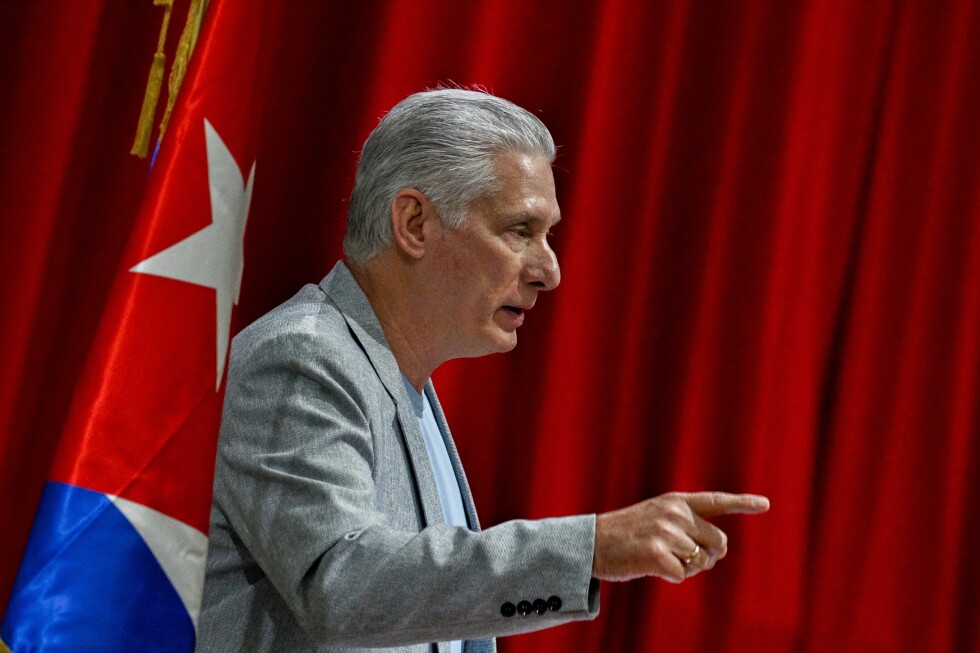
Cuban President Miguel Díaz-Canel has firmly stated that the United States has no legitimate grounds to launch a military attack against Cuba or attempt to remove him from power, highlighting the growing tensions between the two nations.
In a recent interview on NBC News’ Meet the Press, Díaz-Canel warned that any U.S. military intervention would come at a significant cost and destabilize regional security. Speaking through a translator, he declared, “If the time comes, I don’t think there would be any justification for the United States to launch a military aggression against Cuba, or for the U.S. to undertake a surgical operation or the kidnapping of a president.”
The Cuban leader adopted a resolute tone when discussing potential conflict: “If that happens, there will be fighting, and there will be a struggle, and we will defend ourselves, and if we need to die, we’ll die, because as our national anthem says, ‘Dying for the homeland is to live’.”
These pointed remarks come at a time when diplomatic relations between Havana and Washington remain strained, despite acknowledgment from both sides that talks have taken place. Details of these discussions have not been disclosed publicly, maintaining the cloud of uncertainty over bilateral relations.
Díaz-Canel has consistently criticized what he describes as America’s “hostile policy” toward Cuba and questioned Washington’s moral authority to make demands of his government. He expressed openness to dialogue without preconditions, stating that Cuba is willing to discuss any topic, “not demanding changes from our political system as we are not demanding change from the American system, about which we have a number of doubts.”
The current tensions are exacerbated by Cuba’s deepening economic crisis. The island nation blames U.S. energy restrictions for its worsening situation, with petroleum shortages severely impacting healthcare services, public transportation, and essential goods production. Cuba currently produces only 40% of the fuel it consumes, leaving it dependent on foreign supplies.
The situation deteriorated further when Cuba stopped receiving crucial oil shipments from Venezuela following a dramatic U.S. military operation in early 2023. During that intervention, Venezuelan President Nicolás Maduro was seized and taken to New York to face drug trafficking charges. Subsequently, with cooperation from Venezuela’s ruling party, the Trump administration began implementing a phased approach to address the South American country’s long-standing crisis.
After a three-month oil drought, Cuba received some relief when a Russian tanker carrying 730,000 barrels of crude oil arrived in March. Russia has committed to sending a second shipment, offering a temporary lifeline to the struggling Caribbean nation. Despite President Trump’s January threats to impose tariffs on countries selling or providing oil to Cuba, his administration permitted the Russian tanker to proceed.
President Trump’s dismissive comments about Cuba’s future have further heightened concerns in Havana. “Cuba’s finished,” Trump remarked. “They have a bad regime. They have very bad and corrupt leadership and whether or not they get a boat of oil, it’s not going to matter.”
Díaz-Canel acknowledged taking these statements as a serious warning. “You hear that Cuba is next, that Cuba is going to be next, that there are, there’s a way out, that they’re going to take over Cuba,” he said. “So, from the position of responsibility within the leadership of the country, that is a warning. And we need to responsibly protect our people, protect our project and protect our country.”
The escalating rhetoric reflects the historical complexities of U.S.-Cuba relations, which saw a brief thaw during the Obama administration before returning to hostility under President Trump. The current impasse threatens to push bilateral relations to their lowest point in years, with significant implications for regional stability and the Cuban people already suffering from economic hardships.
Fact Checker
Verify the accuracy of this article using The Disinformation Commission analysis and real-time sources.

23 Comments
Interesting update on Cuba’s president says ‘we will defend ourselves’ against any US invasion. Curious how the grades will trend next quarter.
Silver leverage is strong here; beta cuts both ways though.
The cost guidance is better than expected. If they deliver, the stock could rerate.
Good point. Watching costs and grades closely.
Nice to see insider buying—usually a good signal in this space.
If AISC keeps dropping, this becomes investable for me.
Good point. Watching costs and grades closely.
The cost guidance is better than expected. If they deliver, the stock could rerate.
Production mix shifting toward World might help margins if metals stay firm.
The cost guidance is better than expected. If they deliver, the stock could rerate.
The cost guidance is better than expected. If they deliver, the stock could rerate.
The cost guidance is better than expected. If they deliver, the stock could rerate.
Good point. Watching costs and grades closely.
Good point. Watching costs and grades closely.
Nice to see insider buying—usually a good signal in this space.
Good point. Watching costs and grades closely.
Good point. Watching costs and grades closely.
If AISC keeps dropping, this becomes investable for me.
Good point. Watching costs and grades closely.
Good point. Watching costs and grades closely.
Nice to see insider buying—usually a good signal in this space.
I like the balance sheet here—less leverage than peers.
Nice to see insider buying—usually a good signal in this space.