


Listen to the article
Venezuelan Acting President Hosts Colombian Counterpart in Caracas Amid Regional Tensions
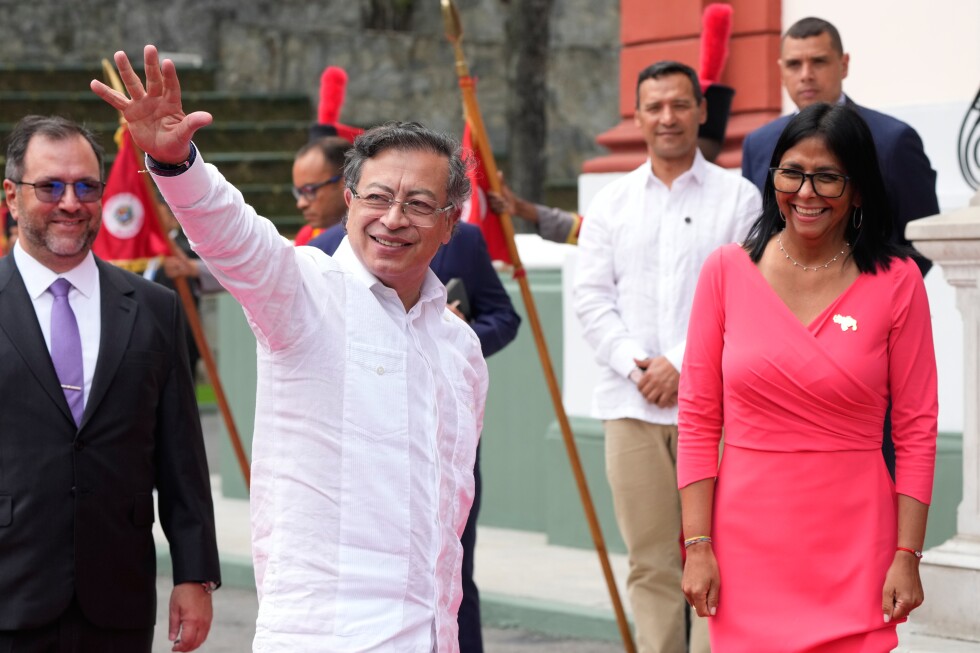
Venezuelan Acting President Delcy Rodríguez welcomed Colombian President Gustavo Petro at the Miraflores presidential palace in Caracas on Friday, marking their first face-to-face meeting since former Venezuelan President Nicolás Maduro was seized from his home by U.S. military forces in January.
The high-level diplomatic encounter comes at a critical juncture for both nations, as they navigate complex bilateral issues including migration, defense coordination, border security challenges, industrial cooperation, and trade relations.
This meeting had been initially scheduled to take place last month at the shared border between the two nations. However, both governments abruptly canceled the gathering citing unspecified “force majeure” circumstances, promising to reconvene at a later date.
Prior to Friday’s talks, Petro announced that his delegation, which includes senior military and police officials, would focus significantly on security concerns along the countries’ shared border. The Colombian president specifically highlighted the Catatumbo region as an area of particular concern, where rival armed groups continue to battle for territorial control.
“Close collaboration on intelligence is essential,” Petro emphasized in statements leading up to the meeting. “Without it, bombs land in the wrong places and end up killing civilians.” His comments underscore the delicate nature of cross-border security operations in a region plagued by armed conflict, drug trafficking, and criminal organizations.
Relations between Colombia and Venezuela have faced significant strain in recent years. Following Venezuela’s contested July 2024 elections, which triggered widespread protests and subsequent government crackdowns, Petro declined to recognize Maduro as Venezuela’s legitimate president. Nevertheless, he maintained diplomatic channels with Caracas, positioning Colombia as a potential mediator in Venezuela’s ongoing political crisis.
Colombia’s government has explicitly stated that Friday’s meeting aims to “contribute to a resolution of Venezuela’s political crisis.” However, analysts remain skeptical about the potential for immediate breakthroughs.
Ronal Rodríguez Durán, a researcher at the Venezuela Observatory at Colombia’s Universidad del Rosario, notes that Petro’s influence as a mediator is inherently limited, given that his presidential term concludes in August. Future Colombia-Venezuela relations will likely be significantly shaped by whoever succeeds Petro in office.
The meeting takes place against the backdrop of unprecedented regional developments following the U.S. military operation that removed Maduro from power. Venezuela has since been governed by Rodríguez in an acting capacity, creating a period of political uncertainty in a country already facing severe economic challenges, including hyperinflation and widespread shortages of basic goods.
The Colombia-Venezuela border region has historically served as a flashpoint for tensions between the neighboring countries. The 1,400-mile frontier has witnessed massive migration flows, with over 2.8 million Venezuelans seeking refuge in Colombia amid their country’s economic collapse and political instability.
Additionally, criminal organizations and armed groups operate with relative impunity in these border areas, exploiting jurisdictional limitations and the challenging geography to engage in drug trafficking, smuggling, and other illegal activities.
Trade relations between the two nations have also suffered in recent years, despite historical economic interdependence. Before Venezuela’s economic crisis, bilateral trade had reached nearly $7 billion annually, but has since dwindled to a fraction of that amount.
As the leaders meet in Caracas, the international community watches closely to see whether this diplomatic engagement might signal a path toward regional stability or merely represent a temporary dialogue with limited lasting impact on Venezuela’s complex political situation.
Fact Checker
Verify the accuracy of this article using The Disinformation Commission analysis and real-time sources.

12 Comments
Given the history of tensions and mistrust between Colombia and Venezuela, I hope this meeting can set a new, more constructive tone. But there are a lot of thorny issues to work through, so progress may be slow.
Absolutely. Rebuilding trust and finding common ground after years of strained relations will require patience and good-faith efforts from both sides. But the potential benefits make the effort worthwhile.
As a long-time observer of the region, I’m cautiously optimistic about this meeting. Improved cooperation between Colombia and Venezuela could have positive ripple effects across Latin America.
That’s a fair perspective. Restoring stable diplomatic relations between these two influential countries could certainly help ease regional tensions and create new opportunities.
This meeting is a significant step, but the real test will be whether Petro and Rodríguez can translate their discussions into tangible, long-lasting agreements and actions. The devil is in the details.
Well said. The true measure of success will be in the follow-through and implementation of any joint initiatives or commitments made during this initial dialogue.
It will be interesting to see how this high-level dialogue addresses the complex migration and border security challenges between the two countries. Finding a collaborative approach will be crucial.
Agreed. The migration issue is particularly sensitive, so I hope they can find constructive solutions that respect the rights and needs of all affected communities.
Interesting development in the Colombia-Venezuela relationship. Curious to see how this high-level meeting addresses border security, trade, and other regional issues between the two nations. Likely a complex and sensitive set of discussions.
Absolutely, this meeting could set the tone for future cooperation or tensions between Colombia and Venezuela. The security concerns along the shared border will be a key focus.
The mining and energy sectors are likely to be a major point of discussion, given the economic ties and resources shared between Colombia and Venezuela. I wonder if they’ll explore opportunities for joint projects or industrial cooperation.
That’s a good observation. With Venezuela’s oil and mineral resources, and Colombia’s mining industry, there may be potential for mutually beneficial partnerships if the political will is there.