


Listen to the article
Israeli Forces and Hezbollah Clash in Strategic Lebanese Town as Peace Talks Loom
Fierce fighting erupted Monday in the strategic southern Lebanese town of Bint Jbeil as Israeli troops appeared to encircle the area while Hezbollah militants launched rockets and artillery in an effort to repel the advance.
The intensifying clashes come at a critical moment, just days after Iran and the United States agreed to a temporary truce and one day before Lebanon and Israel’s ambassadors to the U.S. are scheduled to meet in Washington. The planned face-to-face meeting represents a potential breakthrough, marking the beginning of direct negotiations between the two countries.
While Israel has scaled back its attacks in Beirut following a series of controversial strikes that killed over 350 people in densely populated residential and commercial areas, military operations in southern Lebanon have accelerated. Israeli forces appear determined to establish a security zone extending to the Litani River, approximately 20 miles from the border.
Bint Jbeil, positioned just over 2 miles from the UN-mandated Blue Line dividing the two countries, holds significant strategic value due to its elevated position overlooking the border region. The town is among dozens of communities south of the Litani River that Israel ordered evacuated early in the conflict.
Lebanon’s state-run National News Agency reported Israeli ground forces advancing into the town with most exit roads cut off, effectively trapping dozens of Hezbollah fighters. The Israeli military claimed its troops have surrounded Hezbollah infrastructure and killed over 100 fighters in Bint Jbeil and surrounding areas. Hezbollah has not confirmed these casualties and Israel has not disclosed any losses among its own forces.
The militant group reported launching at least five attacks against Israeli troops in and around Bint Jbeil on Sunday using rockets, artillery, and drones. According to Hezbollah statements, Israeli forces have positioned themselves near sensitive civilian infrastructure, including a school, a hospital, and a junction at the town’s center. Israel countered that its troops attacked Hezbollah fighters operating from Bint Jbeil Government Hospital, where they allegedly discovered weapons caches.
Bint Jbeil holds historical significance in the conflict between Israel and Hezbollah. Until Israel’s withdrawal from southern Lebanon in 2000, the town served as a strategic vantage point for Israeli forces. Hezbollah’s recapture of the town represented a major turning point, symbolized by then-Secretary General Hassan Nasrallah’s victory speech delivered in a local stadium. Israeli forces reportedly destroyed this stadium in a recent strike, sharing satellite images of the destruction.
Israeli Prime Minister Benjamin Netanyahu emphasized the strategic importance of the operation during a Cabinet meeting Monday, stating that the military was expanding beyond the five hilltops it controlled since the 2024 ceasefire with Hezbollah to establish a “solid, deeper security zone” to protect northern Israel.
The human toll of the conflict continues to mount. Lebanon’s Health Ministry reports at least 2,055 people killed in Israeli strikes, including 252 women, 165 children, and 87 medical workers, with 6,588 wounded.
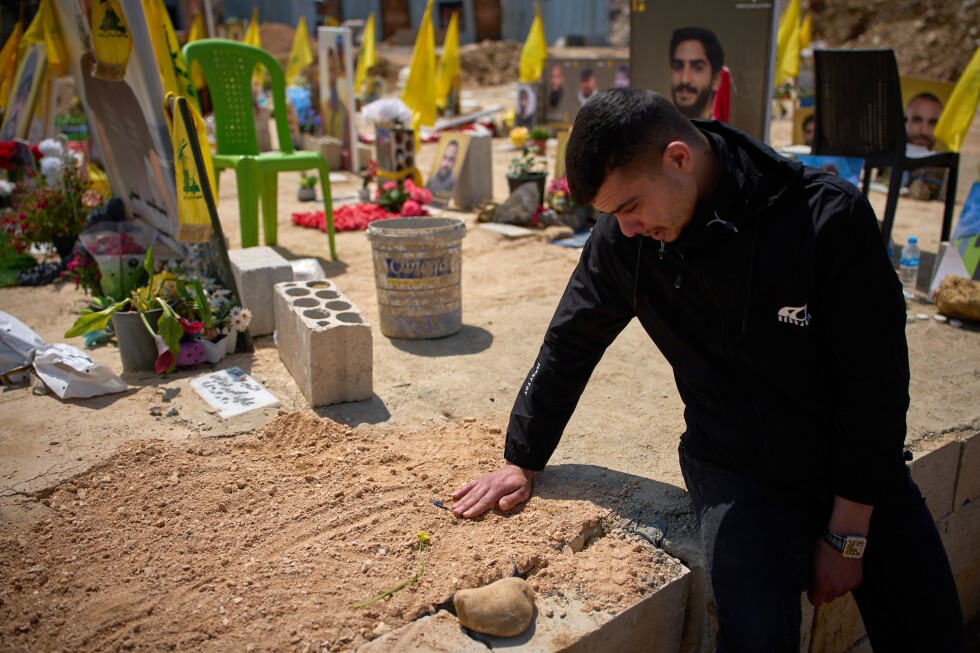
Humanitarian workers have increasingly found themselves in danger. On Monday, Hassan Badawi, a 31-year-old Lebanese Red Cross volunteer, was laid to rest after being killed in an Israeli strike Sunday while responding to an emergency in the southern village of Beit Yahoun. According to colleagues, the mission was coordinated with UN peacekeepers who liaise with Israeli forces, and Badawi’s team had received clearance to proceed.
“That is the only protection we have,” said Ahmad Assi, 29, a fellow paramedic and friend of Badawi.
In another incident Monday, an Israeli strike near Red Cross offices in the coastal city of Tyre killed a wounded person being transported and damaged several Red Cross vehicles. The International Committee of the Red Cross issued a statement urging protection for humanitarian workers.
“Saving lives must never cost a life,” said Agnès Dhur, head of the ICRC delegation in Lebanon. “They must be allowed to reach and help the wounded and return unharmed.”
The latest round of fighting began on March 2 when Hezbollah fired rockets into northern Israel in solidarity with Iran, marking a significant escalation in a conflict that threatens to further destabilize the region.
Fact Checker
Verify the accuracy of this article using The Disinformation Commission analysis and real-time sources.

8 Comments
This is a concerning development as the clashes in Bint Jbeil could further destabilize the region. It’s crucial that all parties involved exercise restraint and pursue diplomatic solutions to address the underlying tensions.
I agree, the timing of these clashes is particularly worrying given the upcoming peace talks. Hopefully the diplomats can make progress and find a way to de-escalate the situation on the ground.
The strategic importance of Bint Jbeil means this conflict has the potential to spiral. I’m curious to see how the U.S.-brokered talks unfold and whether they can lead to a lasting ceasefire and pullback of forces on both sides.
You raise a good point. A lot will depend on the willingness of Israel and Hezbollah to compromise and prioritize de-escalation over entrenching their positions. Careful diplomacy will be essential.
While the fighting in Bint Jbeil is concerning, it’s encouraging to see direct talks between Lebanon and Israel planned. Resolving long-standing border disputes through dialogue rather than force is the best path forward.
Agreed. Diplomatic engagement, even if difficult, is preferable to continued military confrontation. Hopefully the negotiators can find a compromise that satisfies the core interests of both sides.
The strategic significance of Bint Jbeil means this conflict has the potential to escalate rapidly. I’ll be closely watching the upcoming peace talks to see if the diplomats can broker a durable ceasefire and begin addressing the underlying territorial issues.
The intensifying clashes in Bint Jbeil underscore the fragility of the situation in southern Lebanon. With high stakes on both sides, I hope the upcoming talks can chart a path forward that addresses the security concerns of all parties.