


Listen to the article
Malaysia Clarifies Fuel Subsidy Policies Amid Middle East Energy Crisis
Malaysia’s government has moved swiftly to counter a wave of misinformation surrounding its fuel subsidy program as global energy markets continue to be disrupted by ongoing conflicts in the Middle East.
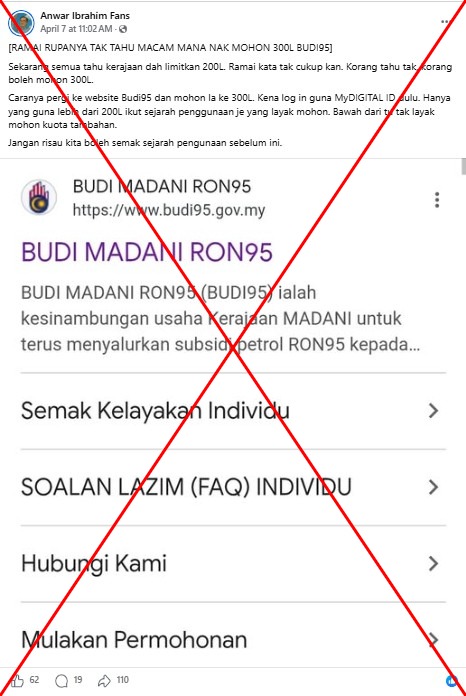
False claims circulating on social media platforms suggest that Malaysian citizens can apply to increase their quota for subsidized fuel under the Budi95 scheme, while others erroneously state that Singapore citizens have become eligible for Malaysia’s petrol subsidies.
The Malaysian Ministry of Finance categorically rejected these claims in a statement released on April 7, calling them “entirely false and baseless.” The ministry clarified that it had removed a previously available application option for additional quota, which was only intended for “specific cases with clear and confirmed operational needs,” such as e-hailing drivers and boat operators.
Independent verification confirms that this application option is no longer accessible on the subsidy website after users log in to the system.
The misinformation emerged following Prime Minister Anwar Ibrahim’s announcement that Malaysia would reduce the monthly quota for subsidized fuel from 300 liters (79 gallons) to 200 liters per month, effective April 1. This policy change comes as a direct response to soaring global crude prices resulting from the closure of the Strait of Hormuz, a critical shipping route for oil and fertilizers.
The Strait’s closure followed the outbreak of war in the Middle East, which began with joint US-Israeli strikes on Iran in February. The resulting energy price surge has put significant pressure on vulnerable economies, particularly those dependent on oil imports from the region.
Malaysia’s Budi95 subsidy scheme allows eligible citizens to purchase unleaded petrol at just 1.99 ringgit (US$0.49) per liter, a policy designed to shield consumers from global price volatility. This represents a substantial government commitment to energy affordability in a time of global instability.
In addition to spreading false information about quota increases, some social media posts have fabricated claims that the subsidized petrol quota was reduced specifically to accommodate Singaporean citizens. These posts featured misleading news graphics with images of Transport Minister Anthony Loke alongside text suggesting that Singapore driving license holders could apply for the Budi95 program.
A spokesperson for Malaysia’s Ministry of Transport confirmed to AFP on April 16 that these graphics are misleading and have been reported to the Malaysian Communications and Multimedia Commission. The ministry clarified that there have been no official announcements about allowing Singaporean citizens to access subsidized Malaysian fuel.
The actual policy, announced by Loke in October 2025, stated that Malaysian citizens holding Singaporean driving licenses would be permitted to apply for Malaysian drivers’ licenses, thus making them eligible for fuel subsidies. This is markedly different from the claims currently circulating online.
Since 2010, Malaysia has maintained a strict policy prohibiting the sale of subsidized RON95 petrol to vehicles registered outside the country, a measure specifically designed to ensure government subsidies benefit Malaysian citizens.
The ongoing energy crisis has prompted additional conservation measures in Malaysia, including work-from-home arrangements for public servants. Officials remain hopeful about diplomatic progress after peace talks between the United States and Iran collapsed on April 12, with US officials expressing optimism about a possible second round of discussions with Tehran in Pakistan.
As global energy markets remain volatile, Malaysian authorities continue to combat misinformation that could further complicate their efforts to manage the country’s fuel supply during this challenging period.
Fact Checker
Verify the accuracy of this article using The Disinformation Commission analysis and real-time sources.

9 Comments
As a global energy crisis unfolds, it’s understandable that there would be public confusion and speculation around fuel subsidies. I appreciate the ministry’s swift action to provide accurate information and clarification.
While subsidies can be a sensitive political topic, it’s important to rely on official government sources rather than unverified social media claims. Fact-checking is essential to avoid contributing to the spread of misinformation.
Agreed. Transparency and clear communication from the authorities are vital during these complex energy market disruptions.
Fuel subsidies are a complex issue with many nuances. While it’s important to scrutinize government policies, it’s equally crucial to rely on verified information from official sources to avoid the spread of false claims.
It’s concerning to see misinformation spreading about Malaysia’s fuel subsidy program. Maintaining accurate information during an energy crisis is crucial. I’m glad the government is swiftly addressing false claims to provide clarity.
The energy landscape is constantly evolving, and it’s important for governments to adapt their policies accordingly. I commend the Malaysian authorities for their efforts to communicate changes and address misinformation directly.
The removal of the additional quota application option was likely an effort to streamline the subsidy program and prevent abuse. Kudos to the Malaysian government for taking proactive steps to address misinformation.
Misinformation can sow division and undermine public trust, especially on sensitive issues like energy subsidies. I’m glad to see the Malaysian government taking a firm stance against false claims and providing transparent updates.
Absolutely. Maintaining the integrity of information is crucial during challenging times like these.