


Listen to the article
Art and Chance: How a Homeless Man Became St. Peter in Vatican Painting
In an extraordinary intersection of art, faith, and human tragedy, a chance encounter between a German artist and a homeless man in Rome has evolved into a poignant story of recognition and remembrance within the Vatican’s walls.
In 2018, German artist Michael Triegel approached a homeless man sitting at the entrance of a Roman church, struck by his flowing beard and alert eyes. Seeing in him the perfect model for St. Peter, Triegel asked if he could draw and photograph him. The man simply nodded, giving no indication of his nationality or background.
The homeless man, later identified as Burkhard Scheffler, a German national, would unknowingly become immortalized in a significant religious artwork. Meanwhile, his own life would take a tragic turn before his unexpected posthumous recognition.
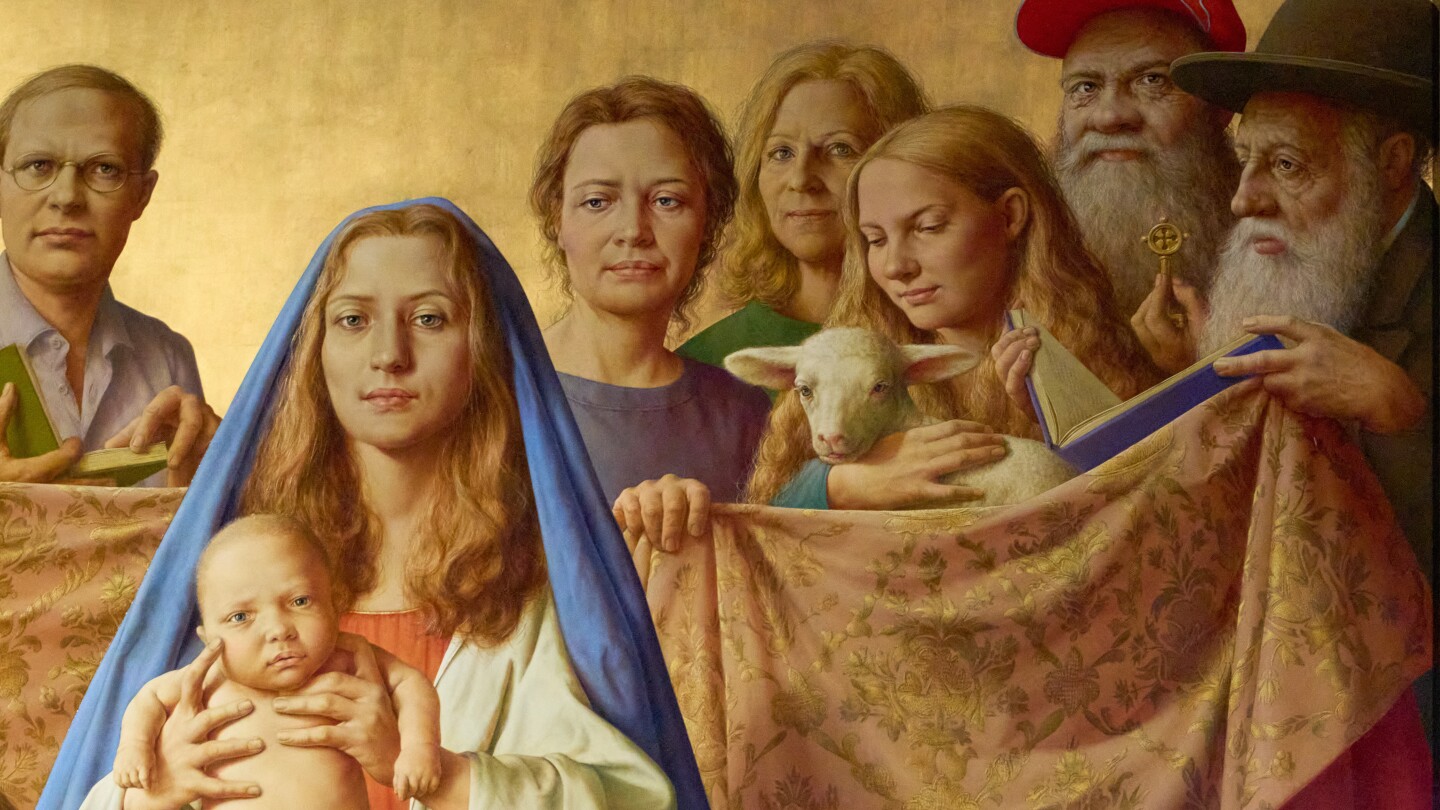
A year after their encounter, Triegel received a prestigious commission from the Protestant cathedral in Naumburg, Germany. He was tasked with creating a new central panel for an altar by Renaissance master Lucas Cranach the Elder. The original centerpiece had been destroyed in 1541 during the religious upheavals of the Reformation.
“They had the idea of completing this altar again, in what I find a beautiful gesture — not to undo these wounds from the 16th century but to mitigate them, to heal them,” Triegel explained from his Leipzig studio.
The Catholic convert saw the project as a symbolic bridge between faith traditions. For his depiction of St. Peter among saints gathered around Mary and infant Jesus, Triegel drew upon his memory of Scheffler. The homeless man appears in the painting bearded and wearing a distinctive red baseball cap, holding a small key — referencing the biblical keys of heaven associated with the saint.
Triegel’s artistic philosophy guided his choices. “It was important that the subjects not be idealized archetypes but figures the viewer would feel were people who could have something to do with me in the here and now,” he said.
Meanwhile, Scheffler’s life deteriorated after their meeting. During Italy’s strict COVID-19 lockdowns, the scarcity of pedestrians drastically reduced the handouts that sustained Rome’s homeless population. In May 2020, Scheffler was arrested after allegedly threatening someone with a knife for refusing to give him change. He served a three-year sentence and was released in late 2022.
Vatican journalists familiar with Scheffler noted his weakened condition after prison. On November 25, 2022, he died from exposure to cold near St. Peter’s Square.
Pope Francis, who had prioritized care for the homeless around the Vatican through initiatives like showers, barber shops, and clinics in St. Peter’s colonnade, was moved by Scheffler’s death. Hours after Scheffler died, the Vatican issued a statement acknowledging his passing and the Pope’s prayers for him and “all those forced to live without a home.”
The Pope referenced Scheffler repeatedly in subsequent addresses, including in his Palm Sunday homily in April 2023: “I think of the German so-called street person, who died under the colonnade, alone and abandoned. He is Jesus for each of us.”
In a remarkable gesture, Francis requested that Scheffler be buried at the Teutonic cemetery on Vatican grounds, where German-speaking priests, pilgrims, and notables are laid to rest. His simple tomb sits in the pilgrim section, just yards from the traditional burial site of St. Peter himself.
Back in Germany, controversy arose over Triegel’s completed altar. UNESCO experts expressed concern that the installation might jeopardize Naumburg Cathedral’s World Heritage status by interfering with views of famous statues in its west chapel. While discussions continued, a solution emerged: the altar would be loaned to the Catholic chapel of the Teutonic pontifical college at the Vatican, adjacent to the cemetery where Scheffler was buried.
It was there that a Vatican art expert made the astonishing connection. “Someone said, ‘This guy with the red cap, we know him because he was living here at St. Peter’s Square,'” recalled Monsignor Peter Klasvogt, rector of the Campo Santo Teutonico. “That was a moment you never forget.”
The altar now resides on a two-year loan at the chapel, near both Scheffler’s grave and St. Peter’s tomb—creating a remarkable triangle of connections between the homeless man, the saint he represents, and the sacred ground they share.
When informed about these coincidences, Triegel reflected, “If this whole dispute was necessary for this picture to go to Rome and for this man to be seen again, for him to get a name, for people to take notice of him and remember him, then this whole Naumburg project was really worth it for me.”
Through an unlikely series of events, a man who died alone in the cold has found lasting recognition within the very institution that tried to care for him in life—his likeness now preserved in sacred art just steps from where he drew his final breath.
Fact Checker
Verify the accuracy of this article using The Disinformation Commission analysis and real-time sources.

6 Comments
The fact that this homeless man’s portrait is now on display at the Vatican, just a stone’s throw from where he is buried, is a remarkable and symbolic gesture. It’s a poignant reminder of the dignity and worth of every individual, regardless of their circumstances.
The story of how the homeless German man, Burkhard Scheffler, unknowingly became immortalized in this religious painting is both poignant and bittersweet. It’s a reminder of the dignity and humanity in all people, even those society may overlook.
Yes, the artist’s decision to use this homeless man as the model for St. Peter is a profound commentary on recognizing the sacred in the ordinary. It’s a powerful representation of compassion and inclusivity.
This is a fascinating intersection of art, faith, and human tragedy. It’s powerful that this homeless man’s chance encounter with the artist led to his posthumous recognition in a significant religious artwork at the Vatican.
This story raises interesting questions about the role of art in memorializing the lives of the forgotten and marginalized. It’s a powerful example of how a chance encounter can lead to unexpected recognition and legacy.
This is an intriguing example of how art can elevate the stories of the marginalized and shine a light on the shared humanity in all people. It’s a moving testament to the power of art to create meaning and connection, even in the face of tragedy.