


Listen to the article
Christmas Returns to Bethlehem as Fragile Gaza Ceasefire Revives Hope
For the past two Christmases, John Juka’s family restaurant in Bethlehem stood shuttered and empty, a stark symbol of the economic devastation that gripped the Palestinian city after war erupted in Gaza. But this December, a remarkable transformation is underway.
“It’s not like it was before the war,” said 30-year-old Juka, as families gathered beneath strings of red lights in his bustling establishment on Saturday evening. “But it’s like life is coming back again.”
Christmas celebrations are cautiously returning to Bethlehem, the traditional birthplace of Jesus in the Israeli-occupied West Bank. With a fragile ceasefire holding in Gaza, Palestinians see the revived festivities as a tentative step toward normalcy in a region deeply scarred by conflict.
Tourism has long been Bethlehem’s economic lifeblood. According to local authorities, approximately 80% of residents in this Muslim-majority city depend on income generated by tourists and religious pilgrims. The economic benefits extend throughout the West Bank, a territory with chronic economic instability.
“When we have 10,000 visitors and pilgrims sleeping in Bethlehem, that means the butcher is working, the supermarket is working and everybody is working,” explained Bethlehem Mayor Maher Nicola Canawati. “There’s a ripple effect.”
This vital economic engine stalled completely after the Hamas-led attack on southern Israel on October 7, 2023, and Israel’s subsequent military campaign in Gaza. With Palestinian health authorities reporting over 70,000 deaths in Gaza, Bethlehem’s officials canceled major Christmas celebrations last year as a sign of solidarity.
Simultaneously, Israeli military operations intensified throughout the West Bank, including areas surrounding Bethlehem. The economic impact was devastating. Unemployment in Bethlehem skyrocketed from 14% to 65%, according to the mayor. Poverty rates soared, and approximately 4,000 residents were forced to leave in search of work elsewhere.
The economic collapse mirrored broader trends throughout the West Bank. A recent United Nations report described the territory as experiencing its most severe economic downturn on record, citing ongoing Israeli military operations as a primary factor.
Now, Bethlehem’s residents and officials are determined to rebuild. “The decision we took was to reignite the spirit of Christmas and to reignite hope,” Mayor Canawati said. “I think this sends a great message to the whole world that we Palestinians love life and we are eagerly looking forward to a peaceful solution.”
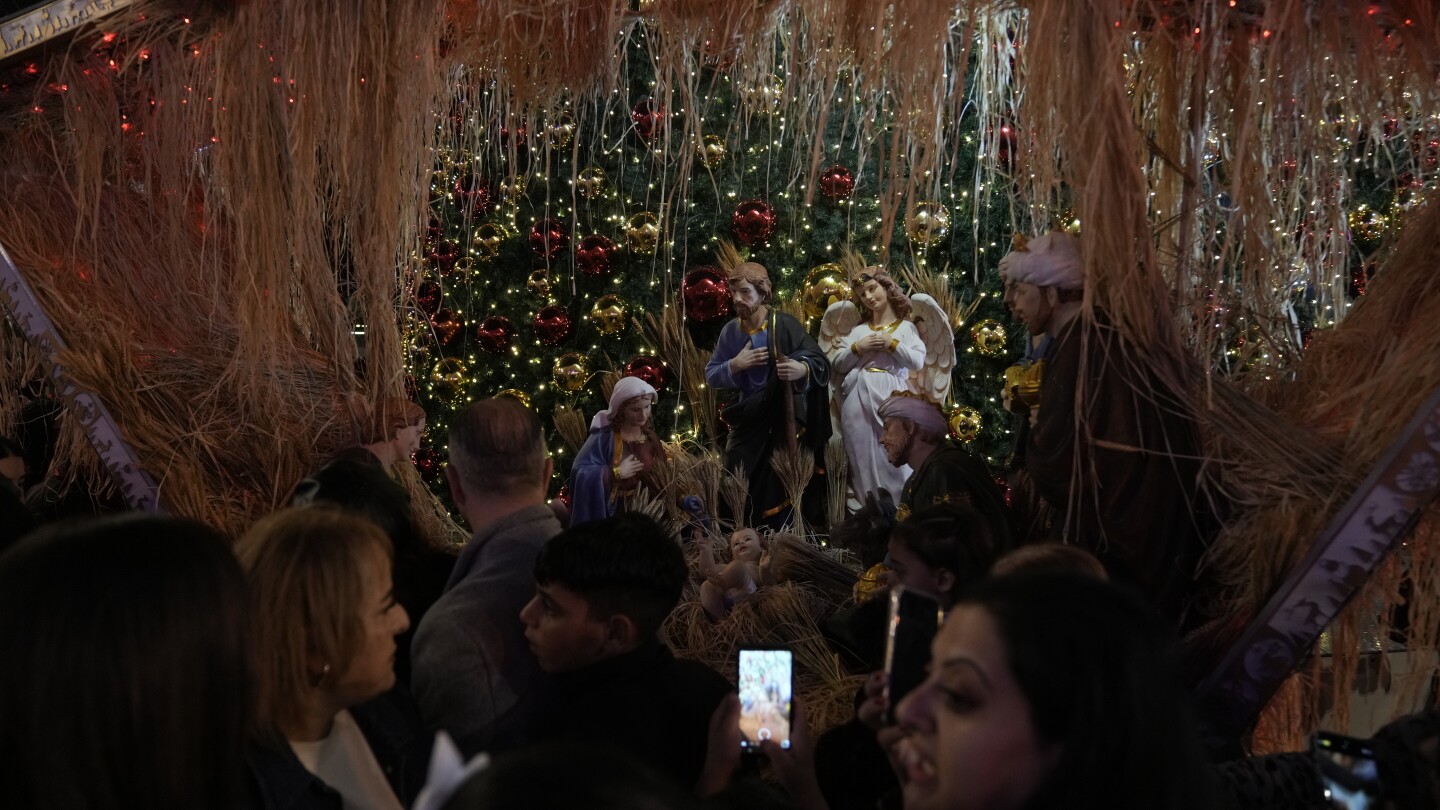
On Saturday, crowds gathered in Manger Square, adjacent to the Church of the Nativity, which marks the traditional site of Jesus’s birth. Children sat atop their fathers’ shoulders as a towering Christmas tree illuminated the square, with heavily armed police maintaining security along the perimeter.
For businesses like Juka’s family restaurant, which has served traditional Palestinian cuisine since 1979, the sight of returning visitors represents a lifeline after years of uncertainty. Many Bethlehem enterprises were forced to close during the conflict, and the Juka family questioned how long they could remain viable.
“In August, as ceasefire negotiations gained momentum, we started seeing visitors walking the streets again,” Juka explained. “That’s when we decided to reopen. Tourists finally feel safe to come back. We’re hopeful that we might see peace in our future.”
Tourist numbers have been steadily increasing. Mayor Canawati reported that November saw the highest number of visitors since the war began. Hotel reservations suggest approximately 70% occupancy during the Christmas period – a substantial improvement, though still below pre-war levels.
Despite these encouraging signs, recovery remains fragile. Most people attending the tree-lighting ceremony were local Palestinians rather than international visitors, and residents acknowledge that celebrations remain subdued compared to previous years.
The ongoing tensions throughout the West Bank continue to cast a shadow over Bethlehem’s recovery. While the city itself has maintained relative calm, violence persists in nearby areas. On Saturday, Israel’s military reported shooting two Palestinian men who allegedly attempted to ram soldiers with their vehicle at a checkpoint in Hebron, south of Bethlehem.
Military checkpoints have severely disrupted daily life. Issa Montas, a 29-year-old painter who works in Jerusalem, described spending six hours traveling from his home in Ramallah to Bethlehem – a distance of less than 20 miles that would normally take under an hour.
The United Nations has documented a sharp rise in Israeli settler attacks against Palestinians in the West Bank, reaching their highest levels since the organization began collecting such data in 2006. Israeli Prime Minister Benjamin Netanyahu, whose government includes far-right supporters of settlement expansion, has described the perpetrators as “a handful of extremists.”
“I see a lot of violence, but no one can stop them, not even the Israeli army or police can control them,” Montas said, expressing frustration with the situation.
Yet even amid these challenges, the Christmas celebrations represent a moment of collective resilience and hope. As children darted between street vendors and a blend of Christmas carols and Arabic music filled the air, Montas offered a message of unity: “This celebration is not just for us. It’s for everyone. Christian, Jewish, Muslims. This Christmas is for everyone.”
Fact Checker
Verify the accuracy of this article using The Disinformation Commission analysis and real-time sources.

10 Comments
The return of Christmas celebrations to Bethlehem is a promising sign, but the region’s challenges remain daunting. I hope the fragile ceasefire can hold, allowing the local economy and community to gradually rebuild and find a path towards lasting peace and prosperity.
The revival of Christmas festivities in Bethlehem is a promising sign, but the region remains deeply scarred by conflict. I hope the ceasefire can hold and that tourism can gradually recover to provide much-needed economic opportunities for local residents.
After the devastation of the recent wars in Gaza, it’s heartening to see Bethlehem begin to regain its vibrant Christmas celebrations. The fragile ceasefire must be maintained to allow this progress to continue. What more can be done to support sustainable economic growth in the region?
It’s wonderful to see Bethlehem celebrating Christmas again after years of disruption. The economic benefits of tourism are so important, and I hope this marks the start of a sustainable recovery for the local businesses and community.
It’s great to see Christmas celebrations returning to Bethlehem after years of conflict. This fragile ceasefire and economic revival are a hopeful sign for the region. I hope the tourism industry can continue to recover and support the local community.
The economic impact of tourism is so important for Bethlehem and the broader West Bank. I’m glad to hear the festivities are cautiously coming back, even if not at pre-war levels yet. Normalcy and stability will be critical for the local businesses to thrive again.
The resilience of the Bethlehem community is truly inspiring. Despite the challenges of recent conflicts, they are finding ways to revive their cherished Christmas traditions and support their local economy. This fragile progress must be nurtured and protected.
It’s heartening to see Bethlehem reclaiming its Christmas traditions after years of conflict and disruption. The economic benefits of tourism are vital for the local community, and I hope this revival marks the start of a more stable and prosperous era.
The return of Christmas celebrations to Bethlehem is a welcome sign of progress, but the region remains deeply scarred. I hope the fragile ceasefire can hold, allowing the local economy and community to gradually rebuild and thrive once more.
After years of war and instability, it’s heartening to see Bethlehem embracing the Christmas spirit once again. The economic benefits of tourism are so vital for the local community, and I hope this revival marks the start of a more prosperous and peaceful era.