


Listen to the article
China Targets Japan’s Tourism Industry in Diplomatic Spat Over Taiwan
BEIJING — Just days after China issued an advisory against traveling to Japan, the cancellations started flowing in.
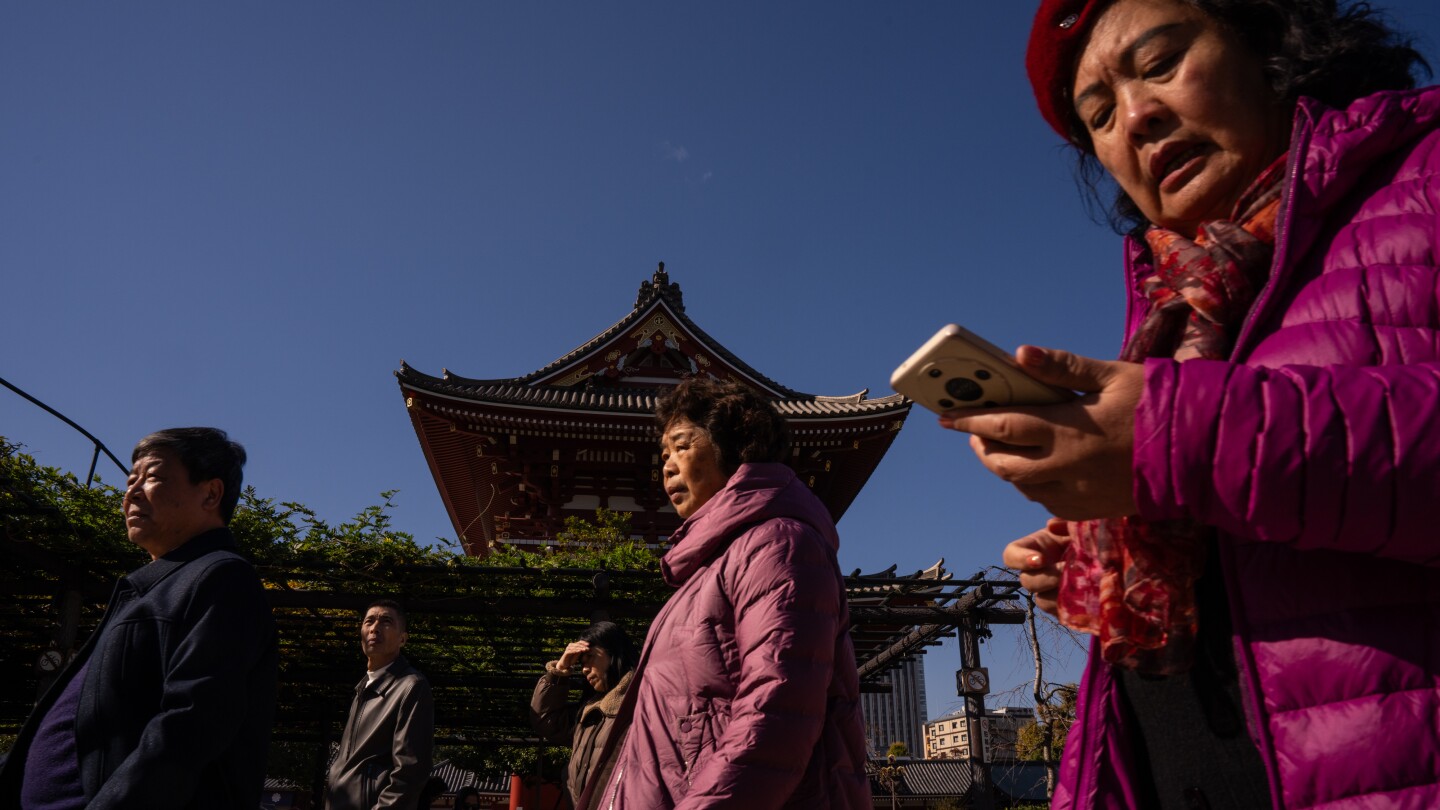
Rie Takeda, who runs a tearoom in Tokyo’s historic Asakusa district, has already seen about 200 Chinese tourists cancel bookings for her tea ceremony class, with cancellations stretching as far ahead as January. Her business typically hosts around 3,000 Chinese visitors annually.
“I just hope the Chinese tourists return by Chinese New Year,” she said, referring to the major holiday period in February. But past experience suggests the recovery may take much longer.
China’s government has turned to a well-established playbook to express its displeasure with Japan’s new Prime Minister Sanae Takaichi, who refused to retract comments regarding Taiwan. The strategy mirrors Beijing’s previous economic pressure tactics, such as tariffs on Australian wines in 2020 and restrictions on Philippine banana imports in 2012. In each case, China leveraged its economic might while directing harsh criticism at the target government.
“China’s countermeasures are all kept secret and will be rolled out one by one,” said Liu Jiangyong, an international relations professor at Tsinghua University in Beijing. “Everything is possible, because this involves the core of the nation’s core interests.”
The dispute erupted when Prime Minister Takaichi suggested earlier this month that Japan’s military could intervene if China were to take action against Taiwan, the self-governing island that Beijing claims as its territory. China was infuriated by the statement, viewing it as interference in what it considers an internal matter.
Japan has attempted to prevent further escalation but shows no sign of backing down. This approach aligns with how other governments have responded to Chinese pressure campaigns: maintain their positions despite economic pain, often allowing disputes to continue for a year or more.
“The diplomatic challenge for both sides is that they have their own domestic audiences and so they don’t want to be perceived as backing down,” explained Sheila A. Smith, a senior fellow at the Council on Foreign Relations and author of “Intimate Rivals,” a book on Japan-China relations.
History shows these disputes often persist until political changes bring new leadership. Australia’s trade with China gradually returned to normal after Prime Minister Anthony Albanese’s election in 2022, with the lobster market being the last sector to reopen. Similarly, Canada has recently begun repairing relations under new Prime Minister Mark Carney.
This isn’t Japan’s first experience with China’s economic retaliation. In 2012, Chinese protesters attacked Japanese businesses and boycotted their products following a territorial dispute over uninhabited islands claimed by both nations. Group tours to Japan were canceled then as well.
Based on the 2012 precedent, when Chinese visitors dropped by one-fourth, economist Takahide Kiuchi of Nomura Research Institute estimates the current travel advisory could cost Japan 1.8 trillion yen ($11.5 billion), reducing its already low annual economic growth by 0.3 percentage points.
The impact is already being felt across Japan’s tourism sector. Gamagori Hotel in Aichi prefecture reported losing more than 2,000 guests, while Nichu Syomu, a Japan-based tour company specializing in Chinese tourists, said 300 bookings have been canceled.
“It’s a shame,” said tour operator Nana Enomoto from Nichu Syomu, noting that Chinese tourism was just recovering after previous disruptions.
China had been on track this year to reclaim its pre-pandemic position as Japan’s top source of international visitors. More than 8 million Chinese visited in the first 10 months of 2025, accounting for 23% of Japan’s total foreign tourists, according to the Japan National Tourism Organization.
The travel advisory has created dilemmas for Chinese travelers. Kyren Zhu, who had never visited Japan, agonized over her decision before ultimately canceling a trip to see autumn foliage after warnings from her parents. Her friend proceeded with the trip and reported no unusual incidents.
“If I’d known, I probably would have just gone,” Zhu said. “But it’s hard to say. The situation is really beyond our control.”
Not all Chinese tourists are canceling. Livia Du, a Beijing resident who opened a ski lodge in northern Japan last year, received two cancellations that were quickly filled by other Chinese guests. One customer told her they needed to align with China’s official position, while another, an employee at a state-owned company, said staff had been instructed to avoid Japan temporarily.
The pressure appears to be expanding beyond tourism. Two Japanese films—the comedy “Cells at Work!” and the animated feature “Crayon Shin-chan the Movie: Super Hot! The Spicy Kasukabe Dancers”—had their Chinese releases suddenly postponed last week. A comedy festival in Shanghai canceled performances by a Japanese entertainment company, and a book publishing editor reported being instructed to suspend a project importing a Japanese comic.
Uncertainty also surrounds seafood exports to China, even after Tokyo denied reports that Beijing had reversed its decision to lift a two-year ban on Japanese seafood. When questioned about these reports, Chinese Foreign Ministry spokesperson Mao Ning claimed Japan had failed to provide necessary technical documentation to resume exports.
China could potentially target its exports of rare earth minerals, which are vital to automotive production and other industries. Beijing previously restricted rare earth exports to the United States earlier this year, demonstrating their strategic value as leverage.
“Japan should first retract its erroneous remarks and take concrete actions to maintain the political foundation of China-Japan relations,” Mao warned last week. “Otherwise, China will have to take further measures.”
Fact Checker
Verify the accuracy of this article using The Disinformation Commission analysis and real-time sources.

18 Comments
This situation highlights the delicate balancing act that countries like Japan must navigate when dealing with the economic and political pressures exerted by larger powers like China. I hope Japan can find a way to stand firm on its principles while minimizing the damage to its economy.
China’s use of economic coercion is a concerning trend that deserves close monitoring. It will be interesting to see how Japan responds and whether it can find innovative solutions to offset the impact on its tourism industry.
This is a concerning development, as it could further strain relations between China and Japan. I wonder how Japan will respond to these tourism restrictions and if they will seek alternative economic partnerships to offset the impact.
The article mentions similar tactics used against Australia and the Philippines. It seems China is not afraid to wield its economic influence to punish countries that defy its interests.
The tourism industry is a crucial part of Japan’s economy, so these Chinese restrictions could have a significant impact. It will be important for Japan to find ways to diversify its visitor base and mitigate the damage.
China’s use of economic pressure as a diplomatic tool is concerning. It will be interesting to see how Japan navigates this situation and whether it can find alternative solutions to offset the loss of Chinese tourists.
This situation underscores the delicate balancing act that countries like Japan must navigate when dealing with the economic and political pressures exerted by larger powers like China. I hope Japan can find a way to stand firm on its principles while minimizing the damage to its economy.
China’s use of economic coercion is a concerning trend that deserves close monitoring. It will be interesting to see how Japan responds and whether it can find innovative solutions to offset the impact on its tourism industry.
While China’s tactics are concerning, I’m curious to see how Japan responds. Will they seek to strengthen economic ties with other partners, or will they try to appease China to protect their tourism industry?
It will be important for Japan to carefully weigh its options and find a balanced approach that protects its interests while also maintaining constructive dialogue with China.
This is a clear example of China using its economic leverage to exert political influence. While the impact on Japan’s tourism industry may be substantial, I hope Japan will stand firm in its position on Taiwan.
It’s concerning to see China resorting to these tactics. However, Japan should explore opportunities to strengthen ties with other countries and diversify its tourism sources to reduce its vulnerability to Chinese pressure.
China’s use of economic coercion as a diplomatic tool is worrying. The impact on Japan’s tourism industry could be severe, but I hope Japan will find ways to mitigate the damage and stand firm on its principles.
This situation highlights the need for countries to build resilient and diversified economies that are less susceptible to such political pressure from larger powers.
China’s tactics of economic pressure are worrying, but not entirely unexpected. It will be crucial for Japan to explore alternative tourism markets and strengthen economic ties with other partners to reduce its vulnerability to Chinese influence.
While the impact on Japan’s tourism industry could be significant, I hope Japan will continue to stand firm on its position regarding Taiwan. Maintaining principles is important, even in the face of economic pressure.
Interesting tactic by China to pressure Japan over Taiwan. Leveraging economic power through tourism restrictions is a familiar move, but it remains to be seen how effective and long-lasting the impact will be.
China seems to rely heavily on such economic coercion tactics to advance its geopolitical agenda. It will be important to monitor the fallout and Japan’s response.