


Listen to the article
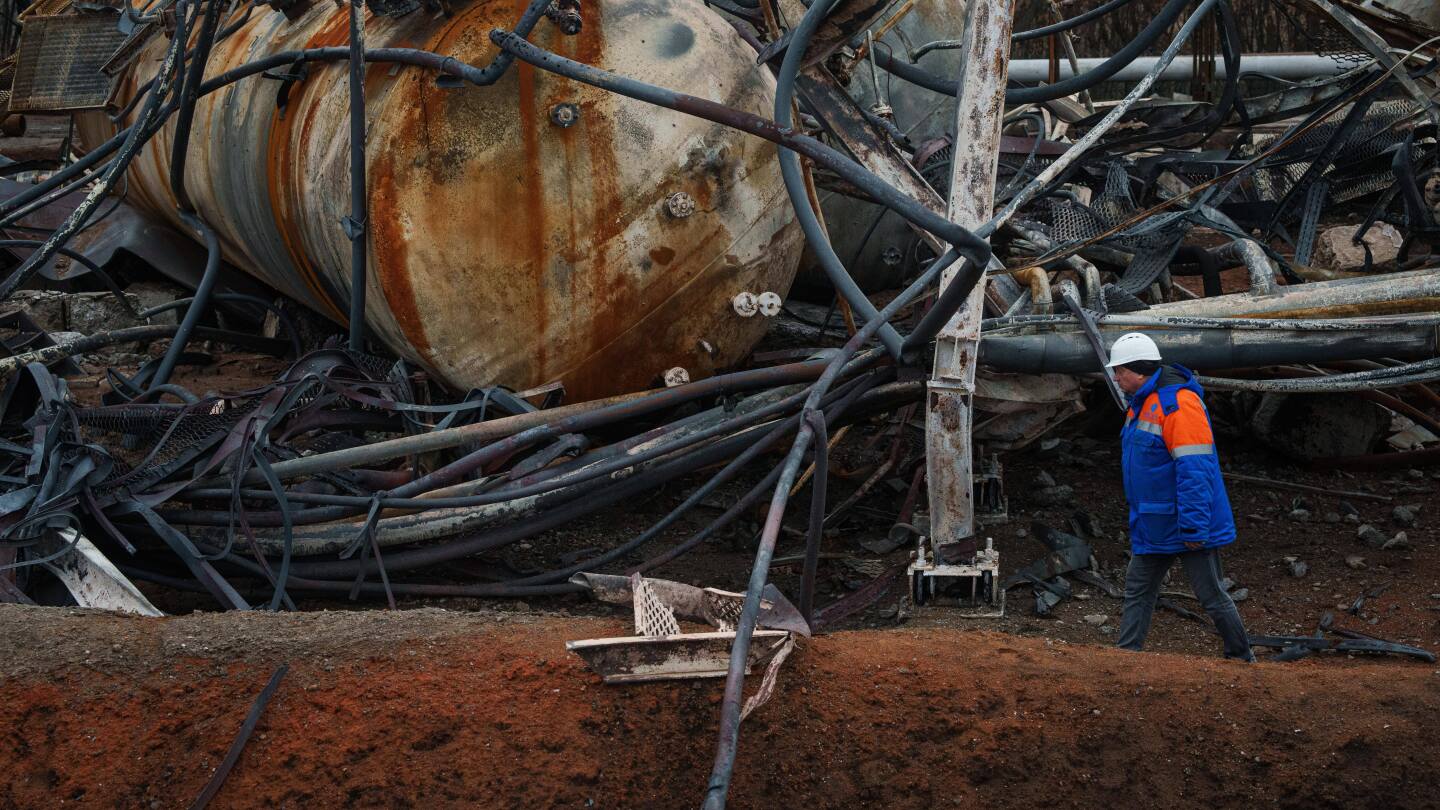
The soil surrounding the Ukrainian gas facility once pitch-black now lies burned to a rusty red, a stark reminder of October’s massive Russian drone and missile assault. Scattered remnants of Shahed drones litter the reservoir designed for storing liquefied propane gas, with numerous tanks left empty and in ruins nearly a month after the attack.
“It hurts to look at all this damage because I saw firsthand the facility’s establishment, construction and development,” said Victor, a 28-year veteran employee whose full name cannot be disclosed for security reasons. “But we have what we have, and we must continue to work.”
The Associated Press gained exclusive access to Naftogaz’s damaged gas extraction fields in central Ukraine last week, becoming the first news outlet permitted to document the war damage. Strict security protocols prevent disclosing the facility’s name or exact location.
Russia has systematically targeted Ukrainian gas infrastructure throughout 2024, aiming to undermine civilian morale and force Ukraine to import expensive gas. Without these attacks, Ukraine could cover most of its consumption through domestic extraction.
Two devastating strikes on gas facilities in March and October have created a significant supply gap, forcing Ukraine to import an additional 4.4 billion cubic meters of gas this winter. To address this shortfall, state gas company Naftogaz is negotiating with U.S. government lenders to secure financing for American liquefied natural gas purchases.
The energy crisis has become a critical factor in peace negotiations, according to a senior Ukrainian official speaking anonymously due to lack of authorization. “It is urgent because of Ukraine’s energy situation, urgent because of what Ukrainians need this winter, urgent in terms of the fight,” the official explained. The continuous attacks on energy infrastructure are imposing heavy economic costs that could extend into next year if the conflict persists.
Gas is essential for Ukrainians during winters that can reach -20 Celsius (-4 Fahrenheit), powering home heating systems, centralized hot water, industry operations, and in some cases, electricity generation.
“Given that gas infrastructure has no relation to military needs, the destruction of gas extraction, gas storage, and gas transportation has only one aim: manic terror attacks so that Ukrainians are left without gas, heating and electricity,” said Serhii Koretskyi, Naftogaz’s CEO, in an interview in Kyiv.
Before Russia began targeting gas infrastructure, Ukraine’s domestic extraction facilities produced approximately 21 billion cubic meters annually, according to 2023 data from the energy regulator. Under normal conditions, Ukraine would need to import only 2 to 3 billion cubic meters yearly. However, the October attack severely impacted extraction capabilities, creating the need for the additional 4.4 billion cubic meters at a cost of roughly $2 billion.
Koretskyi noted that Naftogaz has secured 70% of the necessary funding through European loans and grants. The company is working to obtain the remaining 30% from U.S. government lenders, including the International Development Finance Corporation and EXIM Bank. However, the process is complicated by Naftogaz’s lack of previous borrowing experience with U.S. institutions.
“This money was needed the day before yesterday. It takes time to buy it, bring it, deliver it, pump it, release it,” Koretskyi emphasized. Currently, Naftogaz is importing 25-30 million cubic meters daily, carefully managing purchases to avoid creating price spikes in European markets.
The October attack on the central Ukrainian facility involved multiple missiles and drones, triggering a fire that spread over 100 meters. Workers rushed to salvage equipment as shrapnel pierced gas transport pipes, leaving them in a tangled heap.
“After the explosion, the tanks caught fire and continued to burn and explode, resulting in collapsed metal structures flying around,” Victor explained. Naftogaz employees report that Russian attacks on production and refining facilities have been constant since the full-scale invasion began, but the March and October bombardments were particularly devastating, forcing Ukraine to increase imports as repairs could take months or years due to parts shortages.
While borrowing has been unavoidable this winter, some Ukrainian energy experts argue the government must eventually raise gas prices to prevent Naftogaz—and by extension the Ukrainian state—from relying on large annual loans. However, this risks public anger during a time when the government already faces pressure from corruption scandals in the energy sector.
“Raising prices in these conditions is difficult,” Koretskyi acknowledged, adding that President Volodymyr Zelenskyy’s government has deferred the issue for this winter.
Currently, the state subsidizes around 50% of the market price for households, according to Ukraine’s agreement with the International Monetary Fund. This prevents Naftogaz from generating revenue from residential consumers.
Energy expert Victoria Voytsitska, a former Ukrainian lawmaker now with the think tank We Build Ukraine, believes the subsidy issue creates a persistent financial gap. “As long as this issue is not resolved, there will be a financial hole in the liquidity and operational results of Naftogaz,” she said, suggesting Ukraine’s leadership has been reluctant to implement controversial reforms during wartime.
Former Naftogaz CEO Yurii Vitrenko estimates at least 30% of Ukrainians can afford market-rate energy prices, while others could receive targeted support. He suggests direct consumer payments could incentivize reduced gas consumption while acknowledging the need for “thoughtful” implementation that maintains social cohesion during the crisis.
Fact Checker
Verify the accuracy of this article using The Disinformation Commission analysis and real-time sources.

7 Comments
It’s distressing to see the damage done to Ukraine’s gas facilities. Rebuilding and protecting this critical infrastructure should be a top priority, with US gas exports playing a supporting role until Ukraine can fully restore its own energy self-sufficiency.
The targeting of Ukraine’s energy systems is a clear attempt by Russia to demoralize the civilian population. While US gas exports may help in the short term, Ukraine must focus on developing and securing its own domestic energy resources to build long-term resilience.
Russia’s systematic targeting of Ukraine’s gas facilities is a concerning tactic to erode civilian morale. Diversifying energy sources, including US gas, could help Ukraine weather these attacks, but rebuilding its domestic extraction capacity is crucial for long-term resilience.
Troubling to see the damage Russia has inflicted on Ukraine’s critical energy infrastructure. Hopefully the US can provide some relief through gas exports, but a long-term solution requires protecting and rebuilding Ukraine’s domestic energy capabilities.
Agreed, self-sufficiency in energy should be a priority for Ukraine’s recovery. US gas exports can provide interim support, but Ukraine needs to develop its own sustainable energy resources.
This news underscores the fragility of Ukraine’s energy infrastructure in the face of Russia’s relentless attacks. While US gas exports may provide short-term relief, Ukraine must focus on strengthening and securing its own energy resources to achieve true energy independence.
Absolutely, Ukraine needs to develop robust domestic energy capabilities to withstand future disruptions. Relying too heavily on imports, even from allies, leaves them vulnerable.