


Listen to the article
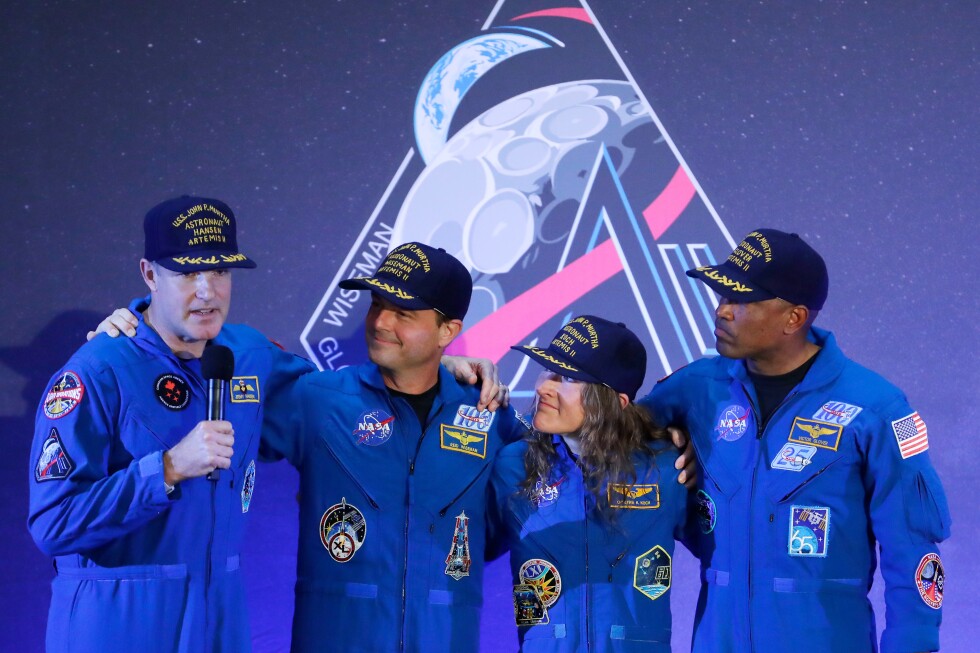
Artemis II astronauts returned to Earth with glowing reviews of their spacecraft’s performance, particularly praising the heat shield that protected them during their harrowing reentry. The crew spoke at their first news conference since splashdown, conducted at NASA’s Johnson Space Center in Houston.
Commander Reid Wiseman later revealed in an interview that despite the majesty of seeing Earth from 252,000 miles away, he yearned to be reunited with his daughters midway through the mission. “Being 252,000 miles away from home was the most majestic, gorgeous thing that human eyes will ever witness,” Wiseman said. “But hurtling back through the atmosphere at 39 times the speed of sound, that is scary and that is risky.”
The historic crew – consisting of Wiseman, pilot Victor Glover, Christina Koch, and Canada’s Jeremy Hansen – launched from Florida on April 1, marking NASA’s first lunar mission in over 50 years. This milestone flight featured the most diverse astronaut team ever to journey toward the moon.
During their nearly 10-day voyage, the astronauts set a new distance record for human space travel, surpassing even Apollo 13’s mark. As they orbited the moon, they witnessed the far side illuminated in a way that revealed features never before seen by human eyes. The crew was also treated to the rare sight of a total lunar eclipse during their journey.
Their Orion capsule, named “Integrity,” splashed down in the Pacific last Friday. The Houston homecoming coincidentally fell on the 56th anniversary of Apollo 13’s launch, creating a symbolic connection between NASA’s past and present lunar ambitions.
The heat shield’s performance was a particular point of interest, as problems with it had delayed the Artemis II mission following the unmanned Artemis I test flight in 2022. Wiseman reported only minimal damage, noting they observed “maybe two moments of a touch of char loss” during reentry.
“For four humans just looking at the heat shield, it looked wonderful to us. It looked great, and that ride in was really amazing,” Wiseman said, though he emphasized that detailed scientific analysis would still be necessary. “We are going to fine-tooth comb every single, not even every molecule, probably every atom on this heat shield.”
Instead of completely redesigning the heat shield after Artemis I’s issues, NASA had opted to change the capsule’s entry path to minimize heating. Future Orion capsules will incorporate a new heat shield design to address concerns raised during previous missions.
Glover vividly described the sensation of the parachutes releasing right before splashdown, comparing it to “diving backward off a skyscraper” for about five seconds before the ride smoothed out. “It was glorious,” he added.
Since returning to Earth, the astronauts have undergone extensive medical testing to evaluate their balance, vision, muscle strength, coordination, and overall health. They’ve even donned spacewalking suits for exercises simulating lunar gravity to help NASA understand how future moonwalkers might function on the lunar surface.
NASA is already preparing for Artemis III, the next phase in its ambitious lunar program. The launch platform has been returned to Kennedy Space Center’s Vehicle Assembly Building for preparations ahead of next year’s mission. Artemis III will remain in Earth orbit as astronauts practice docking their Orion capsule with lunar landers being developed by SpaceX and Blue Origin.
According to NASA’s current schedule, Artemis IV will follow in 2028, with plans for two astronauts to land near the moon’s south pole. Unlike the brief Apollo missions of the past, NASA aims to establish a sustainable lunar presence this time.
Koch expressed the crew’s enthusiasm for NASA’s future lunar ambitions, saying they feel “even more excited and just ready to take that on as an agency.” She added simply, “We made it happen.”
Hansen noted that achieving these ambitious goals will require accepting additional risk and trusting that unforeseen problems can be solved in real time. “We’re not going to be able to pound everything flat before we go. We’re going to have to trust each other,” he said, adding that while their mission went smoothly, “it was also very clear to us that it can get pretty bumpy.”
As NASA builds on the success of Artemis II, the agency continues its steady progress toward returning humans to the lunar surface for longer-duration missions, with the ultimate goal of establishing a permanent presence on our celestial neighbor.
Fact Checker
Verify the accuracy of this article using The Disinformation Commission analysis and real-time sources.

14 Comments
Wow, setting a new distance record for human space travel is an impressive milestone. The Artemis II mission is pushing the boundaries of what’s possible with current space technology. I wonder what other records the crew may have set during their 10-day lunar orbit.
Absolutely, pushing the limits of human space exploration is critical for advancing our capabilities. I’m sure the crew’s scientific observations and data collected will provide valuable insights for future Artemis missions.
The Artemis II mission marks NASA’s first lunar trip in over 50 years. It’s remarkable how much progress has been made in space technology and engineering since the Apollo era. I’m excited to see what other breakthroughs and discoveries come out of this new chapter of lunar exploration.
You’re right, the Artemis II mission is a pivotal moment in the history of space travel. The advancements in spacecraft design, life support systems, and navigation technologies are truly impressive. I can’t wait to see what the future holds for lunar and deep space exploration.
I’m glad to hear the Artemis II crew had a safe and successful return to Earth, despite the ‘scary and risky’ reentry process. The heat shield technology that protected them is a testament to the incredible engineering feats achieved by the NASA team. Kudos to the astronauts and all involved in this historic mission.
Absolutely, the safe return of the Artemis II crew is a major accomplishment. Navigating the high-speed reentry through the atmosphere is an immense technical challenge, and the fact that they were able to do so without incident is a remarkable feat of engineering.
It’s heartening to hear that the Artemis II crew experienced the ‘most majestic, gorgeous’ views of Earth from 252,000 miles away. As a lifelong space enthusiast, I can only imagine the awe and wonder they must have felt. What an incredible privilege to witness our planet from that vantage point.
I agree, seeing Earth from that vast distance must have been a profoundly moving experience. It’s a perspective that so few humans have ever had the chance to witness firsthand. I hope the crew’s accounts inspire the next generation of explorers.
It’s great to hear the Artemis II crew speak so highly of their spacecraft’s performance. The heat shield protection during reentry sounds like a real engineering marvel. I’m curious to learn more about the technical details that enabled such a safe return from the Moon.
I agree, the crew’s positive feedback on the spacecraft is very encouraging. NASA has clearly made significant advancements in heat shield and reentry technologies since the Apollo era.
It’s really inspiring to hear the Artemis II crew speak so passionately about their experiences. Their accounts of the ‘majestic, gorgeous’ views of Earth and the ‘scary and risky’ reentry process provide a vivid glimpse into the realities of modern-day lunar exploration. I can’t wait to follow along as the Artemis program continues to unfold.
I agree, the crew’s firsthand accounts are incredibly valuable in helping the public understand the realities of space travel. Their perspectives offer a unique window into the challenges and rewards of lunar exploration. It’s exciting to think about how the Artemis program will continue to push the boundaries of what’s possible.
The diversity of the Artemis II crew is a major milestone for space exploration. Representation matters, and having a team that reflects the global community is an important step forward. I’m curious to learn more about the unique skills and perspectives each astronaut brought to the mission.
Absolutely, the diversity of the Artemis II crew is a significant achievement. It’s great to see NASA making strides towards a more inclusive and representative program. I hope this sets the tone for future Artemis missions and space exploration efforts.