


Listen to the article
Iran’s AI-Generated Videos Mock Trump, Gaining Massive Viewership
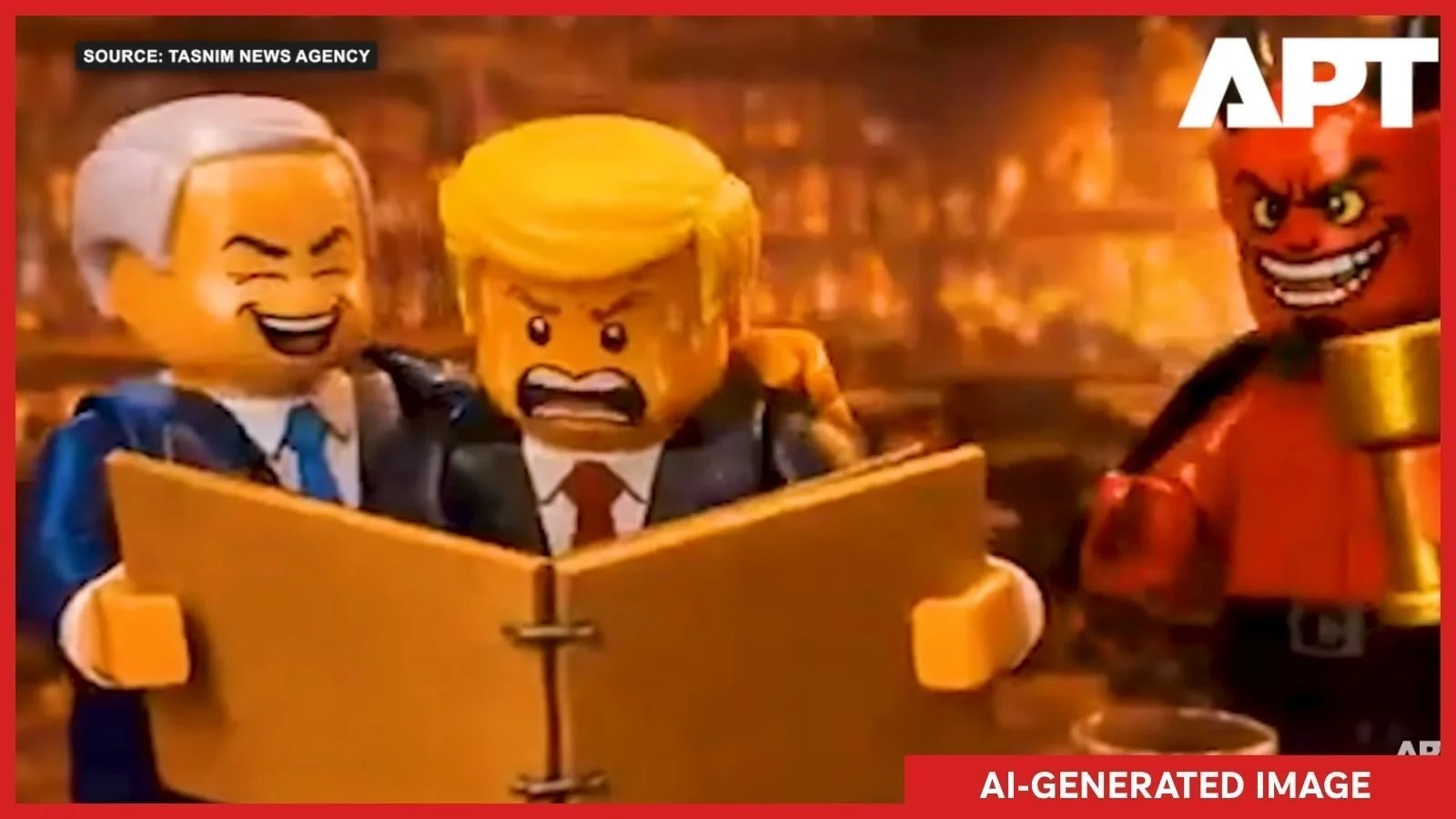
Iran has struck propaganda gold with a series of AI-generated videos featuring Lego-like figures trolling former U.S. President Donald Trump. These viral clips, which have amassed hundreds of millions of views across social media platforms, represent a sophisticated evolution in digital information warfare.
The videos, often set to rap music, portray Trump in unflattering scenarios while drawing explicit connections between military tensions with Iran and Trump’s alleged failure to release files related to Jeffrey Epstein. As reported by the BBC, one widely-shared clip depicts Trump falling through a whirlwind of “Epstein file” documents while rap lyrics declare “the secrets are leaking, the pressure is rising.”
Propaganda expert Dr. Emma Briant told the BBC that traditional terminology like “slopaganda” – a term coined last year as a play on ‘AI slop’ – fails to capture the effectiveness of this “highly sophisticated” content.
The videos first appeared in early April and have rapidly become central to Iran’s digital influence campaign against the United States. The timing coincides with escalating military tensions, as the U.S. and Israel launched large-scale attacks on Iran beginning February 28.
What makes these AI-generated videos particularly effective as propaganda tools is their rapid production cycle. The two-minute clips can reportedly be created and distributed across social media platforms within just 24 hours, allowing for nimble responses to developing events.
Beyond Trump, the videos target other prominent U.S. and Israeli figures, including Israeli Prime Minister Benjamin Netanyahu and Secretary of Defense Pete Hegseth. The latter is portrayed in particularly crude terms – shown as intoxicated, abusive, and in compromising positions with Trump.
The content originates from a group identifying itself as Explosive Media or Explosive News. In a significant admission, one of the group’s organizers acknowledged to the BBC that the Iranian government commissioned these videos, confirming direct state involvement in the propaganda campaign.
Major U.S. publications including Wired and The New Yorker have also reported on the phenomenon, highlighting its growing influence in the information space. The videos have gained such traction that Google recently took action, removing a YouTube channel posting the content for violating its policies against “spam, deceptive practices and scams,” according to a statement provided to Middle East Eye.
This takedown has sparked debate among social media commentators, with some arguing that Google’s actions align with U.S. foreign policy interests. Despite the YouTube removal, the videos continue to circulate widely on X (formerly Twitter) and other platforms.
The Iranian propaganda success comes at a time when Western democratic governments are struggling with their own communication challenges. In Canada, for example, Defence Minister David McGuinty faced significant criticism in March 2026 for contradictory statements regarding an Iranian attack on the Ali Al-Salem airbase in Kuwait, where Canadian forces were stationed.
McGuinty initially claimed he first learned about the attack from a La Presse newspaper report, then later backtracked, stating he knew “immediately following the strike.” His refusal to confirm whether Canadian equipment or infrastructure was damaged at the base – citing operational security concerns – stood in stark contrast to Australia’s approach, where Prime Minister Anthony Albanese openly confirmed that an Iranian projectile had struck the same base where Australian personnel were stationed.
The incident highlights the communication challenges democratic governments face during military conflicts, often caught between transparency obligations and security concerns – a dilemma that Iran’s propaganda machine appears poised to exploit through its innovative use of AI-generated content.
As tensions continue between Iran and Western powers, these viral videos represent a significant evolution in information warfare tactics, demonstrating how artificial intelligence can be leveraged to create compelling propaganda that reaches global audiences with unprecedented speed and scale.
Fact Checker
Verify the accuracy of this article using The Disinformation Commission analysis and real-time sources.

14 Comments
I’m curious to learn more about the technical details behind these AI-generated videos. It’s remarkable how lifelike and convincing the Lego-style animations are, even if the content is blatant propaganda.
Yes, the fact that the videos have gained hundreds of millions of views speaks to their effectiveness. It’s a sobering reminder of the potential for AI to be misused for political influence.
While the propaganda value of these videos is clear, I can’t help but be impressed by the technical sophistication behind them. The Lego animations are remarkably lifelike and the production values are high.
Yes, it’s a prime example of how AI and digital media can be weaponized for political influence. The viral nature of these videos makes them a potent tool in Iran’s information warfare against the US.
Interesting how Iran is using AI and Lego-style videos to mock Trump and stoke tensions. While the propaganda is effective, it’s concerning to see such sophisticated digital influence tactics being deployed.
You’re right, the viral reach of these videos is worrying. It highlights how disinformation can spread rapidly online, blurring the lines between fact and fiction.
The connections drawn between Trump, Epstein, and military tensions with Iran are quite bold. While the propaganda value is clear, I wonder about the broader implications for geopolitical discourse.
You raise a good point. Sophisticated disinformation like this can distort public understanding and erode trust in institutions. We’ll need to see how this plays out in the broader context of US-Iran relations.
It’s striking how Iran is leveraging emerging technologies like AI to create shareable, emotive propaganda. The Lego-style visuals and rap music give these videos a very contemporary, viral feel.
Absolutely. The ability to generate this kind of content at scale is a concerning development. We’ll need to see how platforms and fact-checkers respond to counter the spread of such sophisticated disinformation.
These AI-generated videos seem to be a clever way for Iran to amplify its message and undermine Trump’s credibility. The timing with rising military tensions is noteworthy.
I agree, the use of Lego-like figures and rap music is a savvy tactic to make the propaganda more engaging and shareable. But we should be wary of the long-term impacts of such sophisticated disinformation campaigns.
The timing of these AI-generated videos, coinciding with escalating military tensions, suggests a calculated effort by Iran to sway public opinion. It’s a concerning development in the realm of digital propaganda.
Absolutely. We’ll need to closely monitor how these types of sophisticated disinformation campaigns evolve and how they impact broader geopolitical dynamics. Vigilance and fact-checking will be crucial.