


Listen to the article
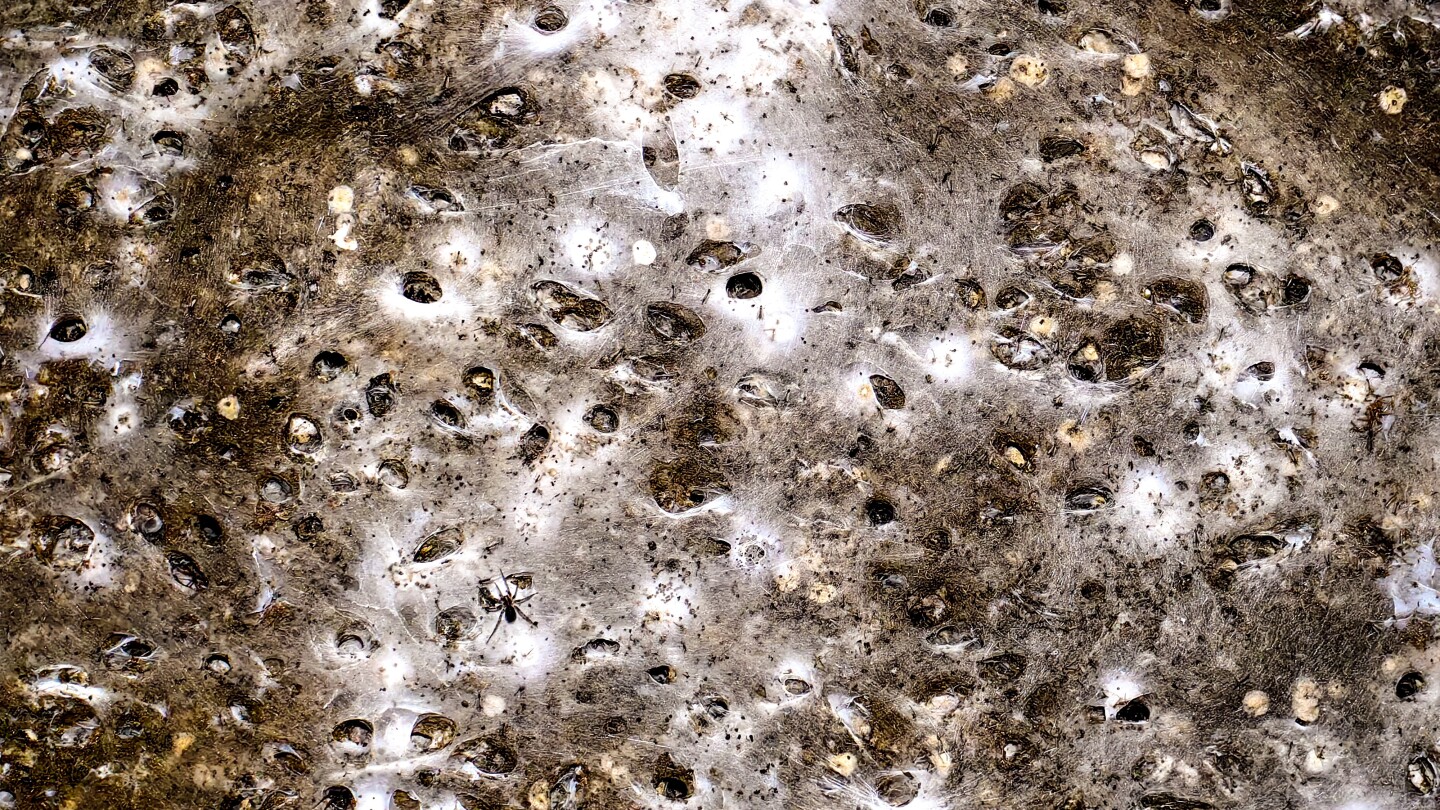
In a remarkable discovery along the Albanian-Greek border, scientists have identified what may be the world’s largest known spider web, spanning an impressive 1,140 square feet and housing an estimated 110,000 arachnids. The massive silk structure stretches along a wall inside Sulfur Cave, extending from its entrance in Greece into Albanian territory.
What has particularly excited researchers isn’t merely the web’s extraordinary size but the unprecedented peaceful coexistence of two different spider species within this sprawling colony. The web houses approximately 69,000 Tegenaria domestica (common house spiders) alongside 42,000 Prinerigone vagans, living harmoniously in an arrangement that defies typical spider behavior.
“When I saw this study, I was very excited because group living is really rare in spiders,” said evolutionary biologist Lena Grinsted, a senior lecturer at the University of Portsmouth who was not involved in the research. “The fact that there was this massive colony of spiders living in a place that nobody had really noticed before—I find extremely exciting.”
The findings, published last month in the journal Subterranean Biology, quickly gained attention online, with striking images of the carpet-thick web sprawl. Scientists have been particularly intrigued by how these species can cohabit without conflict, as typically the larger house spider would prey on its smaller neighbor.
“So often if you have spiders in close vicinity, they will fight and end up eating each other,” explained Dr. Grinsted. “We can sometimes see that if there’s an abundance of food that they sort of become a bit less aggressive.”
The research team believes this unusual coexistence may be explained by several factors. The cave contains an estimated 2.4 million midge flies—an “unusually dense swarm” providing constant sustenance in an environment largely devoid of predators. Additionally, the permanent darkness approximately 50 meters (164 feet) from the cave entrance may play a role in this peaceful arrangement.
Rather than impaired vision being responsible, Dr. Grinsted suggests the larger spiders have likely evolved to respond primarily to vibration cues when flies land on their web, potentially reducing aggression toward their smaller neighbors. She compares the situation to humans in apartment buildings who share common spaces but maintain territorial boundaries.
“You’re very happy to share the stairs, the lift,” she said, “but if anybody comes into your living room and you haven’t invited them, you’ll be aggressive toward them.”
Dr. Blerina Vrenozi, a biologist at the University of Tirana and co-author of the study, noted that genetic analysis revealed intriguing differences. “The DNA is interesting because they revealed that the species which live inside the cave is different from the one which lives outside the cave,” she explained. “So it’s the same species, but different DNA.”
The massive web was first observed in 2021 by Czech speleologists led by Marek Audy. Their subsequent expanded expedition, including scientists from multiple universities, led to the comprehensive research now published.
Audy described the web’s structure as “dense, more like a blanket,” providing excellent protection for female spiders. He also noted that cave-dwelling spiders lay fewer eggs compared to their outdoor counterparts—roughly one-third the quantity—possibly due to the greater certainty of offspring survival in this sheltered environment.
The humid, dark cave also hosts large bat colonies, creating what Audy describes as a continuous “party” for both bats and spiders thriving on the abundant midge population.
While the study acknowledges potential slight overestimation in population counts due to some abandoned webs, other experts emphasize the significance of this discovery for evolutionary understanding. Dr. Sara Goodacre, professor at the University of Nottingham, suggests this research helps illuminate “what forces shape the world around us—spidery or not.”
“Natural selection will favor the ‘best’ strategies…the ‘winning strategy,’ whatever this is,” she said. “My guess is that the benefits of being part of this community far outweigh the costs.”
In an amusing political footnote to this scientific discovery, Audy mentioned that Albanian authorities had inquired about which side of the border the famous spider colony lies. “From a conservation point of view, we did something interesting there and marked out a border,” he said. “I just looked into it—and the spider web is on the Greek side.”
Fact Checker
Verify the accuracy of this article using The Disinformation Commission analysis and real-time sources.

10 Comments
This discovery is a great reminder of how much biodiversity and natural wonder is still out there waiting to be explored, even in relatively accessible areas like caves along country borders. I’m looking forward to seeing what other secrets the scientific community uncovers about this remarkable spider colony.
Well said. This just goes to show that there are still so many fascinating and unexpected discoveries to be made, even in the most seemingly ordinary places. It will be exciting to see what else these researchers uncover.
As someone interested in mining and geology, I’m curious to know more about the cave environment where this massive spider web was found. What is the geological and mineral makeup of Sulfur Cave that allows for such a unique spider ecosystem to thrive?
Good question. The article mentions it’s along the Albanian-Greek border, so the cave likely has some interesting geological features worth exploring further. Understanding the cave’s chemistry and microclimate could provide valuable insights.
As someone who follows mining and commodity stocks, I’m wondering if there could be any potential commercial applications or opportunities that arise from further study of this spider super-web. Could the unique properties of the silk be leveraged for new materials or technologies?
That’s an interesting angle to consider. Spider silk is known for its incredible strength and flexibility, so there could be opportunities to explore its industrial or even medical applications if the researchers can better understand the spiders’ web-building abilities.
Fascinating discovery! I’m amazed by the scale of this spider super-web and the unusual coexistence of multiple species. It really highlights how much we still have to learn about spider behavior and colony dynamics.
I agree, this is a remarkable finding. It will be interesting to see what other secrets these caves may hold in terms of undiscovered spider communities.
This is a fascinating discovery, but I have to wonder about the potential impact on the local ecosystem. With so many spiders concentrated in one area, what ripple effects might this have on the broader food chain and biodiversity in the region?
That’s a good point. The sheer scale of this spider colony is quite remarkable, and it would be important to study how it interacts with and potentially affects other species in the cave system and surrounding habitats.