


Listen to the article
Sony’s Table Tennis Robot Challenges Elite Players, Showcasing AI Advances
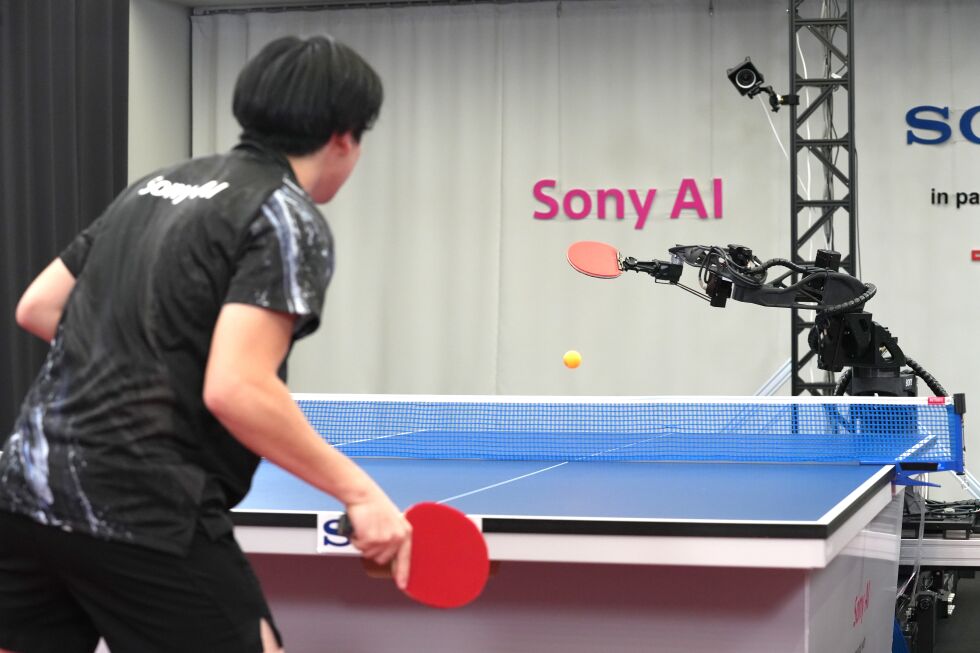
A robotic arm named “Ace,” developed by Sony, is demonstrating remarkable prowess at table tennis, challenging and occasionally defeating elite human players in a significant milestone for artificial intelligence and robotics.
The robot, which learned to play through AI reinforcement learning, represents a major advance in machine agility and real-world performance, according to a study published Wednesday in the science journal Nature.
“There’s no way to program a robot by hand to play table tennis. You have to learn how to play from experience,” explained Sony AI researcher Peter Dürr, a co-author of the study. To create a fair testing environment, Sony constructed an Olympic-sized table tennis court at its Tokyo headquarters where professional athletes could compete against the machine.
The custom-built robot features an eight-jointed arm providing precise control over its movements and positioning. What gives Ace unique capabilities are its nine camera “eyes” positioned around the court and its ability to track the ball’s logo to measure spin—advantages that help it compete at human professional levels while playing by official rules.
“Speed is really one of the fundamental issues in robotics today, especially in scenarios or environments that are not fixed,” said Michael Spranger, president of Sony AI. “We see a lot of robots that are in factories that are very, very fast. But they’re doing the same trajectory over and over again. With this technology, we show that it’s actually possible to train robots to be very adaptive and competitive and fast in uncertain environments that constantly change.”
Sony engineers were careful not to give the robot superhuman abilities that would make competition unfair. Instead, they designed Ace with capabilities comparable to skilled athletes who train at least 20 hours weekly. The goal wasn’t simply to create an unbeatable machine but to develop AI with sophisticated decision-making skills that could compete through strategy and technique.
“It’s very easy to build a superhuman table tennis robot,” Spranger noted. “You build a machine that sucks in the ball and shoots it out much faster than a human can return it. But that’s not the goal here. The goal is to have some level of comparability, some level of fairness to the human, and win really at the level of AI and the level of decision-making and tactics and, to some extent, skill.”
Sony claims this achievement marks the “first time a robot has achieved human, expert-level play in a commonly played competitive sport in the physical world—a longstanding milestone for AI and robotics research.”
The development follows a trajectory in AI research that began with board games like chess, moved to video game environments, and now is advancing into physical interactions with the real world. Spranger described the past year as a “kind of ChatGPT moment for robotics,” with new AI-driven approaches teaching robots about their real-world environments and enabling physically demanding activities.
Sony is not the first to create table tennis robots. John Billingsley pioneered such contests in 1983 with a paper titled “Robot Ping-Pong,” and more recently, Google’s DeepMind has tackled the sport. However, Billingsley, a retired mechatronics professor at the University of Southern Queensland, noted that Sony’s advanced vision systems and motion detection capabilities give the robot advantages that humans with just two eyes cannot match.
Japanese professional players Minami Ando and Kakeru Sone were among those who competed against Ace. After submitting the paper for peer review, Sony researchers continued improving the robot, increasing its shot speeds and making its play more aggressive. In December matches against four high-skilled players, Ace defeated all but one of them.
Olympic player Kinjiro Nakamura, who competed in the 1992 Barcelona Games, was particularly impressed after observing Ace make what he considered an impossible shot. “No one else would have been able to do that. I didn’t think it was possible,” Nakamura remarked in the Nature paper, adding that the robot’s achievement “means that there is a possibility that a human could do it too.”
The technology demonstrated in Ace could have applications beyond sports, potentially benefiting manufacturing and other industries that require fast, adaptive robotic systems operating in dynamic environments.
Fact Checker
Verify the accuracy of this article using The Disinformation Commission analysis and real-time sources.

13 Comments
This is a really intriguing development in the world of AI and robotics. I wonder if the same kind of technologies used to train the table tennis robot could be applied to other physical tasks, like mining or construction work. It would be fascinating to see how that kind of automation could transform certain industries.
Fascinating to see AI making such rapid strides in physical skill domains like table tennis. I wonder what else this kind of advanced robotics and machine learning could be applied to in the future – maybe mining, construction, or manufacturing tasks?
You’re right, the potential applications for this kind of AI-powered robotics are really exciting. It will be interesting to see how the technology evolves and what new capabilities emerge.
I’m impressed that the AI-powered robot was able to defeat elite human players at table tennis. It really highlights the rapid advancements happening in robotics and machine learning. I’d be curious to know more about the technical details behind how the robot was trained and what gives it such precise control.
The article mentions the robot uses multiple cameras and can track the ball’s spin – that must give it some significant advantages over human players. I wonder if similar sensor and tracking technologies could be applied to improve robot performance in other sports or industrial applications.
While the table tennis robot’s skills are undeniably impressive, I can’t help but wonder about the broader societal implications. As AI and robotics continue to advance, we need to be proactive in considering how this technology will impact jobs and the workforce. Careful planning and policies will be crucial to ensure a smooth transition.
While it’s amazing to see an AI-powered robot excel at a complex physical skill like table tennis, I can’t help but wonder about the broader implications. Could this type of advanced robotics eventually displace human workers in certain industries? It’s an interesting and potentially concerning development that bears close watching.
That’s a fair point. Advancements in robotics and AI do raise valid concerns about job displacement, especially in manual or repetitive tasks. It will be important for policymakers and industry leaders to carefully consider the societal impacts as this technology continues to evolve.
The table tennis robot’s defeat of elite human players is a significant milestone for AI and robotics. I’m curious to see how this technology could potentially be applied to other physical tasks, like mining or industrial automation. The precision and control demonstrated in this application are quite remarkable.
The table tennis robot is an impressive technical achievement, but I wonder how it would fare against the very best human players in the world. The article mentions it beat elite players, but I’d be curious to see how it stacks up against the true masters of the sport.
That’s a great question. Defeating top-tier professional players would be an even bigger milestone for the robot’s capabilities. It would be fascinating to see how the two compare at the absolute highest level of table tennis skill and technique.
While the table tennis robot is an undeniably impressive feat of engineering, I can’t help but feel a bit uneasy about the implications. As AI and robotics continue to advance, we need to be vigilant about potential negative impacts on jobs and the workforce. Careful planning and proactive policies will be crucial moving forward.
The table tennis robot’s ability to track the ball’s spin and movement with such precision is truly remarkable. I’d love to learn more about the specific computer vision and control algorithms that allow it to perform at such a high level. Advancements in this kind of real-world AI application are incredibly exciting.