


Listen to the article
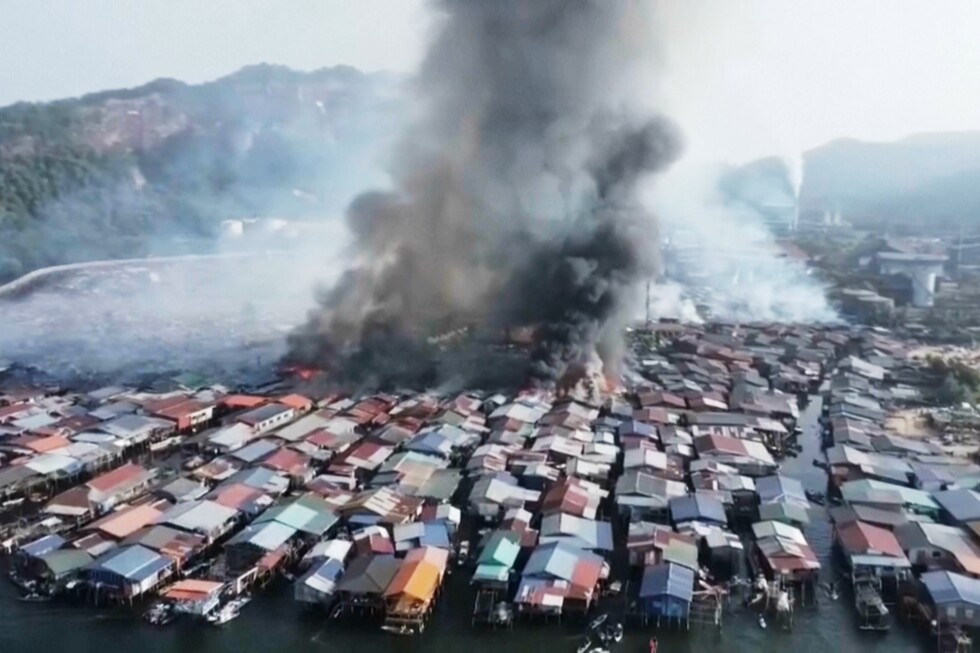
A devastating fire swept through a coastal settlement in Malaysia’s Borneo Island early Sunday, destroying approximately 1,000 homes and displacing more than 9,000 residents in one of the region’s worst residential disasters in recent years.
The blaze erupted in Sandakan district, a coastal area in Sabah state where many residents live in traditional water villages — wooden structures built on stilts over the sea. According to the fire and rescue department, strong winds quickly spread flames through the densely packed wooden dwellings, creating a fast-moving inferno that was difficult to contain.
Emergency response efforts were severely hampered by several factors. The settlement’s narrow access routes made it challenging for firefighters to reach affected areas, while low tide conditions complicated marine-based rescue operations. The tightly clustered wooden structures, many connected to one another, created ideal conditions for the rapid spread of fire.
“The proximity of these homes to each other essentially created one continuous fuel source,” said a local fire official who requested anonymity as they were not authorized to speak to the media. “Once one structure caught fire, it was almost inevitable that nearby homes would follow.”
While no deaths have been reported so far, thousands of affected residents have been relocated to temporary shelters established by local authorities. Many families lost everything in the blaze, escaping with only the clothes they were wearing.
Water villages are common along Sabah’s coastline, representing a traditional way of life for many communities but also reflecting the economic realities of the region. Sabah remains one of Malaysia’s poorest states, with many residents living in informal settlements lacking proper infrastructure and safety features.
These communities often comprise low-income families, Indigenous groups, and people without formal citizenship status, making them particularly vulnerable during disasters. The absence of proper fire breaks, limited access to water for firefighting, and the predominant use of flammable building materials contribute to the high fire risk in these areas.
According to local newspaper Daily Express, village head Sharif Hashim Sharif Iting suggested the fire originated from a cooking accident that spiraled out of control, though authorities have not officially confirmed this account. Fire investigators continue to examine the scene to determine the precise cause of the disaster.
Prime Minister Anwar Ibrahim addressed the situation in a statement, confirming that federal and state agencies are coordinating comprehensive relief efforts, with immediate attention focused on providing shelter, food, and essential supplies to displaced families.
“We are mobilizing all available resources to support those affected by this tragedy,” the Prime Minister stated. “Beyond immediate relief, we must also examine how to rebuild these communities with greater resilience against such disasters.”
The Sabah incident highlights a recurring problem in the region, where fires in water villages have become distressingly common. Despite authorities acknowledging the high fire risk in these settlements for years, implementing broader safety upgrades remains challenging due to complex socioeconomic factors, land rights issues, and the cultural significance of these traditional dwellings.
Regional development experts point out that any long-term solution will require balancing safety improvements with preserving the cultural heritage and way of life these communities represent. Previous attempts at relocating water village residents to mainland housing have met with resistance, as these communities have deep historical and cultural connections to their maritime lifestyle.
As relief efforts continue, local NGOs have begun collecting donations of clothing, food, and household essentials for affected families. The Sabah state government has pledged emergency funding to assist with immediate recovery efforts, though the scale of reconstruction needed presents significant challenges for the economically struggling region.
Fact Checker
Verify the accuracy of this article using The Disinformation Commission analysis and real-time sources.

14 Comments
Wow, over 9,000 people displaced by a single fire in Borneo. That’s staggering. The details about the fire’s rapid spread due to the densely packed wooden homes are really concerning. I wonder what steps can be taken to improve fire safety in these types of vulnerable settlements.
Good point. Strengthening fire codes, improving access routes, and potentially transitioning to more fire-resistant building materials could all help mitigate the risks. But it’ll take significant investment and coordination with the local communities.
Wow, 9,000 people displaced by a single fire – that’s an astounding number. The details about the narrow access routes and tightly clustered wooden homes really explain how the fire spread so rapidly and intensely. I hope the emergency response has been able to provide adequate shelter and aid to all those affected.
Yes, the descriptions of the fire conditions are quite alarming. Improving fire safety and emergency response capabilities in these types of settlements will be crucial to preventing such large-scale disasters in the future.
This is just a devastating situation for the people of Borneo. Losing your home to a fast-moving fire like this must be incredibly traumatic. I hope the authorities are able to provide sufficient shelter, food, and other aid to the thousands who have been displaced.
Such a devastating fire, displacing so many people in Borneo. I hope the emergency response efforts are able to provide aid and shelter to the thousands affected. Disasters like this really highlight the need for better fire safety and infrastructure in vulnerable communities.
Agreed, the tight clustering of homes and limited access routes seem to have exacerbated the situation. Improving fire prevention and emergency preparedness in these types of settlements should be a priority going forward.
This is a terrible situation for the people of Borneo. Losing your home in a disaster like this must be incredibly traumatic. I hope the authorities are able to provide adequate shelter, aid, and support to the thousands displaced by the fire.
This is just a terrible tragedy. My heart goes out to the thousands of people who have lost their homes in Borneo. Disasters like this really highlight the need for better emergency preparedness and resilience-building in vulnerable communities around the world.
Tragic to see such a large-scale fire destroy so many homes and displace thousands in Borneo. The details about the rapid spread due to the tightly packed wooden structures are really concerning. Hopefully the affected communities can recover and rebuild safely.
You’re right, the fire conditions sound incredibly dangerous. I hope the emergency responders were able to evacuate everyone safely, even with the challenges they faced. Rebuilding efforts will be critical in the aftermath.
Tragic to see such a massive fire displace so many people in Borneo. The descriptions of the narrow access routes and tightly packed wooden homes creating ideal conditions for the blaze to spread rapidly are really concerning. I hope the emergency response has been able to provide adequate aid and shelter to all those impacted.
Over 9,000 people displaced by a single fire – that’s an unimaginable scale of destruction. The details about the tight clustering of homes and limited access for firefighters really underscores how quickly things spiraled out of control. My heart goes out to the affected community.
Absolutely. Disasters like this highlight the urgent need for better fire safety infrastructure and emergency preparedness in vulnerable communities. I hope the recovery and rebuilding efforts can make these settlements more resilient in the future.