


Listen to the article
FBI Director’s 3D-Printed Gun Gifts to New Zealand Officials Deemed Illegal
WELLINGTON, New Zealand — Inoperable pistols gifted by FBI Director Kash Patel to senior New Zealand security officials were identified as Maverick PG22 revolvers, a 3D-printed weapon modeled after toy Nerf guns, according to documents obtained by The Associated Press. The officials were forced to surrender the weapons for destruction as they violated New Zealand’s strict firearms laws.
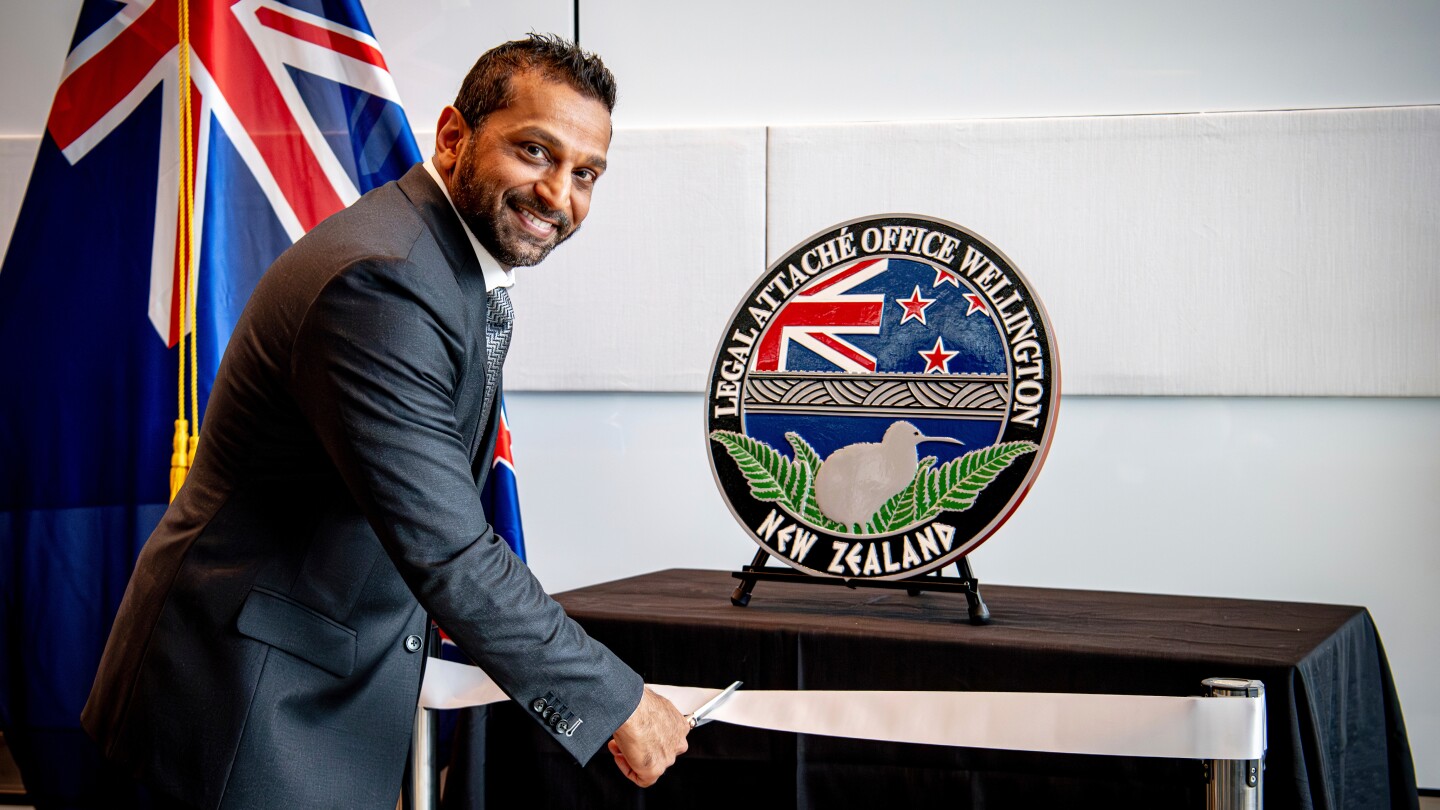
The gifts were presented during Patel’s July visit to Wellington, where he opened the FBI’s first standalone office in New Zealand. The plastic 3D-printed replicas were part of display stands given to New Zealand’s police and intelligence chiefs, along with two cabinet ministers.
New Zealand Police Commissioner Andrew Coster, New Zealand Security Intelligence Service (NZSIS) Director-General Andrew Hampton, and Government Communications Security Bureau (GCSB) Director-General Andrew Clark all received the controversial gifts. Police Minister Mark Mitchell and Defense Minister Judith Collins, who oversees military and intelligence agencies, were also recipients. All five officials voluntarily surrendered the weapons.
Under New Zealand law, pistols are tightly regulated, requiring special permits beyond standard gun licenses. While authorities did not specify whether the officials held such permits, the subsequent handling of the gifts suggests they did not.
Police documents revealed that the Maverick PG22 is among the most common 3D-printed guns seized by New Zealand officers. The model has gained popularity within amateur 3D-printing communities despite serious safety concerns.
“These processes are very straightforward and require minimal skills and common ‘handyperson’ tools,” wrote police armory team leader Daniel Millar in an August email to his superiors, describing how easily the replicas could be made functional. He noted that making the weapons operable would require only “a battery drill and a drill bit for the holes and a small screw for the firing pin.”
Professor Alexander Gillespie, a firearms regulation expert at New Zealand’s University of Waikato, explained the dual risks posed by such weapons: “The first risk is that it can be made viable and it gets into the hands of the wrong person and it’s used for a crime. The second risk is it just explodes because it’s not actually safe.”
The police documents noted that Patel’s gifts had been “manufactured to a high standard,” though online instructions for the Maverick PG22 warn that the weapon “does not feature proper modern safeties and should be used in a controlled environment.” Police destroyed the surrendered weapons on September 25.
New Zealand Police denied the AP’s public records request for photos of the confiscated guns, claiming that “releasing the requested images would be likely to prejudice New Zealand’s relations with the United States of America.” This justification came despite the fact that photos and instructions for making the Maverick PG22 are readily available online.
The incident highlights the stark differences in gun culture between the United States and New Zealand, where firearms legislation was significantly strengthened following the 2019 Christchurch mosque shootings. In that attack, an Australian gunman killed 51 Muslim worshippers using legally obtained semi-automatic weapons.
Unlike the United States, where gun ownership is constitutionally protected, New Zealand law considers it a privilege, not a right. While firearms are common in rural areas for agricultural and pest control purposes, violent gun crime remains rare in the island nation.
The cultural divide is further illustrated by New Zealand’s approach to armed policing. Most front-line officers don’t carry weapons during regular patrols, keeping their firearms secured in their vehicles—a practice that would be unthinkable in many American jurisdictions.
The FBI director’s office did not respond to requests for comment on the incident. Patel, the highest-ranking Trump administration official to visit New Zealand, was in Wellington as part of diplomatic outreach efforts in the Pacific region, where the United States has been strengthening alliances amid growing concerns about Chinese influence.
Fact Checker
Verify the accuracy of this article using The Disinformation Commission analysis and real-time sources.

12 Comments
The FBI director giving 3D-printed gun replicas as gifts seems like an odd choice, even if they were non-functional. I wonder what the intent was behind that decision and if it will impact the FBI’s relationship with New Zealand authorities.
Good point. Gifting restricted weapons, even non-functional ones, could be seen as insensitive or inappropriate, especially for government officials. It may raise some trust issues.
It’s interesting that the 3D-printed guns gifted by the FBI director were based on toy Nerf revolvers. I wonder if this was an attempt to downplay the seriousness of the issue or if there was some other reasoning behind it.
Good point. Regardless of the intent, gifting any kind of firearm replica, even a toy-inspired one, to foreign officials seems like a questionable decision that could cause more problems than it solves.
This news about the 3D-printed gun gifts highlights the ongoing challenges around emerging technologies and firearms regulations. I’m glad the New Zealand officials acted swiftly to comply with their laws.
Agreed. As technology advances, policymakers will need to carefully balance public safety with innovation. Responsible oversight is crucial.
The fact that these 3D-printed revolvers were inspired by Nerf toys makes the situation even more unusual. I wonder if the FBI director was trying to make light of the issue or if there was some other intention behind the gifts.
A curious choice indeed. Regardless of the intention, gifting any kind of firearms, even replicas, to foreign officials seems ill-advised and could create unnecessary complications.
Interesting development with the 3D-printed guns gifted to New Zealand officials. While toy-inspired, it seems they still violated strict firearms laws there. Curious to learn more about the legality and implications of such gifts.
Yes, it’s a complex issue around 3D-printed firearms and regulations. The officials did the right thing by surrendering the weapons for destruction.
This story highlights the ongoing challenges around 3D-printed firearms and the need for clear, consistent global regulations. I’m glad the New Zealand officials acted quickly to comply with their laws and return the gifts.
Absolutely. As technology continues to evolve, countries will need to work together to establish a coherent framework for addressing emerging threats while fostering innovation.