


Listen to the article
Communications Industry Rallies Against Global Threat of Misinformation
Communications professionals worldwide are calling for unified action against the growing crisis of information pollution, according to a new international survey released today. The research, conducted by the International Communications Consultancy Organisation (ICCO), reveals mounting concerns across the PR industry as misinformation and disinformation reach critical levels globally.
The survey, part of ICCO’s Media Information and Education Pledge initiative, gathered insights from 130 professionals spanning over 20 countries, including PR experts, journalists, fact-checkers, and institutional communication officers. The timing is particularly significant as the World Economic Forum’s Global Risks Report 2025 has identified misinformation and disinformation as the most pressing short-term global threats.
Industry professionals report a worrying trend, with 65% of respondents noting an increase in disinformation over the past year. Even more concerning, 42% have been directly involved in reputation management or crisis communications projects triggered by false information targeting their organizations or clients.
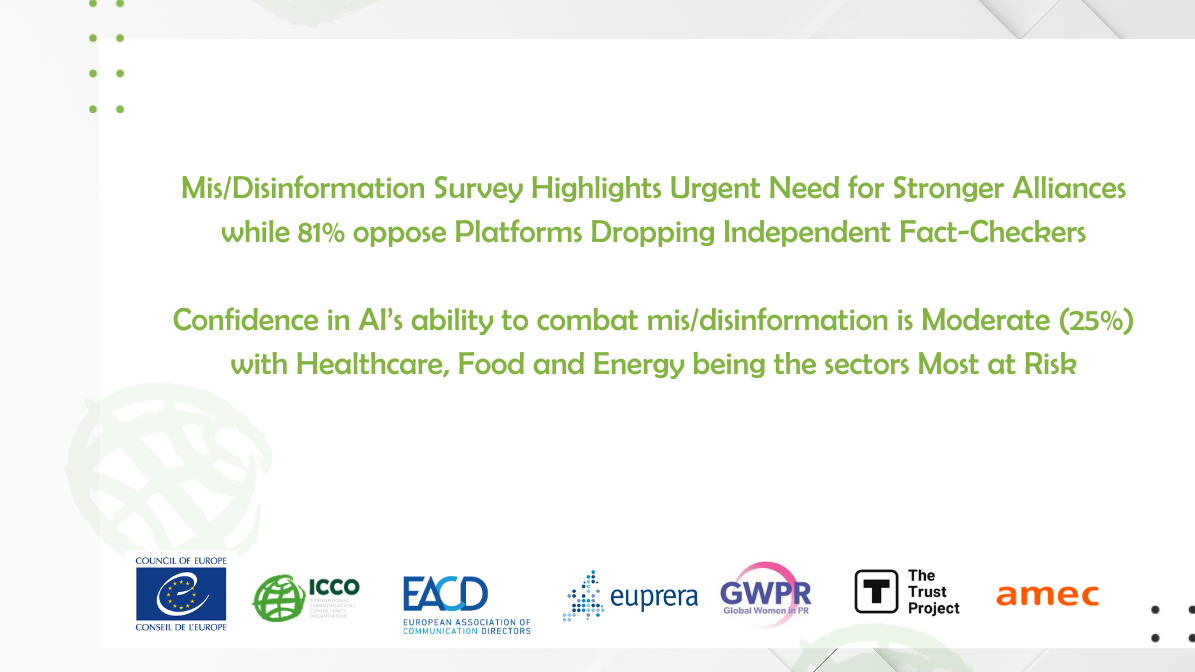
“Our 2025 survey shows an increase in disinformation according to respondents’ daily work experiences along with a moderate confidence in AI’s ability to combat mis/disinformation,” said Massimo Moriconi, ICCO Global VP and Chair of the Mis/Disinformation Working Group. “In this context, professionals call for stronger alliances among different stakeholders of the information society.”
Politics, elections, and armed conflicts emerged as the most vulnerable topics for misinformation, followed by climate change. The healthcare and pharmaceutical sectors face the highest risk of being targeted by false narratives, with food and beverage, energy, and financial services industries close behind.
The survey highlights a clear industry consensus on the most effective countermeasures. Respondents gave their highest endorsement (4.43 out of 5) to forming strategic alliances between institutions, fact-checking organizations, and technology platforms. Professional training and certification in content verification ranked second, scoring 4.22 out of 5.
Social media platforms’ recent decisions to sever partnerships with independent fact-checkers have raised significant alarm within the communications industry. An overwhelming 81% of respondents opposed these moves, expressing serious concerns about further erosion of information integrity in digital spaces.
The role of artificial intelligence in addressing misinformation appears increasingly nuanced. In 2024, 42% of respondents viewed AI as playing a significant role in combating false information. However, this year’s results show more measured expectations, with only 25% expressing strong confidence in AI solutions, while an additional 22% indicated contextual effectiveness with “it depends” responses.
Despite these challenges, the communications industry is mobilizing resources. In May 2025, ICCO and its partners released “Tackling Mis/Disinformation – A Global Digital Handbook for Communicators,” which has received positive feedback for providing practical guidance and tools. The handbook was developed under the Media Information and Education Pledge, a collaboration between ICCO and organizations including the Council of Europe, The Trust Project, and the European Association of Communication Directors.
The Pledge community continues to expand, inviting organizations to align with its ten guiding principles and contribute to improving media literacy and ethical standards. This collaborative framework aims to facilitate the sharing of best practices, training, and resources in the ongoing battle against misinformation.
As technology evolves and information ecosystems grow more complex, the communications industry appears to be embracing its role as a critical line of defense against false information. The survey suggests that while individual efforts remain important, collective action across institutional boundaries may prove the most effective strategy in preserving information integrity.
Fact Checker
Verify the accuracy of this article using The Disinformation Commission analysis and real-time sources.
