


Listen to the article
Social media platforms are undermining democracy through design choices that prioritize profit over societal well-being, according to new research from a University of Notre Dame expert who has developed a blueprint for building more responsible technology.
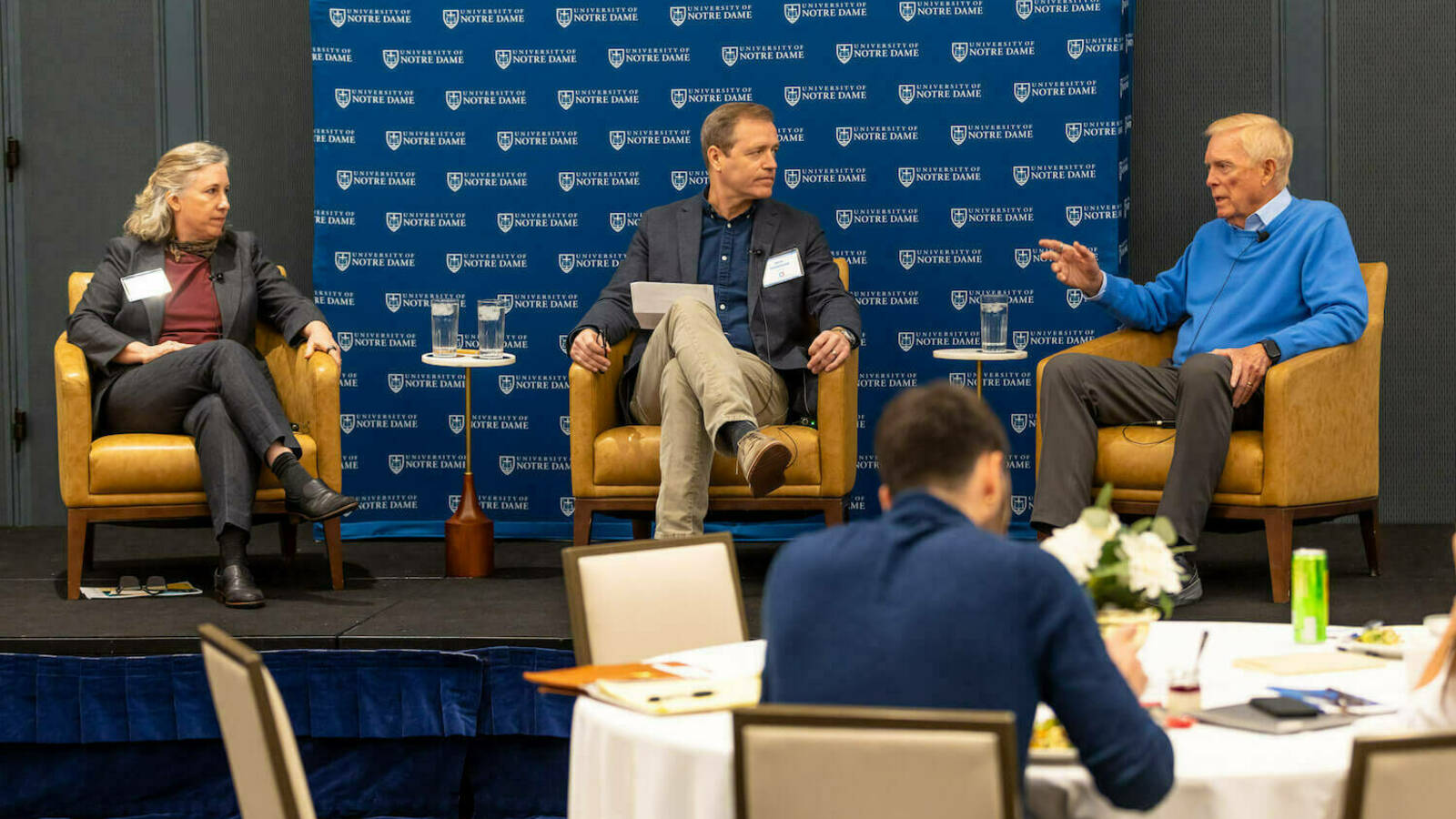
Lisa Schirch, the Richard G. Starmann, Sr. Professor of the Practice of Peace Studies at Notre Dame’s Keough School of Global Affairs, recently presented her findings at the university’s National Convening on Social Media and Democracy, warning that current social media environments threaten to “rip the fabric of democracy” in the United States and globally.
“We are in a very dangerous situation here where we have severe threats to our democracy in the United States,” Schirch said during a public panel at the conference. “I want to start moving toward a solution.”
The gathering, led by the Notre Dame Democracy Initiative in partnership with the Council for Responsible Social Media and Issue One, brought together government officials, industry leaders, and academic experts to explore policy changes that could redirect social media toward healthier civic engagement.
Schirch’s research, compiled in a comprehensive policy blueprint, draws on eight years of work and consultation with the Council on Technology and Social Cohesion, which she co-founded. The effort included a dozen workshops with over 450 experts analyzing the root causes of harmful online content.
According to Schirch, the problem isn’t primarily bad actors but rather the fundamental user experience (UX) design of platforms. “Digital platforms are not neutral — their design influences human behavior,” she explained. “So it’s critical that we address major issues with current designs, which cause the misinformation, polarization and other public discourse issues that we experience on social media.”
Current design choices algorithmically amplify content that triggers fear and anger, she noted, explaining why users encounter falsehoods, fail to exercise healthy skepticism when targeted by disinformation campaigns, and develop negative opinions about people with different political views.
Former House Majority Leader Dick Gephardt, who serves as co-chair of Issue One’s Council for Responsible Social Media, reinforced the urgency during the panel: “We are going to lose this democracy, in my humble opinion, unless we can pull this to a better place.”
Schirch’s policy blueprint proposes solutions in three key areas. First, it calls for advancing prosocial technology design through a tiered certification system that incentivizes platforms to consider their social impact, implementing minimum technology design standards, and supporting third-party services that give users more control over their data.
Second, the blueprint recommends providing foundational governance for digital platform research, including democratic oversight and audits to increase transparency on content moderation, ad targeting, and algorithmic recommendations. It also advocates for developing prosocial technology metrics and protecting independent researchers who evaluate platforms.
Third, the recommendations aim to shift market forces to support prosocial design by enforcing antitrust laws to encourage competition, establishing product liability for harmful technology effects, and creating incentives for investment in prosocial technology through private philanthropy, universities, and nongovernmental organizations.
Critically, the recommendations enlist government, civil society, and the private sector as stakeholders, providing incentives for them to collaborate on governance and accountability measures for technology companies.
The blueprint is part of Notre Dame’s broader efforts to study and strengthen democracy. Faculty experts from across campus are supporting this initiative, including researchers from the Lucy Family Institute for Data and Society, the Notre Dame-IBM Technology Ethics Lab, the Rooney Center for the Study of American Democracy, and the Kellogg Institute for International Studies.
“Technology is a tool that can be used to either support or erode democratic institutions and practices, and the choice is up to us,” Schirch said. “Ultimately, I want this work to guide evidence-based solutions that strengthen the health of democracy worldwide.”
The policy blueprint was co-published by the Council on Technology and Social Cohesion, the Peacetech and Polarization Lab that Schirch directs at the Keough School’s Kroc Institute for International Peace Studies, and the Toda Peace Institute, where Schirch serves as a senior research fellow.
Fact Checker
Verify the accuracy of this article using The Disinformation Commission analysis and real-time sources.

14 Comments
Threats to democracy in the digital age are real and must be taken seriously. I’m glad to see academic research proposing a policy framework to address this.
Protecting free speech while combating misinformation is a delicate balance. Nuanced, evidence-based policymaking will be key.
Misinformation online is a serious threat to democracy. I’m glad to see academic experts proposing concrete policy solutions to address this complex challenge.
Protecting free speech is crucial, but not at the expense of allowing blatant falsehoods to spread unchecked. This will require nuanced policymaking.
Prioritizing profit over societal well-being is a troubling trend we’ve seen across many tech platforms. Policymakers must step in to course-correct.
Responsible social media design choices that foster healthy civic engagement are crucial. This will require industry buy-in and accountability.
This is an important issue that requires thoughtful solutions. Protecting democracy in the age of social media is crucial, but it’s a complex challenge without easy answers.
I’m curious to learn more about the policy framework proposed in the research. Balancing free speech and combating misinformation is tricky.
Ripping the fabric of democracy is a concerning way to describe the effects of social media. I hope the proposed policy framework offers meaningful, impactful solutions.
Bringing together government, industry, and academia is a smart approach to tackle this issue. Diverse perspectives will be key.
It’s good to see the university convening a dialogue on this critical topic. Combating online misinformation while upholding democratic principles is a delicate balance.
I’m eager to learn more about the specific policy recommendations in the research blueprint. Nuanced, evidence-based solutions will be essential.
Social media platforms’ profit-driven design choices are deeply troubling. We need policies that incentivize responsible technology that serves the public good, not just shareholder interests.
Agreed. Policymakers need to get creative and work closely with industry to find the right balance.