


Listen to the article
Behind the scenes at the Resolution Foundation, Soviet-era art raises eyebrows during Spring Statement viewing
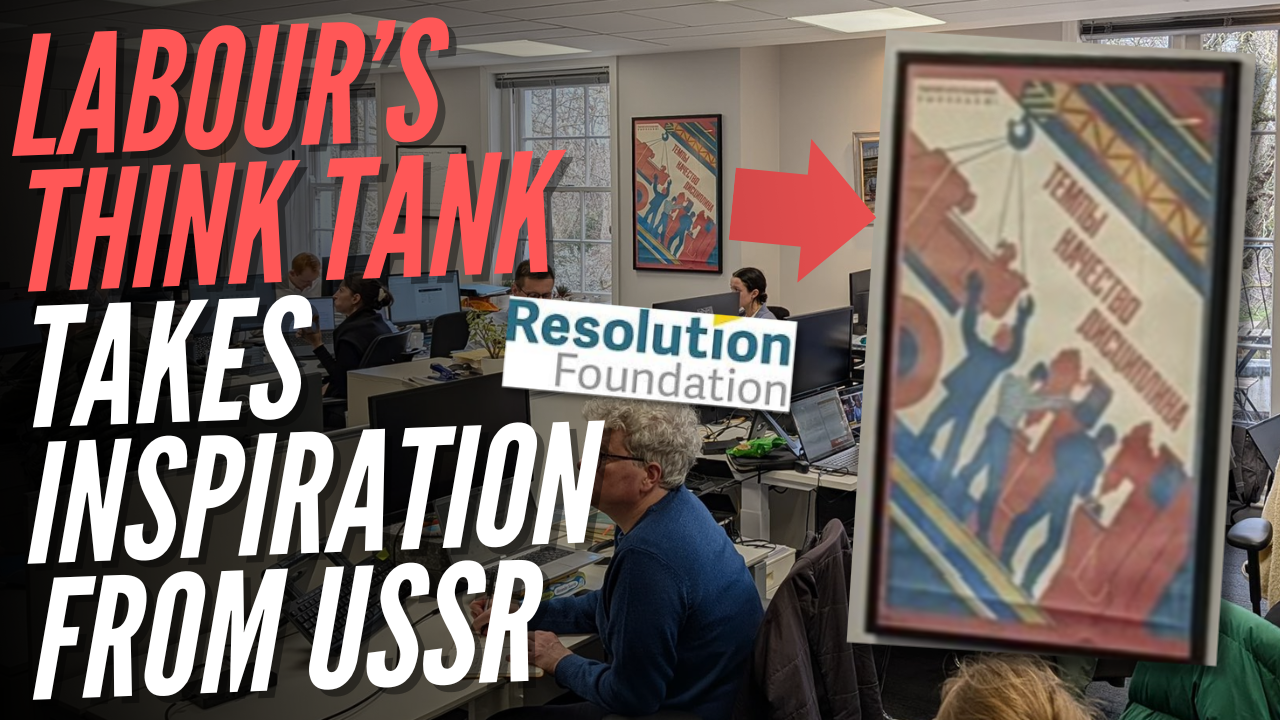
A candid photograph shared by political correspondent Sam Coates has offered a rare glimpse inside the offices of the Resolution Foundation, revealing an unexpected decorative choice that has sparked commentary across political circles.
The image, taken during the Chancellor’s Spring Statement presentation, shows staff members at the influential think tank gathered around screens in their Old Queen’s Street headquarters, intently analyzing the government’s latest fiscal announcements.
What caught the attention of observers, however, was not the economic data being presented but rather a distinctive piece of artwork prominently displayed on the office wall. The photograph clearly shows a Soviet constructivist-style poster hanging in the middle of the workspace.
Upon closer inspection, the poster bears the slogan “PACE, QUALITY, DISCIPLINE” – phraseology reminiscent of Soviet-era propaganda that emphasized industrial efficiency and collective adherence to production targets. The stark graphic style characteristic of 1920s and 1930s Soviet visual propaganda is unmistakable in the image.
The Resolution Foundation, established in 2005, has become one of Britain’s most prominent economic policy think tanks, particularly focused on improving living standards for low and middle-income families. Under the leadership of Chief Executive Torsten Bell, a former advisor to Labour, the organization has gained significant influence in policy debates around inequality, housing, and fiscal policy.
Bell, who joined the Foundation in 2015 after serving as Ed Miliband’s Director of Policy, has positioned the organization as a key voice in economic discussions. Their analysis is frequently cited by politicians across the spectrum and regularly features in mainstream media coverage of budget announcements and economic forecasts.
This Spring Statement was particularly significant, coming at a time of continued cost-of-living pressures and ahead of what many analysts expect to be a general election year. The Resolution Foundation’s assessment of the Chancellor’s announcements will likely carry substantial weight in the ensuing public debate.
The presence of Soviet-inspired imagery in the offices of such an influential economic policy institution has prompted some light-hearted commentary about the organization’s ideological leanings. Some political observers have jokingly questioned whether Bell is implementing his own “Five-Year Plan” – a reference to the centralized economic planning approach synonymous with Soviet governance.
However, decorative choices in office environments often reflect aesthetic preferences rather than ideological statements. Soviet constructivism has long been appreciated in design circles for its bold graphic approach and innovative typography, independent of its political origins. Many contemporary offices, particularly in creative industries, feature similar artwork purely for its visual impact.
The Resolution Foundation itself maintains that its work is independent and evidence-based, with analysis driven by data rather than political ideology. Its board includes members with varied political backgrounds, and its research is respected across the political spectrum.
The organization typically publishes comprehensive analyses following major fiscal events like the Spring Statement, examining the distributional impact of policy changes and their effects on different income groups. These reports often highlight the consequences of government decisions on economic inequality – a focus that has occasionally led to accusations of political bias from some quarters.
As the economic implications of the Spring Statement continue to be debated in the coming days, the Resolution Foundation’s assessment will likely focus on substantive policy questions rather than office décor choices. Nevertheless, this brief glimpse into their working environment has provided an unexpected talking point in Westminster circles.
Fact Checker
Verify the accuracy of this article using The Disinformation Commission analysis and real-time sources.

7 Comments
Hmm, an interesting choice of decor. I wonder what the symbolism and meaning behind displaying Soviet-era art are, if any. Seems a bit out of place for a prominent economic think tank.
This is an unusual find. I’d be interested to learn more about the context and decision-making behind displaying such politically-charged artwork in the offices of a policy research institute. Seems like it could be a conversation starter, at the very least.
Hmm, Soviet-era propaganda imagery in the office of an economic think tank? That’s certainly an eyebrow-raising choice. I wonder if there’s a deeper meaning or symbolism behind it, or if it’s simply a curious design decision.
While art can be open to interpretation, the use of Soviet imagery raises some eyebrows. I’m curious to hear the organization’s perspective on this and whether it aligns with their mission and values.
Good point. The optics could be seen as contradictory, given the Soviet system’s track record on economic policies and individual freedoms. Transparency around the reasoning would be helpful.
Very intriguing. I’m curious to hear the organization’s explanation for this unusual decor choice. While art can be open to interpretation, the use of such potent Soviet imagery does seem rather incongruous for a prominent economic policy institute.
This is an interesting find. I’d be keen to understand the reasoning behind displaying Soviet-era propaganda art in the offices of a prominent economic think tank. The symbolism and messaging seem at odds with the organization’s stated mission and values.