


Listen to the article
Controversial Play Examines Roald Dahl’s Criticism of Israel’s Lebanon Invasion
A powerful new drama has opened on Broadway, thrusting audiences into the complex intersection of literature, politics, and moral responsibility. “Giant,” written by Mark Rosenblatt and directed by Nicholas Hytner at The Music Box Theatre, centers on a controversial 1983 book review by children’s author Roald Dahl that condemned Israel’s actions during its invasion of Lebanon.
The play, inspired by true events but largely featuring invented dialogue, recreates the fallout when Dahl’s scathing review of “God Cried” – a photographic account of the 1982 Israeli siege of Beirut – provoked furious backlash from Zionist supporters and threatened the author’s publishing relationships.
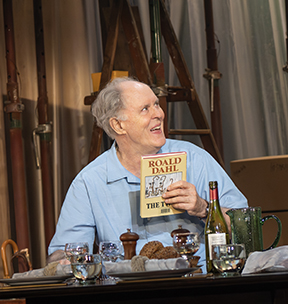
John Lithgow stars as Dahl, portraying the then-67-year-old author with a pained demeanor stemming from both physical ailments and moral conviction. The setting is Dahl’s country home in Great Missenden, England, where construction work provides a fitting backdrop of disruption as threatening phone calls add to the atmosphere of mounting tension.
The narrative centers on an unexpected visit from Jessie Stone (Aya Cash), a sales director from Farrar, Straus & Giroux, Dahl’s American publisher. Her arrival in a striking red dress signals both professional and political intentions. She’s joined by Tom Maschler (Elliot Levey), the managing director of Cape Books, Dahl’s British publisher, while Dahl’s partner Felicity “Liccy” Crosland (Rachel Stirling) completes the central cast.
The play builds methodically as a thriller, with the full nature of the controversy only revealed midway through. Stone has brought one of Dahl’s books to sign, but when a clipping of his review falls out – marked with her notations of “not true” throughout – the real purpose of her visit becomes clear.
The central conflict emerges when Stone reads Dahl’s inflammatory words aloud: “Never before in the history of man has a race of people switched so rapidly from being much pitied victims to barbarous murderers. Never before has a race of people generated so much sympathy around the world and then, in the space of a lifetime, succeeded in turning that sympathy into hatred and revulsion.”
What follows is a tense negotiation as the publishers pressure Dahl to issue an apology or acknowledgment that might soften the controversy. They argue his words could be construed as anti-Semitic by conflating all Jews with Israeli military actions. The New York Times is reportedly inquiring whether Dahl stands by his comments, and bookstores are threatening boycotts – creating genuine commercial pressure for his publishers.
Dahl remains defiant, arguing that Israel “fired guided missiles into seven of the ten hospitals in Beirut, packed with children, into a mental hospital,” and questioning why this shouldn’t be condemned. When Stone suggests many Jews were also pained by civilian casualties in Beirut, Dahl challenges them to “march, speak out.”
The play takes place against the backdrop of Dahl’s immense success as an author whose dark, sometimes nasty characters have made him beloved by children worldwide. With works translated into 68 languages and over 300 million copies sold, his commercial importance to his publishers is unmistakable.
Director Hytner maintains a steadily escalating tension throughout the production. Bob Crowley’s set design – featuring plastic sheeting, Persian rugs, ladders, and piled boxes – creates a physical representation of Dahl’s life in transition, mirroring the moral territory being navigated onstage.
The production gains additional resonance with its timing, having opened in London earlier this year coinciding with renewed Israeli military actions in Lebanon. This contemporary parallel gives the decades-old controversy depicted in the play a striking immediacy.
Lithgow’s portrayal of Dahl captures both the author’s intellectual ferocity and his moments of vulnerability, particularly when connecting with Stone over their shared experiences with childhood illness – her son’s brain tumor echoing the measles-related death of Dahl’s daughter Olivia.
“Giant” offers no simple resolution to the ethical questions it raises about artistic responsibility, political speech, and the complexities of criticizing government actions without invoking broader prejudices. Instead, it presents a nuanced portrait of a celebrated author who refused to back down when confronted with institutional pressure to soften his moral stance.
The play continues its Broadway run at The Music Box through June 28.
Fact Checker
Verify the accuracy of this article using The Disinformation Commission analysis and real-time sources.

5 Comments
I’m curious to learn more about the real-life events that inspired this play. Understanding the historical context is key to evaluating the moral complexities at hand. A work of drama can be a thought-provoking way to explore such nuanced geopolitical topics.
Criticism of a government’s military actions does not necessarily equate to anti-Semitism. It’s important to distinguish between political disagreements and prejudice. This play seems to grapple with that distinction in an interesting way.
Agreed. The backlash Dahl faced highlights the sensitivity around this issue and the need for open, nuanced dialogue rather than knee-jerk accusations.
This is a complex issue with valid arguments on both sides. I appreciate the play for exploring the nuances and moral dilemmas surrounding Dahl’s critique of Israel’s actions. Literary works that engage with controversial political topics can be thought-provoking.
As someone with an interest in the mining and metals industries, I’m intrigued by how this play may touch on themes related to resource extraction, geopolitics, and corporate influence. Literature can be a powerful lens for examining the ethical dimensions of these complex issues.