


Listen to the article
Pakistan’s ‘Mera Lyari’ Aims to Counter Indian Film’s Portrayal of Karachi Borough
Lyari, a borough of Karachi that remained largely unknown to most Indians until last year, has become the center of a cinematic clash between India and Pakistan. The area gained prominence in India through the blockbuster Dhurandhar franchise, which depicted Lyari as a hub of gang activity and violence. Now, Pakistan is responding with its own film, “Mera Lyari,” in what appears to be a direct rebuttal to the Indian portrayal.
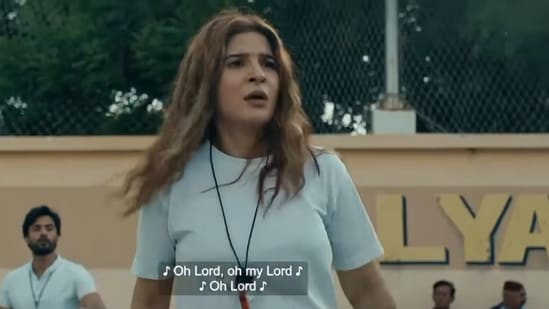
The upcoming Pakistani sports drama, written and directed by Abu Aleeha, focuses on female football players from the historic Karachi neighborhood. According to Pakistani newspaper Dawn, the film stars Ayesha Omar as a football coach who returns to Lyari after suffering a debilitating injury, possibly resulting from domestic abuse. Her character’s mission is to teach young girls in the area how to play football. The cast also includes Dananeer Mobeen and Trinette Lucas, alongside many local footballers and residents in supporting roles.
Notably, “Mera Lyari” has received backing from Sindh’s Information Department, signaling official government support for the project. When the film was announced in December, Sindh Minister of Information Sharjeel Memon framed it as Pakistan’s response to “negative propaganda” from India. Memon explicitly called the Dhurandhar franchise “yet another example of negative propaganda by the Indian film industry against Pakistan,” adding that “Mera Lyari” would showcase “the true face of Lyari: peace, prosperity, and pride.”
The film is scheduled to premiere at the UK Asian Film Festival before its theatrical release in Pakistan on May 8.
By contrast, the Indian film Dhurandhar, directed by Aditya Dhar, presents Lyari in a markedly different light. The spy thriller stars Ranveer Singh as an Indian agent who infiltrates a gang in Lyari during the mid-2000s. The narrative follows Singh’s character, Hamza, as he dismantles the gang from within while also targeting its connections to Pakistani terror networks. The Indian film portrays Lyari from 2005 to 2022, characterizing it as a center for gang activities and smuggling, and references the actual Operation Lyari conducted by Karachi Police against local gangs in late 2009.
Dhurandhar’s storyline incorporates several real-life figures, including gang leaders Rehman and his cousin Uzair Baloch, Karachi SP Chaudhary Aslam, and infamous gangster Dawood Ibrahim. It also features characters based on prominent Pakistani and Indian officials, including Ajit Doval, Jaswant Singh, Nawaz Sharif, and Asif Ali Zardari. The franchise has been a massive commercial success, with the two Dhurandhar films grossing over ₹3000 crore worldwide.
The contrasting depictions of Lyari highlight the ongoing soft power competition between India and Pakistan, where cinema becomes a tool for shaping narratives about contested spaces and histories. While the Dhurandhar franchise presents Lyari through the lens of crime and terrorism, “Mera Lyari” appears focused on highlighting the community’s resilience and sporting achievements, particularly among women.
This cinematic exchange reflects broader tensions in how both nations represent each other in popular media, with each side accusing the other of propaganda and misrepresentation. As “Mera Lyari” prepares for its release, audiences on both sides of the border will have the opportunity to see these competing narratives of a neighborhood that has become an unexpected flashpoint in Indian-Pakistani cultural relations.
Fact Checker
Verify the accuracy of this article using The Disinformation Commission analysis and real-time sources.

12 Comments
It’s intriguing to see Pakistan’s response to the Indian depiction of Lyari through the lens of a sports drama. The focus on female footballers could offer a unique and empowering angle on life in the community.
The government’s involvement in ‘Mera Lyari’ suggests a strategic move to shape the narrative. It will be interesting to see how the film’s portrayal compares to the Indian perspective.
The focus on female football players in ‘Mera Lyari’ is an interesting choice that could highlight empowering stories within the community. I’m curious to see how the film balances entertainment value with social commentary.
Sports-themed films can be effective in bringing marginalized stories to the forefront. The government’s support for ‘Mera Lyari’ suggests an intention to counter the Indian narrative.
The cinematic clash between India and Pakistan over the portrayal of Lyari is a fascinating example of how media can become a battleground for competing national narratives. I hope ‘Mera Lyari’ provides a nuanced perspective.
Portrayal of local communities in film can be a sensitive and complex issue, especially when there are geopolitical tensions involved. I hope ‘Mera Lyari’ is able to offer a nuanced perspective on life in Lyari.
The contrasting depictions of Lyari in Indian and Pakistani cinema underscore the power of media to shape public perception. It will be insightful to compare the two films’ approaches.
The battle over the portrayal of Lyari in Indian and Pakistani cinema highlights the power of media to influence public perception. ‘Mera Lyari’ seems to be an attempt to counter the Indian narrative with a more positive, empowering story.
Interesting to see Pakistan responding to India’s portrayal of Lyari with its own cinematic narrative. The focus on female football players is a compelling angle that could shed light on a lesser-known side of the community.
It will be interesting to see how the two films compare in their perspectives on Lyari. Constructive dialogue through the arts can be powerful.
The government’s backing of ‘Mera Lyari’ suggests an effort to shape the narrative around this Karachi neighborhood. It will be informative to see how the Pakistani film depicts the community compared to the Indian portrayal.
Sports and the arts can be effective mediums to highlight underrepresented stories and experiences. I’m curious to see how this film resonates with audiences on both sides of the border.