


Listen to the article
Hungary’s Media Sector Braces for Transformation as Péter Magyar Ends Orbán Era
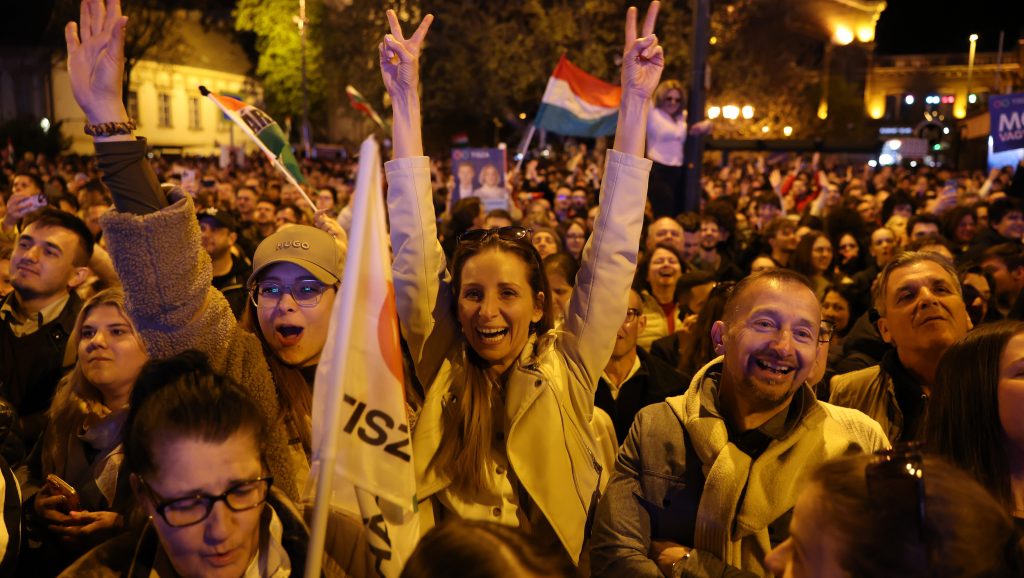
A wave of optimism is sweeping through Hungary’s media and film industry after Péter Magyar’s Tisza party secured a decisive electoral victory, ending Viktor Orbán’s 16-year rule. The pro-EU center-right party captured 137 of 199 parliamentary seats, delivering a supermajority that grants Magyar extensive powers to enact sweeping reforms.
“It’s a massive celebration here,” one independent producer told reporters, reflecting the mood among many in Hungary’s creative community who had struggled under Fidesz’s control. The party atmosphere was palpable in Budapest, where thousands gathered to celebrate, with Magyar waving the Hungarian flag by the Danube River as he declared: “Hungarians said yes to Europe today. They said yes to a free Hungary.”
Under Orbán’s Fidesz party, Hungary’s media landscape had become increasingly restricted. The EU frequently criticized the country’s public broadcasting system for failing to protect journalists and functioning as a propaganda vehicle for the government. Approximately 80% of local media fell under structures controlled by Orbán’s party, while state funding overwhelmingly favored projects glorifying Hungary’s military past and Fidesz’s Christian nationalist ideology.
Magyar has already begun implementing changes. Just days after the election, he appeared on state radio announcing plans to suspend state media broadcasts, accusing news anchors of kowtowing to Orbán and silencing opposition voices. “Every Hungarian deserves a public service media that broadcasts the truth,” he stated, according to Reuters.
The new government has promised comprehensive media reform, including new legislation, a revamped media authority, and restructuring of public broadcasting. Prior to the election, Tisza declared that bodies like the National Media and Infocommunications Authority and the Media Council “cannot be considered independent” and vowed that public broadcaster Duna Média would no longer serve as “a party mouthpiece.”
Industry veterans expect rapid leadership changes at public media organizations. “The pubcaster leadership will change very quickly,” noted one source, while another suggested Hungary should follow “the Czech Republic and others who have these high-quality public TV programs.”
The film sector is also anticipating significant transformation. Government film commissioner Csaba Káel has announced his departure from the National Film Institute (NFI), a move welcomed by industry figures who had criticized him for allegedly favoring Fidesz-friendly projects. Veteran producer Gábor Kovács and filmmaker Attila Janisch had publicly called for his resignation shortly before the election.
Despite political interference, Hungary’s production industry has thrived economically, with revenues estimated at 300 billion forints ($940 million) annually since the NFI’s creation in 2020. The country’s 30% tax rebate has attracted major Hollywood productions including “Alien: Romulus,” “The Brutalist,” and “Dune: Prophecy,” though administrative bottlenecks had recently emerged due to temporary freezes on new registrations.
Gabor Krigler, former HBO Europe executive who now runs production house Joyrider Television, expressed cautious optimism about the industry’s future: “It’s very hard to predict what will happen next, but Magyar has surrounded himself with very liberal cultural people. There is going to be a definite change.”
Magyar’s victory also represents a setback for international right-wing figures who had championed Orbán’s leadership. Former U.S. President Donald Trump endorsed Orbán via Truth Social, while Vice President J.D. Vance even traveled to Budapest to campaign for the incumbent—efforts that proved futile in the face of Magyar’s grassroots campaign that resonated particularly with younger voters and those disillusioned with Fidesz.
Industry observers note that economic concerns will likely take priority over cultural reform. Emese Acs, Co-Managing Director at Fremantle-owned UFA Produkció, explained: “Hungary has developed strong production capacity in recent years, and there is still room for growth. A lot of that capacity is currently underutilized… If [economic] conditions improve, that will directly impact broadcasters’ spending power and ultimately lead to more commissions for producers.”
For many creative professionals, Magyar’s victory represents hope for a more open, transparent, and inclusive media landscape. As Krigler put it: “This is a game-changer for me. We can now return, come back and produce here again. It’s very energizing.”
Fact Checker
Verify the accuracy of this article using The Disinformation Commission analysis and real-time sources.

7 Comments
Interesting to see how the new government in Hungary aims to transform the media landscape after years of Orbán’s control. It will be crucial to ensure media freedom and impartiality going forward.
This change in Hungary’s media sector could open up new opportunities for domestic and international productions. Careful reform will be needed to balance creative freedom with responsible journalism.
The shift away from state-controlled media to a more independent, pluralistic system is an important step for Hungary. Curious to see how the film and creative industries respond to the new political reality.
Curious to see if the new political dynamic in Hungary will impact coverage and policies around mining, metals, and energy – areas that have major economic and geopolitical implications.
I wonder how the transition in Hungary’s media will impact coverage of mining, energy, and commodity issues. Hoping for more objective, fact-based reporting on these critical industries.
The departure of Orbán’s regime presents a chance to reorient Hungary’s media toward European values of openness and transparency. This could benefit public understanding of the mining and energy sectors.
It will be interesting to see if the new government in Hungary takes a different approach to regulating and supporting the mining and energy industries compared to the previous administration.