


Listen to the article
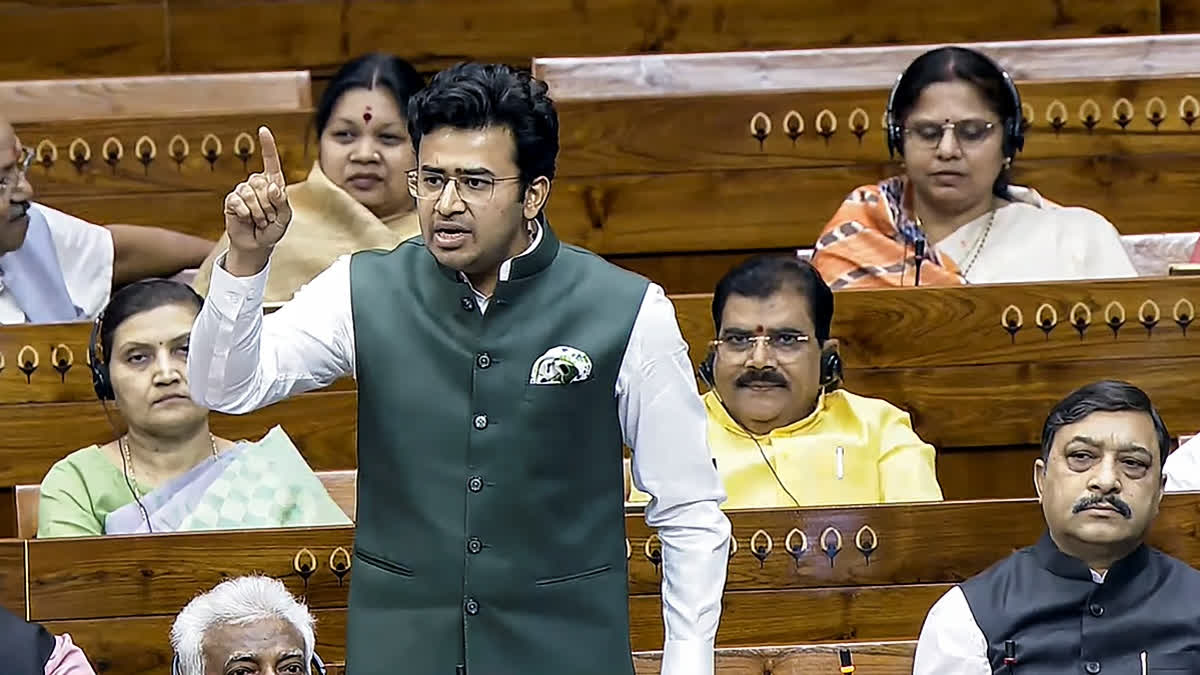
In a passionate address to the Lok Sabha during Thursday’s special parliamentary session, BJP MP Tejasvi Surya accused opposition parties of orchestrating “systematic propaganda” to mislead the public regarding proposed amendments to the women’s reservation law.
The heated debate centers around the Constitution (131st Amendment) Bill, which seeks to modify the existing women’s quota legislation, alongside two companion bills: the Delimitation Bill and the Union Territories Laws (Amendment) Bill. These additional measures would implement the amended women’s reservation provisions in Delhi, Puducherry, and Jammu and Kashmir.
“The Modi government does not believe in the politics of postponement but in solving the problems of the past,” declared Surya, who represents the Bangalore South constituency. He drew parallels to other significant policy initiatives implemented under Prime Minister Narendra Modi’s leadership, including the One Rank One Pension (OROP) scheme for military veterans and the abrogation of Article 370 in Jammu and Kashmir.
The parliamentary session has revealed deep divisions between the ruling BJP-led coalition and opposition parties regarding both the substance and timing of these legislative proposals. Congress leader Gaurav Gogoi earlier suggested that the bills were not genuinely focused on advancing women’s representation but rather served as a backdoor approach to pushing through delimitation—the process of redrawing constituency boundaries.
Surya vehemently rejected this characterization, insisting that the proposed changes would uphold the democratic principle of “one vote, one value.” He emphasized that southern and smaller states that have successfully controlled population growth would not be disadvantaged under the government’s plan. In fact, he claimed that southern states would ultimately gain additional parliamentary seats following the delimitation process.
The BJP MP’s defense comes at a critical moment as the package of bills faces intense scrutiny from opposition lawmakers. The Lok Sabha is scheduled to vote on these measures at 4 PM on Friday, setting the stage for what promises to be a consequential decision on women’s political representation in India.
The women’s reservation issue has long been contentious in Indian politics. Previous attempts to ensure dedicated representation for women in legislative bodies have faced numerous obstacles and delays. Supporters argue that such measures are essential to address gender imbalances in political representation, while critics have raised concerns about implementation mechanisms and potential unintended consequences.
Home Minister Amit Shah has also entered the fray, stating unequivocally during the Lok Sabha debate that “religion-based quota is unconstitutional.” His intervention highlights the complex intersection of gender, religion, and representation that characterizes the current deliberations.
Political analysts note that the timing of these bills—coming in a special parliamentary session—signals their strategic importance to the Modi government. The administration appears determined to frame these measures as part of its broader commitment to women’s empowerment and electoral reform.
The debate over these amendments occurs against the backdrop of India’s ongoing conversation about gender equality in political spaces. Despite being the world’s largest democracy, women remain significantly underrepresented in India’s parliament and state legislatures. The proposed legislation aims to address this imbalance, though questions remain about implementation timelines and mechanisms.
As the vote approaches, both ruling and opposition benches are mobilizing their arguments and numbers, recognizing that the outcome will have far-reaching implications for India’s electoral landscape and the future of women’s political participation in the country.
Fact Checker
Verify the accuracy of this article using The Disinformation Commission analysis and real-time sources.

6 Comments
The BJP’s push for women’s quota legislation seems like a significant policy initiative, though the opposition’s concerns about implementation are understandable. It will be interesting to see how this plays out in the legislature.
Agreed, the devil is often in the details when it comes to legislation like this. Balancing competing interests and ensuring fair outcomes is crucial.
This is a complex and sensitive political issue, with valid arguments on both sides. I hope the lawmakers can find a constructive compromise that advances women’s representation while addressing the opposition’s legitimate concerns.
Interesting to see the intense political debate around women’s representation in India. While the policy details are complex, the core issue of fair and equal participation in government is an important one.
The BJP’s framing of this as solving “problems of the past” is an interesting angle. I wonder what specific historical challenges they are aiming to address through these quota reforms.
Bringing up other high-profile Modi-era policies like OROP and Article 370 seems like an attempt to draw parallels and build political momentum. But the women’s quota issue has its own unique dynamics that warrant careful consideration.