


Listen to the article
Estonian Journalists’ China Visit Raises Influence Concerns, Says Security Service
Several Estonian journalists and public relations professionals participated in what security officials describe as a “propaganda visit” to China last fall, according to reporting by Postimees. The trip has drawn attention following revelations in the Estonian Internal Security Service’s (ISS) annual yearbook released earlier this week.
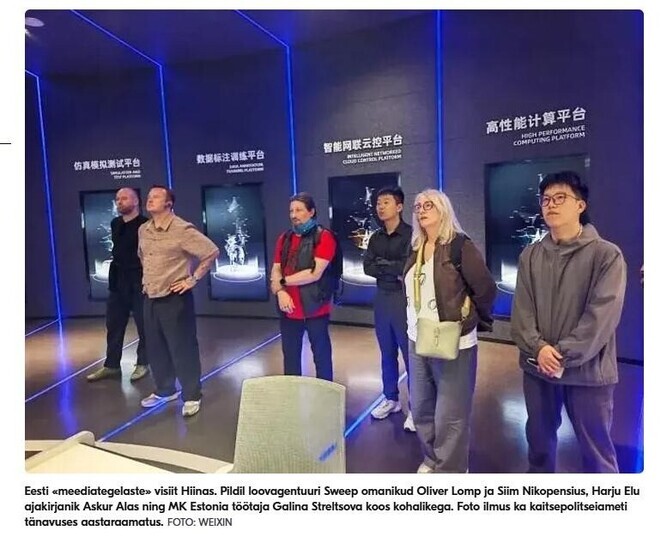
The October visit to China included media representatives and business figures who traveled at the invitation of a foreign relations firm based in Jiangsu province. Among those attending were regional daily Harju Elu journalist Askur Alas, Russian-language newspaper MK Estonia employee Galina Streltsova, and Oliver Lomp and Siim Nikopensius, owners of creative agency Sweep.
When contacted by Postimees, Alas confirmed that Harju Elu’s editor-in-chief received the invitation through the Chinese Embassy in Estonia. He maintained that no reciprocal actions were demanded of participants, though he acknowledged that “of our own volition, we published one article four months later, in connection with the start of the Chinese New Year.” Streltsova declined to provide any comment regarding her participation in the trip.
The ISS, also known locally as Kapo, highlighted in its 2025 annual report that China significantly expanded its influence operations in Estonia during the past year. These activities frequently offer what the security service describes as a “curated and polished ‘China experience'” under the guise of cultural cooperation initiatives.
According to the security service, China’s influence strategy employs multiple approaches. These include cultural outreach coordinated through the embassy, often organizing events in partnership with local governments. The Chinese officials simultaneously pursue connections with Estonian political and business leaders while reportedly paying local media outlets and public relations firms to facilitate these relationships.
The security report specifically mentioned LinkedIn as a platform commonly used by Chinese representatives to establish initial contact with potential Estonian targets. The ISS noted that these influence activities predominantly focus on science, technology, and security sectors, with Chinese intelligence services attempting to cultivate relationships with influential individuals by extending invitations to visit China and the surrounding region.
Estonia, a NATO and EU member that shares a border with Russia, has grown increasingly vigilant about foreign influence operations in recent years. The small Baltic nation has been particularly sensitive to both Russian and Chinese attempts to shape public opinion and policy, given its strategic position in Northern Europe and its strong digital infrastructure.
The security service further elaborated that these Chinese efforts appear designed to counterbalance negative media coverage about China’s human rights record, allegations of unfair economic practices, and growing support for Russia in its war against Ukraine. By cultivating positive relationships with media figures and opinion leaders, China seeks to promote alternative narratives about its global activities and policies.
This revelation comes amid growing concern across Europe about Chinese influence operations targeting media, academia, and political institutions. Several European countries have recently strengthened their foreign investment screening mechanisms and implemented stricter regulations regarding foreign-funded media operations.
The Estonian case highlights the evolving nature of influence operations, which increasingly target smaller countries with specialized expertise or strategic significance rather than focusing exclusively on major powers. Security experts note that such soft power approaches can be particularly effective in smaller nations where media markets are less robust and international coverage more limited.
Neither the Chinese Embassy in Estonia nor representatives from Jiangsu province’s foreign relations firm have publicly responded to the ISS report or the Postimees coverage as of this writing.
Fact Checker
Verify the accuracy of this article using The Disinformation Commission analysis and real-time sources.

8 Comments
The Estonian security service’s concerns about this China visit are understandable. Media independence is crucial, and we must be wary of state-sponsored efforts to influence foreign journalists, even if unintentionally. I hope the Estonian media continues to investigate this case and provide readers with a clear, objective assessment.
This situation highlights the delicate balance between international cooperation and guarding against undue influence. I appreciate the Estonian journalists being upfront about publishing an article related to the Chinese New Year, but more details on the overall purpose and findings of the trip would be helpful for assessing its merits.
The Estonian journalists’ participation in this China visit raises important questions about media independence and the potential for foreign influence. I’m glad the security service is examining these issues carefully. Maintaining journalistic integrity is crucial, even when opportunities for international engagement arise.
Kudos to the Estonian security service for flagging this visit and bringing it to public attention. While cultural and journalistic exchanges can be valuable, it’s critical that they are not exploited for propaganda purposes. I hope the Estonian media continues to scrutinize these types of state-sponsored initiatives.
Interesting that Estonian journalists visited China at the invitation of a foreign relations firm. While cultural exchange can be valuable, it’s important to remain vigilant about potential propaganda efforts. I wonder what the journalists’ impressions were and whether they disclosed the nature of the trip to their readers.
It’s good that the Estonian security service is scrutinizing this China visit. While cultural exchanges can be valuable, we must be vigilant about potential propaganda efforts targeting the media. I hope the journalists involved provide more details to ensure their reporting remains objective and independent.
It’s concerning to see that the Estonian security service flagged this as a potential ‘propaganda visit’. Journalists need to be careful not to be used as mouthpieces for foreign governments, even inadvertently. Transparency around the trip’s purpose and sponsors is crucial.
This is a complex issue that highlights the need for media organizations to have robust policies around accepting invitations from foreign governments or state-linked entities. The Estonian journalists should be commended for their transparency, but more information is needed to fully assess the nature and implications of this trip.