


Listen to the article
BJP MP Defends Women’s Quota Law Amendments Against Opposition Criticism
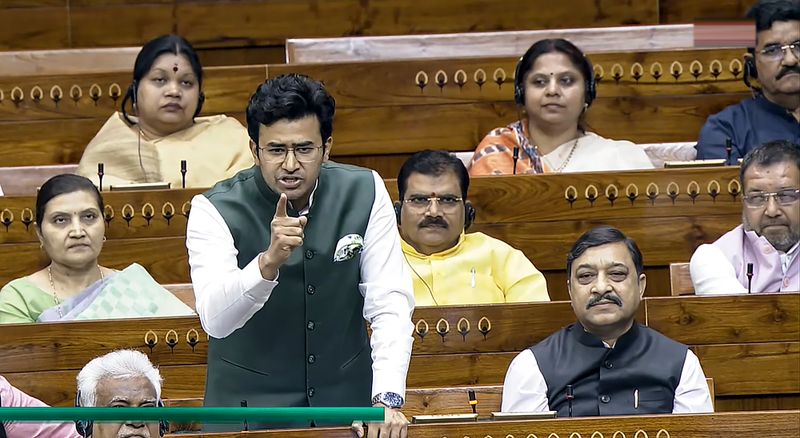
BJP MP Tejasvi Surya has launched a strong defense of the government’s proposed amendments to the women’s reservation legislation, accusing opposition parties of orchestrating a “systematic propaganda” campaign to mislead the public about the bills’ intentions and effects.
Speaking during a parliamentary discussion on Thursday, the Bangalore South representative asserted that Prime Minister Narendra Modi’s government “does not believe in the politics of postponement” but rather in resolving longstanding issues that previous administrations had left unaddressed.
The debate centers around three pieces of legislation recently introduced in the Lok Sabha: the Constitution (131st Amendment) Bill, which modifies the existing women’s quota law; the Delimitation Bill; and the Union Territories Laws (Amendment) Bill, which would implement the amended reservation system in Delhi, Puducherry, and Jammu and Kashmir.
The legislative package has sparked intense political disagreement, with opposition members, including Congress leader Gaurav Gogoi, claiming the bills are less about advancing women’s representation and more about pushing through delimitation—the redrawing of constituency boundaries—”through the backdoor.”
Surya firmly rejected this characterization, maintaining that the proposals would uphold the democratic principle of “one vote, one value.” He specifically addressed concerns from southern states regarding potential disadvantages in parliamentary representation following the implementation of these changes.
“Southern states would be getting more seats after delimitation,” Surya stated, dismissing fears that regions with better population control measures would be penalized in the reallocation of constituencies. The demographic patterns across India have shifted significantly since the last major delimitation exercise, with northern states generally experiencing faster population growth than their southern counterparts.
To bolster his argument about the government’s commitment to substantive policy implementation, Surya highlighted other significant reforms enacted under Modi’s leadership, including the implementation of the One Rank One Pension (OROP) scheme for military veterans and the revocation of Article 370, which had granted special status to Jammu and Kashmir.
The women’s reservation issue has a complex history in Indian politics. The original Women’s Reservation Bill, which sought to reserve one-third of seats for women in the Lok Sabha and state legislative assemblies, was first introduced in 1996 but faced numerous delays and obstacles before being passed in modified form.
Political analysts note that the current amendments come at a time when women’s political representation remains significantly below parity in India. Despite women constituting nearly half the population, they hold less than 15 percent of parliamentary seats. The proposed changes could substantially alter this landscape, though the timeline for implementation remains a subject of debate.
The delimitation aspect of the legislation is particularly contentious because constituency boundaries have been frozen since 1976 to encourage population control measures without penalizing states that successfully implemented them. Any adjustment now would inevitably shift political power dynamics between states with different population growth patterns.
As the bills move through the parliamentary process, they will likely continue to generate intense discussion about federalism, representation, and the balance of power between India’s diverse regions. The government maintains that these changes are essential for equitable democracy, while critics argue they could undermine federal principles and regional autonomy.
The debate reflects broader tensions in Indian politics about how to balance demographic realities with democratic representation in a diverse and rapidly changing nation.
Fact Checker
Verify the accuracy of this article using The Disinformation Commission analysis and real-time sources.
