


Listen to the article
In recent weeks, social media platforms have been flooded with comparative images purportedly showing Latvia’s prosperous Soviet past juxtaposed against its allegedly deteriorated present within the European Union. These nostalgic narratives, which paint the Soviet era as a golden age and modern Latvia as a failure, have gained significant traction online despite their questionable authenticity.
An investigation by fact-checking project “Re:Check,” operated by independent journalism center “Re:Baltica,” has uncovered the truth behind these misleading comparisons that have been widely shared across multiple platforms.
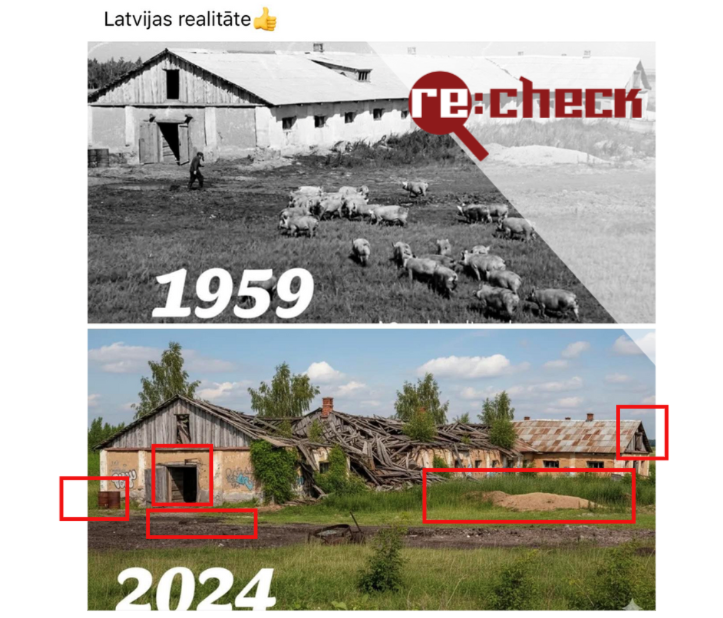
The viral image set features two photographs side by side. The first, a black and white image labeled as being from 1959, depicts a seemingly thriving Soviet-era pig farm with workers, barrels positioned near an open door, and approximately a dozen pigs in the foreground. The second, supposedly showing the same location in 2023, presents a dilapidated, abandoned building with no sign of agricultural activity.
Captions accompanying these images declare them to be “Latvian reality,” suggesting the country’s agricultural sector has collapsed since the Soviet Union’s dissolution. The posts have been amplified by figures with political connections, including former Daugavpils deputy mayor Aleksejs Vasiļjevs, previously affiliated with the Latvian Russian Union, and Edvīns Puķe, known for spreading pro-Kremlin content and who ran for office with the “Latvia in First Place” party.
However, “Re:Check” investigators quickly determined the first image isn’t from Latvia at all. Using reverse image search tools, they traced the photograph to Kazakhstan’s “Krasnodonskij” state farm, taken in 1959 – approximately 4,000 kilometers from Latvia.
Even more telling, the “modern” image shows clear signs of artificial intelligence manipulation. Rather than being a genuine contemporary photograph, it appears to be an AI-modified version of the original Kazakhstan image, digitally altered to depict decay and abandonment.
The investigation highlighted several telltale signs of manipulation. The shadows in both images are identical in position and angle – a virtual impossibility if the photos were actually taken 65 years apart. Curiously, while a person visible in the first image has been removed from the second, their shadow inexplicably remains.
Further evidence of fabrication includes the presence of the exact same metal barrels and sand pile in the “modern” image – elements that would be highly unlikely to remain untouched for over six decades.
This case exemplifies a broader pattern of disinformation targeting Baltic states, particularly regarding their Soviet past and current EU membership. Such narratives often seek to undermine public confidence in Western alliances while glorifying the Soviet era, despite historical evidence of economic stagnation and political repression during that period.
Latvia’s agricultural sector, while having undergone significant restructuring since independence, remains an important component of the national economy. Modern Latvian farming has shifted toward sustainable practices and specialized production, with the country becoming an exporter of dairy products, grain, and organic foods to European markets.
The circulation of such fabricated comparisons reflects ongoing information warfare tactics that exploit historical nostalgia and economic concerns. These efforts typically target Russian-speaking populations in Latvia and other Baltic states, attempting to sow division and distrust in democratic institutions.
Media literacy experts emphasize that such manipulated content has become increasingly sophisticated with the advent of AI image generation tools, making critical evaluation of sources and claims more important than ever for Baltic citizens navigating a complex information landscape.
As Latvia continues to strengthen its position within European institutions and NATO, countering such disinformation campaigns remains a priority for both government agencies and independent fact-checking organizations working to protect the integrity of public discourse.
Fact Checker
Verify the accuracy of this article using The Disinformation Commission analysis and real-time sources.

9 Comments
Interesting to see the contrasting narratives around Latvia’s agricultural past and present. While the images may be misleading, it highlights the ongoing debates around the legacy of the Soviet era and economic transitions.
Fact-checking is so important to cut through the propaganda and get a more balanced view. Curious to learn more about the real state of Latvia’s agriculture and how it has evolved since independence.
This is a timely reminder of the importance of critical thinking and fact-checking, particularly when it comes to politically-charged narratives around economic performance and development. Looking forward to seeing more balanced reporting on Latvia’s agricultural sector.
While the specifics of this case may be debatable, it highlights the broader challenge of verifying visual content online. In the age of deepfakes and selective editing, we must be vigilant consumers of information.
As someone interested in the commodities and energy sectors, I wonder how these narratives might impact perceptions of the broader region’s economic development. It’s an important issue to follow.
Good point. Distorted historical narratives can certainly influence views on a country’s current economic standing and investment potential. Fact-based analysis is crucial for understanding the nuances.
The use of nostalgic imagery to push a particular political agenda is a well-known tactic. I appreciate the diligence of the fact-checkers in exposing the misleading nature of these viral farm photos.
Absolutely. Cutting through propaganda and misinformation is so vital, especially when it comes to sensitive political and economic issues. Kudos to the investigative journalists for their work.
I’m glad the experts were able to investigate the authenticity of these viral images. Propaganda often relies on selective or misleading visuals, so it’s good to have independent analysis to separate fact from fiction.