


Listen to the article
Defense Secretary Hegseth Under Scrutiny for Media Approach in US-Iran Conflict
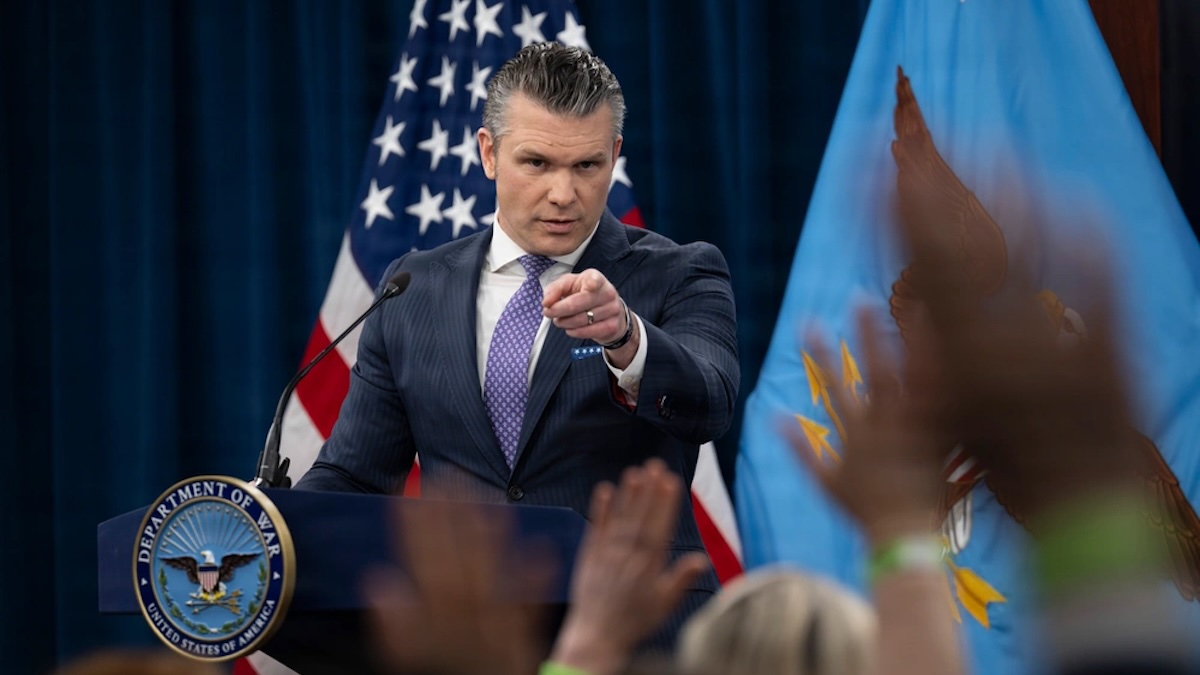
U.S. Secretary of Defense Pete Hegseth has adopted an unusually confrontational stance toward media coverage during the early phase of the 2026 U.S.-Israel conflict with Iran, raising concerns about press freedom and democratic accountability.
Rather than maintaining the traditionally more neutral posture of defense leadership, Hegseth has actively challenged journalists, dismissed critical reporting as false, and promoted what he characterizes as more “patriotic” coverage of the conflict. His approach represents a significant departure from conventional civil-military communication norms.
The conflict itself presents unique challenges for media coverage. Described by analysts as a “hybrid and undeclared war,” it lacks formal declaration and operates through indirect and limited forms of engagement. This ambiguity has elevated the importance of narrative framing in shaping public understanding of the situation.
Hegseth’s media strategy has included interrupting reporters during press briefings, rejecting questions he deems critical, and restricting media access to certain military operations. These actions have prompted constitutional concerns from press freedom advocates, who point to a troubling trend of declining journalistic access during military conflicts.
“When defense leadership acts as political communicators rather than neutral briefers, it undermines the institutional credibility of defense establishments and risks politicizing military operations,” noted one security analyst who requested anonymity due to the sensitivity of the subject.
The Secretary has been particularly critical of coverage focusing on military casualties, framing such reporting as politically motivated rather than legitimate journalism. His communication approach often bypasses traditional media channels, speaking directly to the public through social media and select friendly outlets.
Experts in media theory point out that Hegseth’s approach aligns with concepts like “indexing” – where narrowing elite debate limits the diversity of viewpoints presented to the public – and elements of “manufacturing consent,” though implemented in a more direct and personal manner than these theories typically describe.
His rhetoric frequently employs emotionally charged language that divides audiences into “patriotic” supporters and illegitimate critics. This binary framing simplifies complex realities and potentially discourages critical engagement with policy decisions.
Online reaction has been mixed, with some supporters praising what they see as a refreshingly direct approach, while critics have employed satire and pointed criticism, sometimes drawing comparisons to authoritarian information control tactics. However, media analysts note that even negative engagement can inadvertently amplify his messaging.
The tension between strategic communication and propaganda remains a central concern. While governments have legitimate needs to manage information during conflicts – protecting operational security and maintaining public morale – these practices risk crossing into propaganda when they move from selective transparency to active narrative suppression.
“Strategic communication ideally informs while safeguarding necessary secrets, but propaganda seeks to shape perception by suppressing dissent and limiting alternative interpretations,” explained Dr. Helena Morgan, professor of media studies at Georgetown University.
The situation also raises concerns about America’s global standing. The United States has long positioned itself as a defender of press freedom, and restrictions on media coverage create a credibility gap that adversaries like Iran can exploit in their own information campaigns.
This potential “soft power” erosion could have strategic implications beyond the immediate conflict. Democratic allies may question U.S. commitment to shared values, while international audiences may become more skeptical of American messaging.
What makes the current information environment particularly challenging is that narratives are no longer controlled solely by governments or traditional media. They are co-produced across a decentralized network of journalists, social media users, influencers, and online communities.
As this conflict continues to unfold, the struggle over narrative is proving to be as central to the war as military operations themselves. The outcome will shape not only how the public understands current events but also how the conflict will be remembered historically.
Fact Checker
Verify the accuracy of this article using The Disinformation Commission analysis and real-time sources.

8 Comments
The Defense Secretary’s confrontational approach towards the media is concerning and could set a dangerous precedent. Transparent, factual reporting is a cornerstone of democracy, even (or especially) during times of conflict. I hope cooler heads prevail and a more constructive relationship can be established.
This is a complex and concerning issue. While national security is paramount, the freedom of the press to report the facts is also crucial. I hope the Defense Secretary can find a way to balance these competing priorities and maintain constructive engagement with the media during this challenging time.
As an investor following the mining and commodities sectors, I’m curious to see how this geopolitical situation might impact global supply chains and resource availability. Will there be disruptions to key materials like uranium, lithium, or rare earth elements? Something to keep a close eye on.
Good point. Conflicts can often have ripple effects on commodity markets, especially for strategic minerals. Monitoring the situation closely will be important for investors and industry players alike.
Interesting perspective on the tensions between defense leadership and media coverage during times of conflict. The challenges of reporting on ‘hybrid and undeclared wars’ are certainly significant, and it’s concerning to see the Defense Secretary take such an adversarial stance toward the press.
I agree, the media’s role in shaping public understanding during complex, ambiguous conflicts is crucial. Striking the right balance between security needs and democratic transparency seems increasingly difficult.
This highlights the delicate balance between national security and press freedom. While the military may feel the need for tighter control over messaging, unrestricted media access is vital for public accountability. It’s a tough challenge with no easy answers.
Well said. Maintaining that balance will be critical going forward, as the lines between war and peace continue to blur. Careful, nuanced communication from all sides will be essential.