


Listen to the article
Croatian Students Walk Out Over Secret Netanyahu Visit Amid Gaza War Concerns
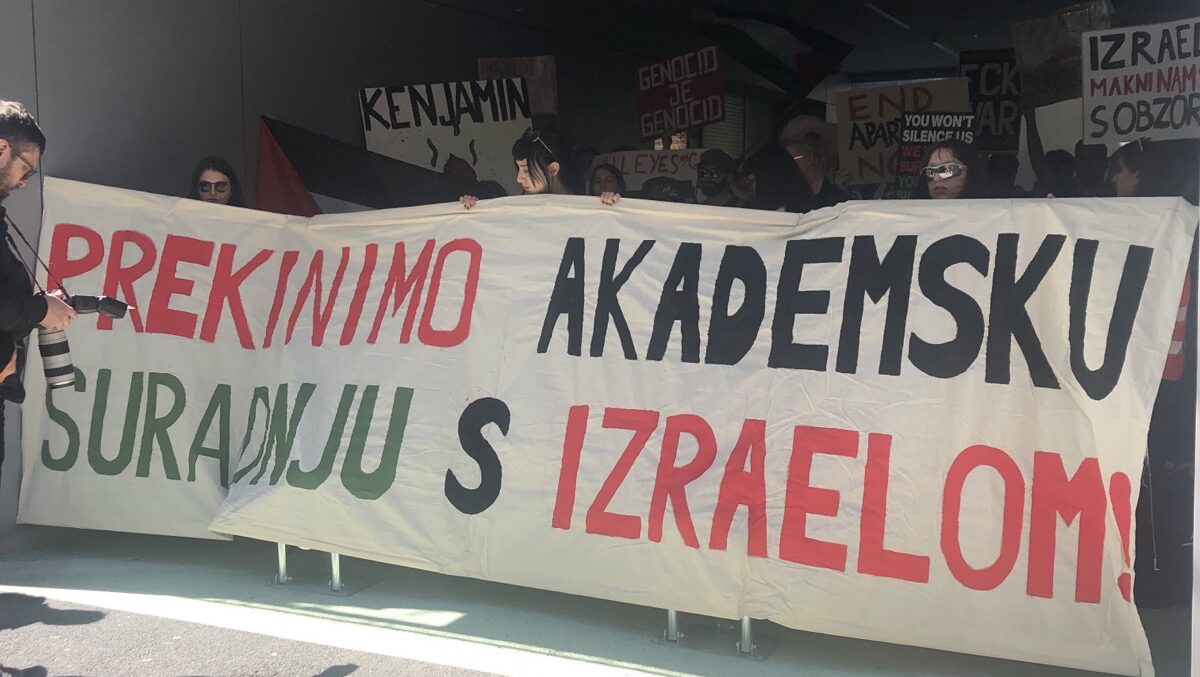
Students at the Faculty of Political Science in Zagreb staged a walkout in solidarity with Palestine last Friday, following revelations that Iddo Netanyahu, brother of Israeli Prime Minister Benjamin Netanyahu, had given an unannounced guest lecture at their institution earlier in the week.
The protest came amid heightened tensions over Israel’s military actions in Gaza and growing concerns about academic institutions’ relationships with Israeli entities. Students expressed particular outrage that Iddo Netanyahu’s visit occurred without transparency and was not publicized through official university channels.
According to student accounts, Netanyahu was accompanied by Israel’s ambassador to Croatia, Gary Koren. The lecture was organized by faculty member Boris Havel, who has developed a local reputation for his promotion of Zionist perspectives.
“Yesterday, in silence and without any announcement, as if hiding from the students he came to meet, Iddo Netanyahu walked into our faculty,” one student stated during the protest. “He was brought in to hold a book promotion at the course ‘Oriental Jews and Arabs in the time of Zionism’ – without any notice on the faculty’s website, without any academic transparency.”
Students were particularly disturbed by Netanyahu’s comments regarding Palestinian casualties in the ongoing conflict. According to those present, when questioned whether peace was worth more than 60,000 Palestinian lives, Netanyahu reportedly responded, “Yes, a simple question. It’s worth it if it means the survival of Israel.”
The protesters also claimed Netanyahu dismissed concerns about child casualties, quoting him as saying, “Well, children die in wars,” and drawing parallels to historical conflicts including those in Croatia and World War II bombing campaigns, characterizing civilian deaths as “the nature of conflict.”
One student emphasized the human toll of such perspectives: “That’s 1,000 school classes of children. One thousand classes that will never have the chance to set foot in college, and Iddo Netanyahu walks into ours to make statements like this.”
In response to the controversy, the Faculty of Political Science administration released a statement distancing itself from the event, claiming they were unaware of the lecture taking place. “The organizer of the lecture, which was not announced to either the Administration or the students, did not take into account the well-being of the students and the integrity of the institution where they work, nor the broader socio-political context,” the statement read.
The protesters demanded accountability from the institution and called for an investigation into Havel’s actions, with some advocating for his suspension. They characterized the hosting of Netanyahu as damaging to the faculty’s reputation and academic integrity.
This incident follows broader student activism across Croatia regarding the ongoing situation in Gaza. In late March, a group called Students for Palestine organized rallies in Rijeka and Zagreb protesting Israel’s participation in the EU’s Horizon program, which provides funding to academic and research institutions. The protesters argued that collaboration between Croatian research centers and Israeli companies, particularly those in military and communications sectors, implicitly supports actions they characterize as genocidal.
These student movements have gained additional support from academic staff through the Initiative for Academia of Solidarity and Epistemic Justice (IZASEP), which has amplified calls for an academic boycott of Israeli institutions.
The controversy highlights the growing tensions in Croatia’s political landscape regarding the Israel-Gaza conflict. While Croatian President Zoran Milanović has criticized Israeli authorities and even summoned Ambassador Koren over comments related to Croatian foreign policy, the right-wing government led by Prime Minister Andrej Plenković has maintained friendly relations with Israel despite numerous public protests since October 2023.
Defense Minister Ivan Anušić recently faced criticism for traveling to Israel but remained defiant, stating he “would go again” despite the public backlash.
As the conflict in Gaza continues to unfold, this incident illustrates how global geopolitical tensions are increasingly manifesting within academic institutions, challenging traditional notions of academic freedom and institutional neutrality in the face of humanitarian concerns.
Fact Checker
Verify the accuracy of this article using The Disinformation Commission analysis and real-time sources.

6 Comments
This highlights the delicate balance universities must strike between academic freedom and accountability to their student community. Ultimately, the institution should serve the interests of its students, not outside political agendas.
This protest highlights the need for universities to have clear policies and procedures around guest lectures and external partnerships. Students deserve to have a voice in these matters that directly impact their educational experience.
This is concerning if the university is allowing private agendas to be pushed without transparency. Students have a right to know what’s happening on their campus and to voice their dissent if they feel it’s being used for propaganda purposes.
While academic institutions should encourage diverse viewpoints, there is a line where perceived propaganda can undermine the university’s credibility and independence. The students seem justified in demanding more openness from the administration.
Protests over perceived propaganda on university campuses are not uncommon. It’s good to see the students taking a stand and pushing for more openness. Hopefully this leads to a productive dialogue between the administration and the student body.
I’m curious to learn more about the background and context here. Was this a one-off event or part of a broader pattern? What are the specific concerns the students have about the university’s relationship with Israeli entities?