


Listen to the article
Concerns Raised Over CBC Kids News Report on Lebanon-Israel Conflict
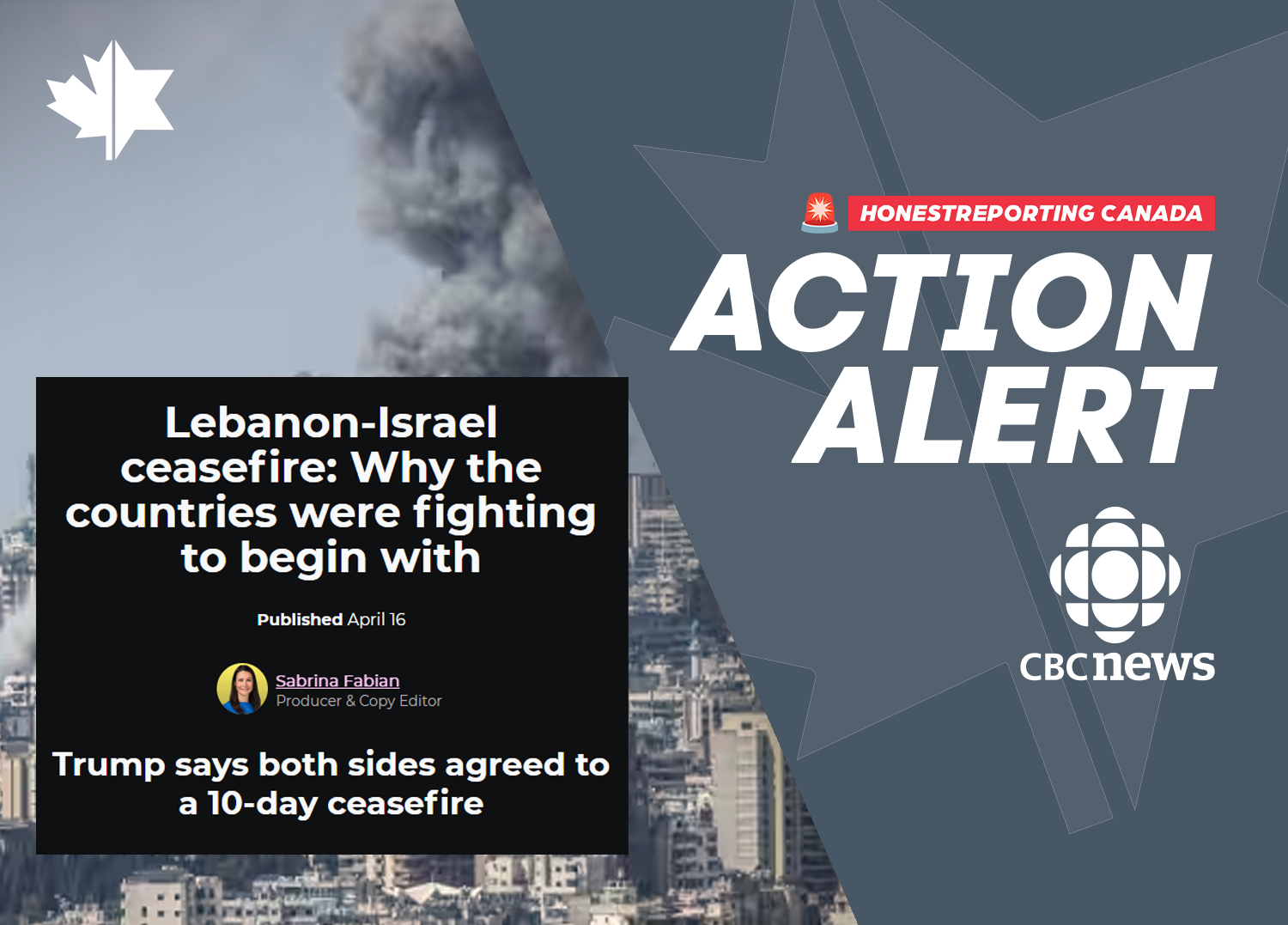
A recent CBC Kids News article on the Lebanon-Israel conflict has drawn criticism for allegedly presenting an unbalanced perspective on the complex situation in the Middle East. The article, titled “Lebanon-Israel ceasefire: Why the countries were fighting to begin with,” was published on April 16 and authored by CBC producer and copy editor Sabrina Fabian.
Critics argue the piece contained several problematic characterizations of the conflict, beginning with its framing. The article opened by stating that “the two countries have been involved in a conflict since March 2, following Israel and the U.S.’s attacks on Iran.” This description has been questioned for two reasons: it portrays the conflict as between nation-states rather than between Israel and Hezbollah specifically, and it seemingly reverses the chronology of events by not immediately clarifying that Hezbollah initiated rocket fire on March 2.
The article did acknowledge that Hezbollah is designated as a terrorist organization by Canada, but critics suggest this critical information was buried deep within the text. Sources cited in the piece include McGill University’s Rex Brynen, who was quoted as saying “Hezbollah was born of the opposition to Israeli occupation.” Critics contend this characterization lacks important context about Hezbollah’s founding principles, which include explicit calls for Israel’s destruction and the establishment of an Iranian-style Islamic government in Lebanon.
When discussing civilian casualties, the article referenced Professor Brynen’s assessment that the conflict is “disproportionately affecting a lot of kids and women.” While acknowledging the proximity of civilians to militants, critics argue the article failed to adequately address Hezbollah’s documented strategy of embedding military infrastructure within civilian areas. Israel’s military has frequently highlighted its warning systems designed to reduce civilian casualties, including advance notices of strikes, while Hezbollah has been documented targeting Israeli civilian infrastructure.
The article also featured commentary from Maurice Jr. Labelle, a history professor at the University of Saskatchewan, suggesting Israel has territorial ambitions in Lebanon. Critics maintain this framing overlooks Israel’s stated security concerns regarding cross-border attacks, which have motivated its military operations in southern Lebanon.
When reporting casualty figures, the article cited Lebanese Health Ministry statistics indicating at least 2,124 people killed in Israeli strikes, compared to two Israeli citizens and 13 Israeli soldiers killed. Critics note the article did not initially clarify how many of the Lebanese casualties were Hezbollah combatants—a figure Israel places at approximately 1,800. They also point out that Israel’s lower civilian casualty figures reflect its extensive defensive infrastructure, including bomb shelters and the Iron Dome missile defense system.
CBC News later added both a clarification and correction to the article. The clarification updated casualty figures, while the correction addressed an erroneous claim about Hezbollah’s membership. The article had initially stated that many Hezbollah members were Palestinians displaced from Israel in 1948, when in fact, the organization’s membership is primarily Lebanese Shia Muslims.
Media literacy experts emphasize the importance of providing appropriate context in news reporting, especially in educational content aimed at young audiences. Balanced reporting on complex geopolitical conflicts requires careful attention to chronology, proportionality, and the inclusion of diverse perspectives.
This controversy highlights the ongoing challenges in media coverage of the Middle East conflict, where terminology, framing, and source selection can significantly influence readers’ understanding of events. For educational platforms like CBC Kids News, which reaches impressionable young audiences, such concerns take on additional significance as they shape how future generations understand complicated global issues.
Fact Checker
Verify the accuracy of this article using The Disinformation Commission analysis and real-time sources.

10 Comments
Covering these kinds of topics for a children’s news program is a real challenge. I hope CBC Kids can find a way to inform their audience while avoiding overt political agendas or oversimplification.
Hmm, this is a tricky topic. Providing balanced and age-appropriate coverage of complex geopolitical conflicts for children is a real challenge. I hope CBC Kids can find a way to inform young audiences without oversimplifying or taking sides.
You raise a fair point. Nuance and objectivity are crucial when discussing the Middle East with children. Hopefully the criticism leads to improvements in their approach.
Reporting on the Middle East for a children’s news program is undoubtedly challenging. However, the criticism raises valid concerns about the article’s framing and lack of nuance. Maintaining impartiality is crucial.
Absolutely. Objective, fact-based reporting on complex issues like this is essential, even for a young audience. Hopefully, this experience leads to positive changes in their coverage.
The framing and chronology issues raised in the article are concerning. Presenting an accurate, impartial account of the Lebanon-Israel conflict is crucial, especially for a children’s news program.
Agreed. Burying key information like Hezbollah’s terrorist designation seems problematic. Transparency and objectivity should be the top priorities when reporting on such sensitive subjects.
It’s a delicate balance to inform young audiences about geopolitical conflicts without taking sides or oversimplifying. I hope CBC Kids can learn from this experience and improve their approach.
As a parent, I’m concerned about how this conflict is being portrayed to kids. It’s important they understand the history and multiple perspectives, not just one-sided narratives. Objective, fact-based reporting is essential.
I agree. Presenting complex geopolitical issues to young audiences requires great care and sensitivity. Simplifying the dynamics could inadvertently promote harmful biases.