


Listen to the article
In what appears to be the first major armed conflict of the generative AI era, a digital propaganda battle has overshadowed traditional war reporting, with AI-generated content promoting the Trump administration’s military campaign in Iran amassing more than 2 billion social media impressions, according to White House claims.
Factual coverage of civilian casualties, military losses, and the expanding regional conflict has struggled to gain traction amid what researchers describe as an “algorithmic noise” of entertainment-style war content dominating social media platforms.
The White House has deliberately produced meme-format videos that splice actual airstrike footage with clips from popular video games like “Call of Duty” and “Grand Theft Auto.” These videos, designed to dominate social feeds rather than inform the public, feature elements from entertainment media including NFL highlights and audio cues from “Top Gun” and “Mortal Kombat.”
White House press secretary Karoline Leavitt confirmed this approach in a statement to NBC News, describing it as a “non-traditional and traditional media strategy” that has proven “highly successful.” The administration claims their videos have generated more than 2 billion impressions across social platforms.
“People are talking about the tremendous success of the war and the US Military’s obliteration of Iranian terrorists, and that’s exactly the point,” Leavitt stated.
The 2 billion figure represents the White House’s own accounting of impressions across its social media accounts and has not been independently verified. Leavitt’s assertion that these metrics demonstrate public support for the military campaign contrasts with polling data. A Reuters-Ipsos poll shared by journalist Glenn Greenwald showed nearly 60% of Americans disapprove of the operation, dubbed “Operation Epic Fury.”
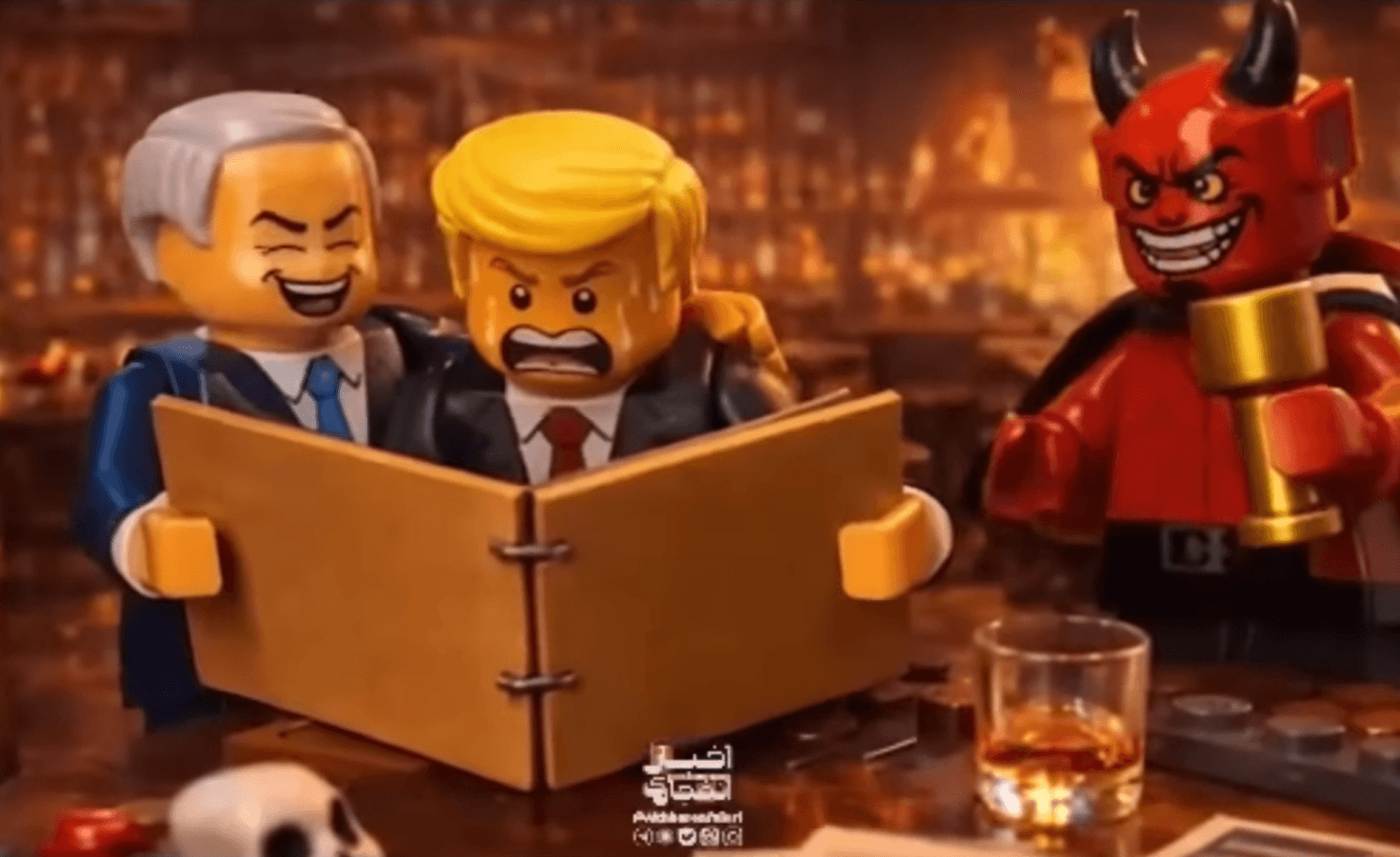
Iran has responded with its own sophisticated digital campaign. Since the war began on February 28, 2026, media bodies linked to the Iranian state have produced a series of AI-generated LEGO animations depicting former President Trump and Israeli Prime Minister Benjamin Netanyahu as miniature figures facing Iranian military retaliation.
Emerson Brooking, director of strategy at the Atlantic Council’s Digital Forensic Research Lab, told Axios that LEGO animations provided Iran with “an easy way to get their point across,” noting that Iran has been pioneering distributed propaganda techniques since its 1979 revolution.
Attribution of digital content has become increasingly difficult. Multiple actors, including state bodies, proxy groups, and anonymous accounts, have produced nearly identical content, blurring the lines of origin and making platform moderation challenging.
Renée DiResta, a prominent disinformation researcher, noted in a TIME essay that generative AI has made polished propaganda so affordable that the distinction between official state messaging and opportunistic imitation has effectively disappeared.
Iran’s official diplomatic channels have participated in this digital battle, with the Iranian Embassy’s X account posting an AI animation mocking Trump styled after Pixar’s “Inside Out.” Other Iranian-linked content depicted Trump as a Teletubby in American flag attire playing with toy fighter jets in the Oval Office.
Behind this digital spectacle lies a serious and escalating military conflict. According to NPR reporting, the US-Israeli operations in Iran have triggered widening regional instability, with retaliatory strikes hitting Israel and Gulf states. The Pentagon has reportedly ordered thousands of additional troops to the Middle East, raising the possibility of a ground phase in the conflict.
The digital information environment has been further complicated by deepfakes and AI-generated misinformation. Truthout, citing New York Times reporting, noted a “cascade of AI fakes about war with Iran” flooding social media since the conflict began. One widely shared clip showing missiles striking Tel Aviv was identified as a deepfake, while another depicting an attack on a Bahrain high-rise was AI-generated and traced to Iranian government-linked accounts. Both spread virally before fact-checkers could intervene.
Information warfare analysts warn that this pattern—where audiences encounter war primarily as entertainment content rather than news—represents a troubling new paradigm. DiResta argues that social media has fundamentally democratized propaganda, creating an environment where government messaging, proxy group content, and anonymous posts compete for the same audience, with the most entertaining material winning regardless of its factual accuracy.
As this conflict continues, the digital propaganda battle may ultimately be documented more thoroughly than the actual war itself—precisely because so much of what spread most widely bore little relationship to reality.
Fact Checker
Verify the accuracy of this article using The Disinformation Commission analysis and real-time sources.

7 Comments
It’s alarming to see traditional war reporting struggling to gain traction against the ‘algorithmic noise’ of flashy, entertainment-style content. This raises deep concerns about the manipulation of public perception during crises.
Hmm, the White House strategy of blending real footage with gaming elements seems more aimed at generating engagement than informing the public. I wonder how this will impact the global response to the unfolding conflict.
This is a troubling trend that risks undermining public trust and understanding of complex global conflicts. We need more transparency and accountability around the use of AI-generated content, especially for matters of national security.
Fascinating insights into the power of AI-generated content in shaping public discourse around military conflicts. This raises serious questions about the integrity of information flows and the responsibilities of platforms and governments.
This is a concerning development that highlights the need for robust media literacy and fact-checking efforts to combat the spread of AI-generated propaganda, especially around sensitive geopolitical issues.
The White House’s ‘non-traditional media strategy’ blending actual footage with gaming elements is certainly eye-catching, but does it serve to inform the public or just inflame tensions? This merits deeper scrutiny.
I agree, the use of entertainment media to sensationalize military operations is concerning. Balanced, fact-based reporting should be the priority, not algorithmically-driven propaganda.