


Listen to the article
The White House is expected to submit plans for President Donald Trump’s new ballroom to a federal planning commission in December, approximately three months after construction began on the project, officials said Thursday.
Will Scharf, who serves as both chairman of the National Capital Planning Commission and one of Trump’s top White House aides, announced the timeline during the commission’s monthly meeting. He emphasized that the commission’s substantive role would only begin once the plans are formally submitted.
“Once plans are submitted, that’s really when the role of this commission, and its professional staff, will begin,” Scharf said, adding that the review would proceed at a “normal and deliberative pace.”
The White House also confirmed that a second architectural firm has joined the high-profile project. Shalom Baranes, a Washington, D.C.-based architect whose firm has worked on numerous federal buildings including the Pentagon and Treasury, will help guide the ballroom’s development as it enters its next phase.
“As we begin to transition into the next stage of development on the White House Ballroom, the Administration is excited to share that the highly talented Shalom Baranes has joined the team of experts,” White House spokesperson Davis Ingle said in a statement.
Baranes joins the original firm, McCrery Architects, which will remain as a consultant on the project. The White House praised Baranes as “an accomplished architect whose work has shaped the architectural identity of our nation’s capital for decades.”
The ballroom, first announced this summer, represents one of the most significant additions to the White House grounds in decades. At 90,000 square feet, the proposed structure would be nearly twice the size of the White House itself and designed to accommodate 999 people. The project’s estimated cost has already risen from an initial $200 million to $300 million.
Trump has repeatedly stated that the ballroom will be funded entirely through private donations rather than taxpayer money. The White House has released a list of 37 donors, including cryptocurrency billionaires, sports team owners, tech companies, tobacco giants, charitable organizations, and prominent Republican supporters, many of whom are from Trump’s social circle in Palm Beach, Florida. The president has also indicated he will contribute personally to the project, though he hasn’t disclosed how much.
The ballroom represents the fulfillment of a longstanding wish for Trump, who has frequently complained about the limited capacity of the White House’s existing spaces. The State Dining Room and East Room, the White House’s two largest formal rooms, cannot accommodate the scale of events Trump envisions. He has also expressed frustration with using temporary tents on the South Grounds for larger gatherings.
At a recent dinner honoring Saudi Arabia’s Crown Prince Mohammed bin Salman, Trump alluded to the space constraints: “I only wish we had about 2,000 more seats. We would have filled every one of them two times over,” he said, adding that “very soon you’ll be having that.”
The project has raised eyebrows among government oversight experts because construction work began in September without formal approval from the National Capital Planning Commission. Scharf has defended this sequence by distinguishing between demolition work, which he says falls outside the commission’s purview, and above-ground construction.
However, L. Preston Bryant Jr., who chaired the commission under President Barack Obama, told The Associated Press that projects typically undergo a four-stage approval process, beginning with an early consultation while still in the conceptual phase.
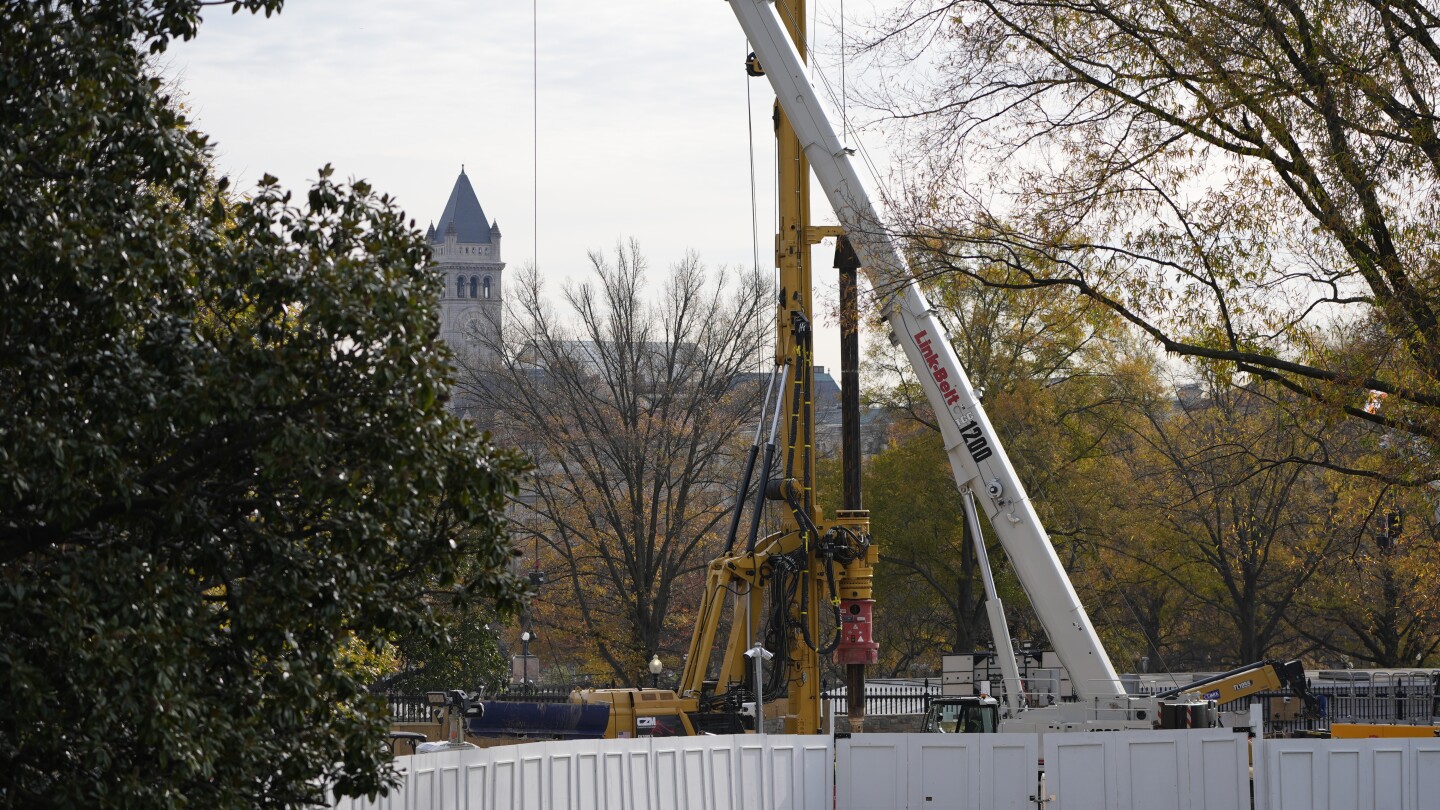
Work has continued steadily since October when Trump demolished the East Wing to make way for the ballroom. The East Wing traditionally housed the First Lady’s offices and staff, along with various other White House operations. These functions have been temporarily relocated to other areas of the White House complex and the adjacent Executive Office Building.
If completed as planned, the ballroom would be finished before the end of Trump’s term in 2029 and would represent what Trump has called “the greatest addition to the White House since the Oval Office.”
Fact Checker
Verify the accuracy of this article using The Disinformation Commission analysis and real-time sources.

20 Comments
Interesting update on White House is expected to submit plans for new ballroom to planning commission this month. Curious how the grades will trend next quarter.
Good point. Watching costs and grades closely.
Good point. Watching costs and grades closely.
Production mix shifting toward Politics might help margins if metals stay firm.
Nice to see insider buying—usually a good signal in this space.
Good point. Watching costs and grades closely.
Exploration results look promising, but permitting will be the key risk.
Good point. Watching costs and grades closely.
Good point. Watching costs and grades closely.
Interesting update on White House is expected to submit plans for new ballroom to planning commission this month. Curious how the grades will trend next quarter.
Good point. Watching costs and grades closely.
Silver leverage is strong here; beta cuts both ways though.
Good point. Watching costs and grades closely.
Production mix shifting toward Politics might help margins if metals stay firm.
Good point. Watching costs and grades closely.
Good point. Watching costs and grades closely.
Uranium names keep pushing higher—supply still tight into 2026.
Good point. Watching costs and grades closely.
Interesting update on White House is expected to submit plans for new ballroom to planning commission this month. Curious how the grades will trend next quarter.
Good point. Watching costs and grades closely.