


Listen to the article
The $125 Million Reshaping of Illinois Politics
It turns out reshaping a congressional delegation comes with a hefty price tag of approximately $125 million. On Tuesday night, Illinois Democrats welcomed a new generation of lawmakers, selecting five new nominees for Congress in open seats expected to remain under Democratic control this fall.
The nominations followed an unusually chaotic and expensive primary season. Around $70 million poured in from outside groups, with candidates spending an additional $54 million across five competitive races for open U.S. Senate and House seats.
This level of competitive, high-stakes electoral activity represents a significant departure for Illinois, a state historically associated with machine politics rather than wide-open contests. But 2024 brought unique circumstances: an exceptionally high number of retirements created opportunities for fresh representation throughout the ballot.
The catalyst came when U.S. Senator Dick Durbin announced last year he wouldn’t pursue a sixth term, prompting two House members to vie for his seat. The cascading effect of Durbin’s decision, combined with the retirement of three other Chicago-area Democratic representatives, meant that for the first time in at least seven decades, more than a quarter of Illinois’ U.S. House seats were open simultaneously.
This unprecedented opportunity attracted a flood of candidates—and with them, an avalanche of campaign money.
The Senate primary alone generated more than $34 million in independent expenditures. For perspective, according to OpenSecrets, a nonpartisan organization tracking political spending, only nine Senate general election campaigns nationwide in 2024 saw more outside spending.
In a state containing the expensive Chicago media market, such sums were quickly depleted. Ten political action committees each reported a minimum of $1 million in independent expenditures across the five competitive races. Two PACs—Illinois Future PAC, which received at least $5 million from Governor JB Pritzker, and the cryptocurrency-backed Fairshake—each spent over $10 million.
Crypto and artificial intelligence-backed PACs invested heavily in four Illinois races. The American Israel Public Affairs Committee (AIPAC), which advocates for U.S. support of Israel, also contributed millions to these contests.
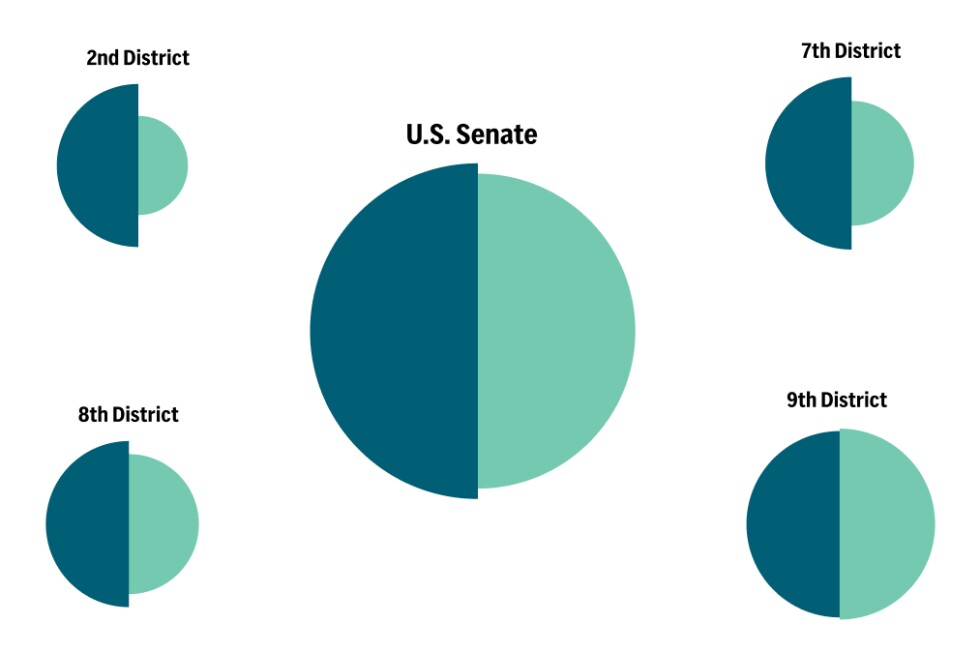
In four of the five contested primaries for open House seats, outside groups outspent all candidates combined—an unusual phenomenon in American politics. According to OpenSecrets, in the 2024 general election, this occurred in only 49 federal races out of approximately 470 nationwide.
The Senate Democratic primary saw outside spending heavily favoring the ultimate winner, Lieutenant Governor Juliana Stratton. Outside groups invested more than $16 million supporting her campaign, while about $11 million was spent opposing her. Stratton’s campaign itself reported just under $2.8 million in expenditures to the Federal Election Commission.
Meanwhile, Representative Raja Krishnamoorthi, who trailed Stratton by approximately 7 percentage points as of Wednesday morning with nearly all votes counted, spent almost $24 million from his own campaign treasury. Outside groups contributed more than $4 million opposing his candidacy.
The only other race where outside spending exceeded $10 million was in Illinois’ 9th District, covering Chicago’s North Shore suburbs. The contest began with over a dozen candidates but narrowed to three primary contenders—a mayor, a state senator, and a former journalist with significant online following—who attracted most of the outside attention.
Kat Abughazaleh, the former journalist who would have been the first Gen Z woman elected to Congress, faced exclusively oppositional outside spending. State Senator Laura Fine benefited from more than $4.3 million in support from Elect Chicago Women, a newly formed super PAC. The primary winner, Evanston Mayor Daniel Biss, received over half a million dollars each from 314 Action Fund and the Congressional Progressive Caucus PAC.
Elect Chicago Women also spent more than $1.4 million opposing Biss.
The three other open House races with large candidate fields each saw between $8 and $9 million in total spending. The 2nd District led this category, with winner Cook County Commissioner Donna Miller receiving a boost of more than $4.3 million from an outside group called Affordable Chicago Now, which has yet to disclose its donors.
While some groups have clear industry connections to cryptocurrency and AI, the financial backers of other major spenders remain unknown. Affordable Chicago, Elect Chicago Women, and Chicago Progressive Partnership haven’t yet disclosed their donors, meaning the source of substantial portions of this money will remain unclear until PAC filing deadlines pass later this month.
Fact Checker
Verify the accuracy of this article using The Disinformation Commission analysis and real-time sources.

8 Comments
$125 million spent in Illinois primaries is a staggering figure. This level of investment underscores the high stakes involved, as the state’s congressional delegation is reshaped. I wonder how this will influence the general election outcomes.
The retirements of several long-serving Illinois Democrats have clearly created a dynamic electoral environment. It will be fascinating to see if the new generation of nominees can maintain Democratic control of these seats in the fall, or if the GOP can make inroads.
You’re right, the open seats and high spending do present an interesting opportunity for both parties. The general election will be a crucial test of which way Illinois voters decide to go.
Fascinating to see the high level of spending in these Illinois primaries. I wonder how it will impact the general election dynamics – will the new Democratic nominees be able to capitalize on the investment and win in the fall?
The amount spent does seem quite staggering, even for a high-profile state like Illinois. It will be interesting to see if the winning candidates can translate that financial advantage into real voter engagement and turnout.
The retirement of long-serving Senator Durbin certainly opened up a lot of opportunities in Illinois. With machine politics giving way to more open contests, I’m curious to see if this leads to greater political diversity and representation.
You raise a good point. The infusion of outside money could disrupt the traditional power structures in Illinois. It will be worth watching to see if this results in a real shift in the state’s political landscape.
With the cascading effect of Senator Durbin’s retirement, it’s no surprise that the Illinois primaries were so chaotic and expensive. The influx of outside money is certainly shaking up the state’s traditional political landscape. I’m curious to see how the new Democratic nominees perform in the general election.