


Listen to the article
Virginia Supreme Court Weighs GOP Challenge to Democratic Redistricting Plan
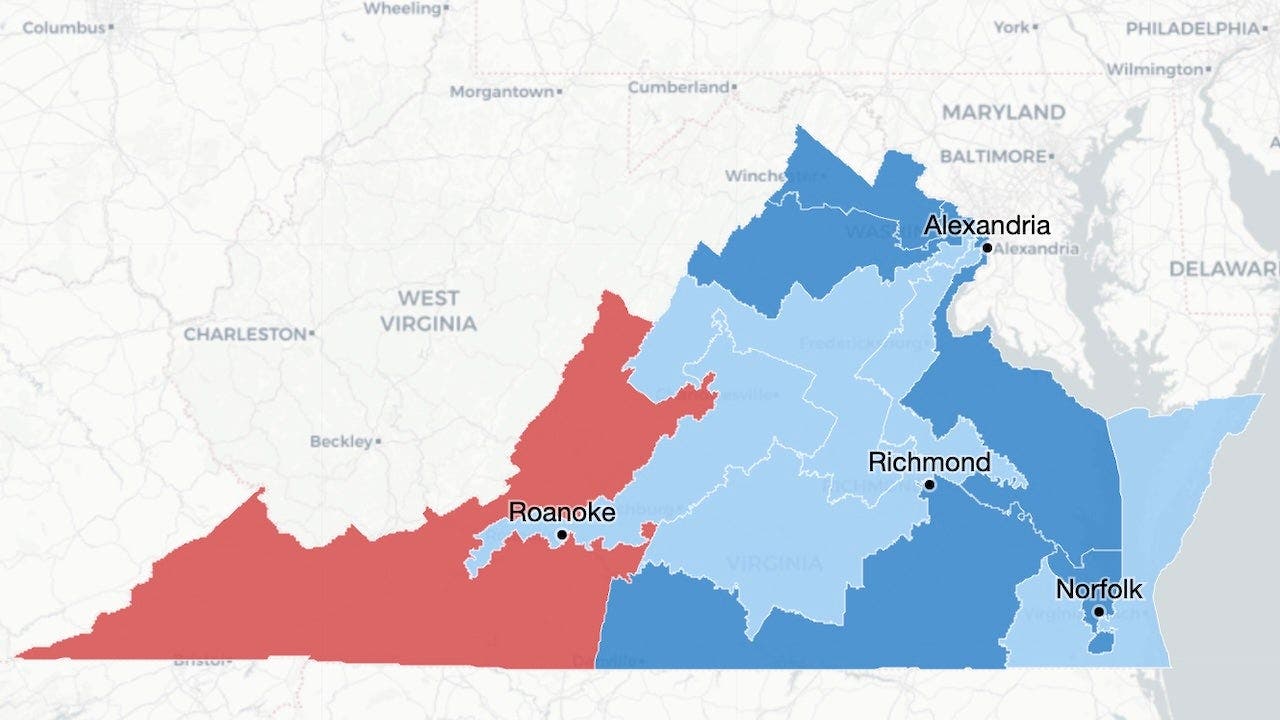
The Virginia Supreme Court heard arguments Monday in a Republican legal challenge to a controversial congressional redistricting plan that could significantly alter the state’s political landscape. The Democratic-backed measure, narrowly approved by voters last week, could help Democrats gain as many as four additional U.S. House seats and transform a 6-5 Republican advantage in the state’s congressional delegation to a 10-1 Democratic majority.
At the center of the dispute is whether Virginia Democrats followed proper constitutional procedures when placing the redistricting amendment on the ballot. Republicans contend that the Democrat-led General Assembly violated state law by authorizing mid-decade redistricting through a constitutional amendment.
“The proposed amendment is invalid for several reasons, any one of which is sufficient to invalidate the proposed amendment and require invalidation of the vote,” argued Thomas McCarthy, attorney representing the Republican challenge, during Monday’s hour-long hearing.
McCarthy emphasized democratic principles in his argument, stating, “It’s often said ours is a government of laws, not of men. Sadly, that’s not the case if a bare partisan majority can circumvent the constitutional amendment process and undermine the rights of the people in whom all government power ultimately rests.”
Lawyers for Democratic legislative leaders countered that both voters and lawmakers followed every step required by Virginia’s constitution. Attorney Matthew Seligman argued in rebuttal that “the people did, in fact, validly ratify the proposed amendment last Tuesday,” and suggested the challengers were attempting to overturn a legitimate democratic process.
Seligman further contended that the Republican challenge relied on reading limitations into the Constitution that don’t actually exist. He argued the General Assembly controls its own procedures and that nothing in the constitution prohibited lawmakers from acting as they did in special session.
The justices acknowledged during proceedings that Virginia courts had only permitted the vote to be held amid the ongoing legal challenge, suggesting they recognized the constitutional questions at stake.
This Virginia dispute represents the latest development in a nationwide redistricting battle between Republicans and Democrats seeking advantage ahead of November’s critical elections, which will determine control of the U.S. House of Representatives. Republicans currently hold a slim majority in the chamber, making redistricting fights in key states potentially decisive.
The Virginia case also highlights the increasingly aggressive tactics both parties are employing in redistricting battles. Democrats have accused Republicans of gerrymandering in states where they control the process, while Republicans have levied similar charges against Democratic-led states.
Political analysts note that the Virginia map could significantly impact the balance of power in Washington. If upheld, the new districts would likely favor Democratic candidates in areas that have been competitive or Republican-leaning in recent elections, potentially helping Democrats in their effort to regain House control.
The state’s redistricting dispute comes amid similar battles in other battleground states. Florida is emerging as another key redistricting battleground, with both parties gearing up for a contentious fight over congressional district boundaries that could also affect multiple House seats.
The Virginia Supreme Court did not indicate when it would issue a ruling, but the decision will likely have immediate implications for candidates preparing for the upcoming election cycle. If the court invalidates the amendment, it would render last week’s statewide vote meaningless and maintain current district boundaries.
Both parties are closely watching the outcome, recognizing that control of Congress could ultimately hinge on how redistricting disputes are resolved in Virginia and several other states in the coming months.
Fact Checker
Verify the accuracy of this article using The Disinformation Commission analysis and real-time sources.

9 Comments
Interesting case on redistricting in Virginia. Ensuring fair and representative electoral maps is crucial for democracy. It will be important to see how the state Supreme Court rules on the GOP’s legal challenge.
I’m curious to hear more perspectives on this case and the potential impact on Virginia’s political landscape.
The clash over redistricting in Virginia highlights the ongoing battle for political control. It will be interesting to see how the state Supreme Court navigates this complex and politically charged issue.
What role do you think public opinion and voter sentiment should play in the court’s decision-making process?
This is a complex issue with valid arguments on both sides. Redistricting can be highly politicized, so it’s important the process is transparent and adheres to constitutional procedures.
What do you think will be the key factors the court considers in making its decision?
This is a high-stakes case that could reshape Virginia’s congressional representation. I’m curious to see how the state Supreme Court balances democratic principles with the legal arguments presented by both sides.
Redistricting is always a contentious issue, with both parties jockeying for political advantage. I hope the Virginia Supreme Court can make a fair and impartial ruling based on the law, not partisan interests.
Do you think the court’s decision could have significant ramifications for future elections in Virginia?