


Listen to the article
Navy Refutes Claims of Food Shortages on Middle East Warships
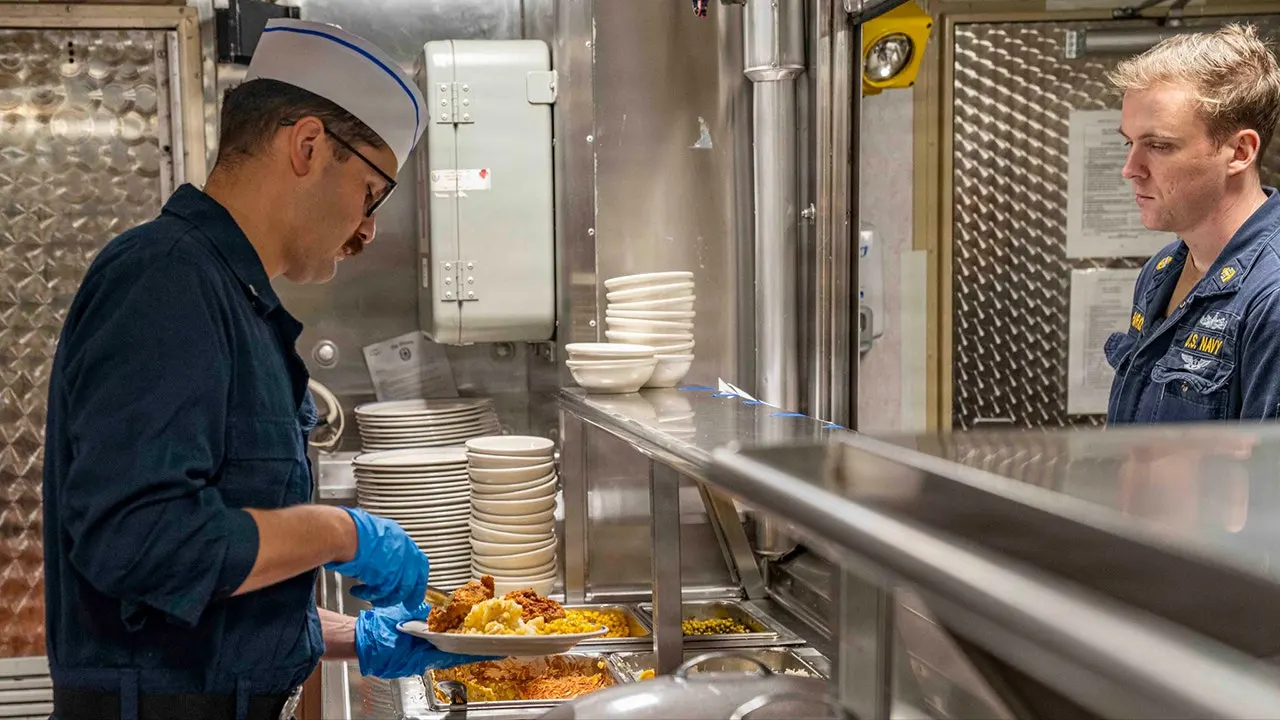
The U.S. Navy has strongly rejected claims of food shortages aboard vessels deployed to the Middle East during Operation Epic Fury, releasing photographs showing well-stocked galleys and full meals being served to sailors on the USS Abraham Lincoln and USS Tripoli.
“Fresh meals. Full service. Mission ready. Sailors aboard USS Abraham Lincoln and USS Tripoli continue to receive regularly prepared meals at sea — no interruptions, no shortages,” the Navy stated Saturday on social media platform X. The post included multiple images depicting full plates of food being served to personnel and supply rooms stacked with provisions.
The Navy’s response comes amid circulating images allegedly showing inadequate meals provided to sailors participating in operations against Iran. These claims have been dismissed at the highest levels of the Pentagon hierarchy.
Chief of Naval Operations Admiral Daryl Caudle issued a definitive statement on Friday addressing the controversy: “Recent reports alleging food shortages and poor quality aboard our deployed ships are false. Both USS Abraham Lincoln and USS Tripoli have sufficient food onboard to serve their crews with healthy options.”
Caudle emphasized that sailor welfare remains paramount to naval operations. “The health and wellbeing of our Sailors and Marines are my top priority, and every crew member continues to receive fully portioned, nutritionally balanced meals,” he added.
The nutritional adequacy of meals for deployed personnel has significant operational implications beyond mere comfort. Proper nutrition directly affects combat readiness, crew morale, and mission effectiveness, particularly during high-stress operations like those currently underway in the Middle East.
U.S. Central Command Admiral Brad Cooper reinforced this position during a press briefing, calling the reports “blatantly false” and emphasizing, “Our service members are absolutely being fed across the region. This is an absolute priority.”
Secretary of War Pete Hegseth was particularly forceful in his rebuttal, describing the allegations as “FAKE NEWS from the Pharisee Press.” Hegseth provided specific details about the vessels’ provisions, stating, “My team confirmed the logistics stats for the Lincoln & Tripoli. Both have 30+ days of Class I supplies (food) on board. NavCent monitors this everyday, for every ship.”
The controversy emerges at a critical juncture for U.S. Naval operations in the Middle East, with tensions escalating between the United States and Iran. Recent reports indicate Iran may be reconsidering its position on reopening the Strait of Hormuz, a vital maritime passage for global energy supplies.
The Abraham Lincoln and Tripoli are key assets in the U.S. military presence in the region. The Abraham Lincoln is a Nimitz-class aircraft carrier with approximately 5,000 personnel onboard, while the USS Tripoli is an America-class amphibious assault ship carrying Marines and aircraft. Both vessels require substantial logistical support to maintain operational readiness.
Military supply chain management has grown increasingly complex in recent years, with geopolitical tensions affecting traditional supply routes and necessitating adaptive logistics strategies. Despite these challenges, naval officials maintain that supply chains remain robust and capable of supporting deployed forces.
The Navy’s response, including the release of photographic evidence, appears aimed at countering any narrative that might suggest diminished operational capabilities or preparedness during this sensitive period of heightened military activity in the region.
Fact Checker
Verify the accuracy of this article using The Disinformation Commission analysis and real-time sources.

10 Comments
It’s important the Navy quickly addresses any misinformation about the conditions facing our sailors. Transparency and facts are needed to counter unfounded rumors.
Absolutely. The Navy seems to have done a good job providing evidence to dispel the claims. Keeping our troops well-fed is a basic but critical responsibility.
This appears to be another case of unfounded claims circulating on social media. I’m glad the Navy has moved quickly to provide factual information and visuals to counter the misinformation.
This is an important issue. I’m glad the Navy has firmly denied the food shortage allegations and provided visual evidence to back up their statement. Maintaining operational readiness requires proper logistical support.
It’s reassuring to see the Navy’s definitive response and the photographic evidence they’ve provided. Maintaining morale and operational readiness is critical, and the Navy seems to be handling this situation well.
While concerning if true, the Navy’s strong response and photo evidence seem to clearly refute the food shortage claims. It’s good they are being proactive in addressing this misinformation.
The Navy’s handling of this situation is commendable. Rapidly addressing and disproving false allegations helps preserve public trust and confidence in our military. Transparency is crucial in these matters.
Good to see the Navy refuting these food shortage claims. Maintaining proper nutrition and morale is crucial for effective operations. The photos of well-stocked galleys are reassuring.
Given the importance of this issue, I’m glad the Navy has taken swift action to address the claims of food shortages. Their transparency and provision of visual proof is commendable.
The Navy’s prompt response and visual evidence seem to convincingly refute the food shortage allegations. It’s good they’re being proactive in addressing this misinformation to maintain public confidence.